

A Midsummer Nightmare?
William Shakespeare's "A Midsummer Night's Dream" includes one of the most famous literary depictions of fairies. How do Oberon and Titania compare to the fairies of Elizabethan folklore?

This essay is part of a series called On the Origin of Fairies.

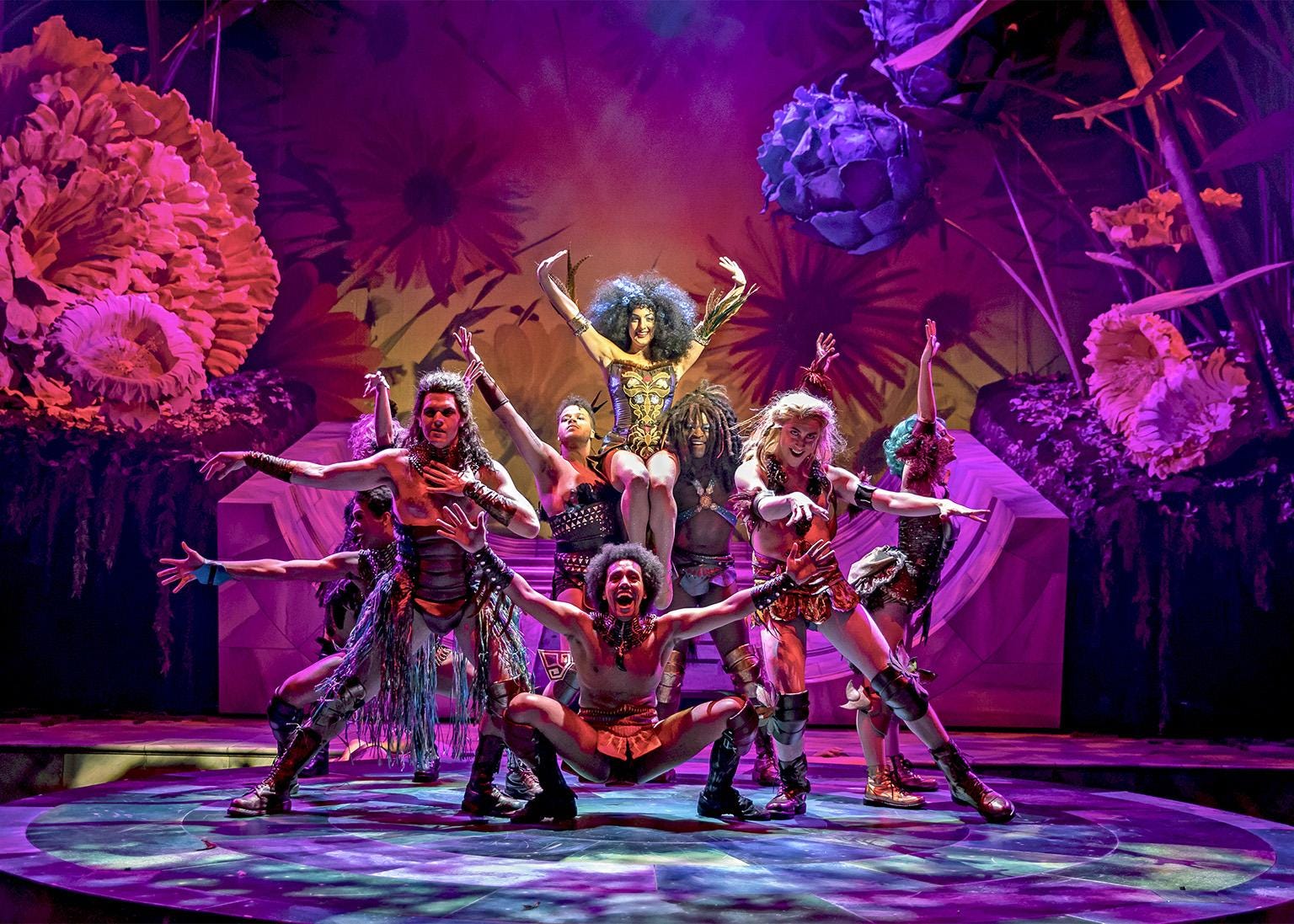
Years ago, I saw a very odd production of A Midsummer Night’s Dream at the Chicago Shakespeare Theater.
It was a 1970s-meets-medieval(ish)-meets contemporary extravaganza, an acid trip with vibrant colors and disco dancing. Like all bad Shakespeare productions, the show lacked a clear artistic direction—it didn’t know what it wanted to be. The best one could say was that the fairies were fabulously costumed, as you can see below.
(No hate to Chicago Shakespeare! I’ve seen some truly remarkable adaptations there. This wasn’t one of them.)
The beauty of Shakespeare’s writing is that the conflicts and themes present in his work transcend time, such that theater directors today can employ whatever setting or costume direction speaks to them. But Shakespeare’s fairies can also give us some insight into differing views of the Good People in a period when almost everyone believed in spirits.
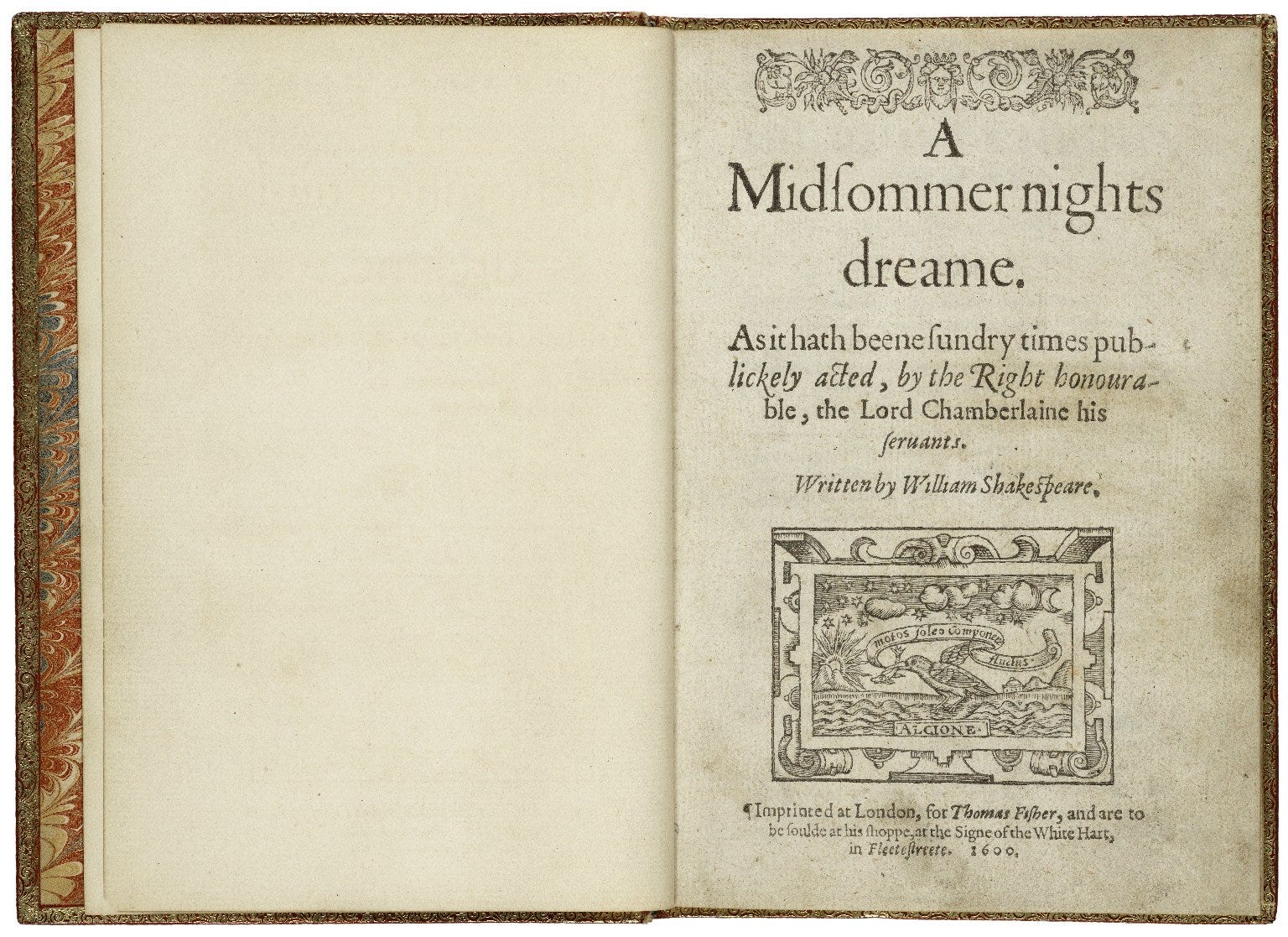
Scholars don’t have a precise date for when A Midsummer Night’s Dream was written, though it is generally estimated to date from 1594 to 1596.1 The fairies in the play are not quite as malicious as those of Elizabethan folklore. Midsummer is a romantic comedy, after all, and the fairies seek to undo the trouble they’ve caused by the end of the show. Oberon and Titania’s squabbling (not to mention, their interference with the human characters’ love lives) is much more reminiscent of the Greek pantheon’s antics than the wild, weird world of fairy lore.
Shakespeare adapts the Greek myth of Pyramus and Thisbe for the play performed at the wedding of Theseus and Hippolyta. A Midsummer Night’s Dream is set in Athens. Needless to say, the Greeks were on the mind. But some aspects of the play come straight out of British folklore. After all, the root of the conflict between Oberon and Titania—the argument that launches much of the play’s action—is over a changeling.
As Robin Goodfellow (Puck) informs a member of Titania’s fairy court in Act 2 Scene 1:
The King doth keep his revels here tonight.
Take heed the Queen come not within his sight,
For Oberon is passing fell and wrath
Because that she as her attendant hath
A lovely boy stolen from an Indian king—
She never had so sweet a changeling—
And jealous Oberon would have the child
Knight of his train, to trace the forests wild.2
Shortly after, the fairy recognizes Robin Goodfellow as an infamous fairy spirit:
Fairy: Either I mistake your shape and making quite,
Or else you are that shrewd and knavish sprite
Called Robin Goodfellow. Are you not he
That frights the maidens of the villagery,
Skim milk, and sometimes labor in the quern,
And bootless make the breathless housewife churn,
And sometime make the drink to bear no barm,
Mislead night-wanderers, laughing at their harm?
Those that “hobgoblin” call you, and “sweet puck,”
You do their work, and they shall have good luck.
Are you not he?
Robin: Thou speakest aright;
I am that merry wanderer of the night.3
This has become familiar territory in the most recent entries of our series: a stolen child, a trickster spirit, and a reason to call a “knavish sprite” a “sweet puck”—because appeasing a dangerous fairy can sometimes bring good fortune. (Phrases like the Good Folk, the Good People, and the Gentry come to mind.)
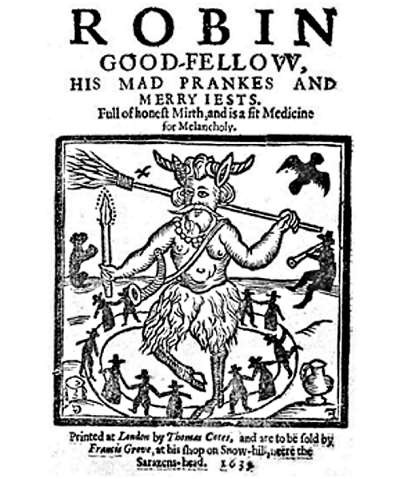
The word “puck” is derived from the Indo-European root *bheug- (“to flee in fear, be frightened of”), which in Old English became “puca,” and in Middle English “pouke.”
This root is also the wellspring of other words such as the Irish púca and the Welsh bwg (pronounced “boog”).4 In the late Middle Ages, pouke was the common word for “fairy” in southern England before the introduction of the French “fée.” At the end of this series, we will examine the possible merging of Norman and Anglo-Saxon folklore after the Norman Invasion, and how this could have resulted in the emergence of the unified group we now call fairies.
In any case, this process was complete by the time William Shakespeare was writing A Midsummer Night’s Dream. Pucks were a class of pesky, trickster fairies; Robin Goodfellow is the preeminent puck of Elizabethan folklore. The earliest known reference to Robin Goodfellow comes from the 1584 Merry Jests of Robin Goodfellow (author unknown), but it’s possible that the character predates that text.5
In Shakespeare’s day, fairies were derided by both Catholic and Protestant authorities as evil, while simultaneously being used as symbols of political power and dissent. When Shakespeare wrote Midsummer, Queen Elizabeth I was still on the throne, and she sometimes adopted the fairy as a whimsical symbol of her power; she styled herself as the “Fairy Queen” worshipped by her knights. This is in spite of the subversive uses of fairy symbolism in early modern England: in 1450, the leaders of Thomas Cheyne’s rebellion called themselves the King and Queen of Fairyland, and poachers called themselves the Fairy Queen’s servants.6
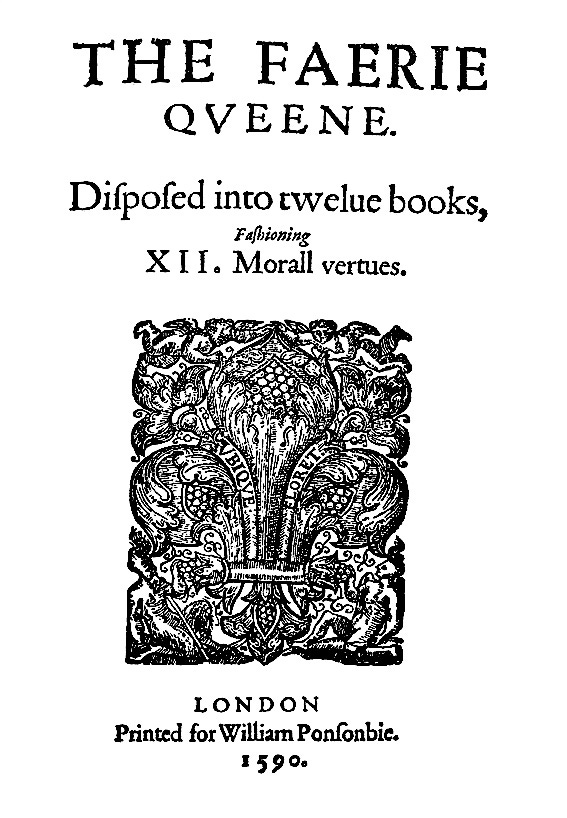
Then again, if the Fairy Queen was an alternate, folkloric authority, it makes sense why Elizabeth would wish to conflate herself with that figure. Edmund Spenser also made use of this symbolism in his epic poem The Faerie Queene (published in two parts in 1590 and 1596); the poem is an allegorical work about Elizabeth’s reign.

A defining issue of Queen Elizabeth’s government was the reinstatement of Protestantism in Britain and the dismissal of papal authority. Elizabeth established herself (and all future monarchs) as the Supreme Governor of the Church of England and made church attendance compulsory, though she did allow her subjects some leeway in believing what they wished, as long as they did not pose a threat to social order. In the 1500s, it was as good of a religious compromise as one could expect.
So, how did the fairies survive the Reformation? Calvin himself said that “the Devil works strange illusions by fairies and satyrs.”7
Here, we arrive at the essential clash between establishment doctrine and popular faith, in which clergy try (and fail) to rein in folk belief that they deem too far outside the realm of acceptability. If you’re wondering what this might look like, consider All Hallows’ Day: a Catholic holiday that was meant to mark the celebration of All Saints, yet in the Irish tradition, All Hallows’ Eve retained its spooky character. Halloween is a time of magic, the thinning of the veil between our world and the Otherworld. The extent to which the Irish version of All Hallows’ Eve mirrors Samhain (the ancient Celtic festival that marked the end of the harvest season) remains a hotly-debated subject. Irish myths were only recorded by monks several centuries after the Irish Celts’ conversion, making for some delightfully mysterious territory.
In any case, the practice of divination games and creating charms to ward off mischievous spirits—including fairies—definitely does not fall within established Catholic doctrine. But you try to keep the party down, and see where it gets you.
In the newly-Protestant England, the fairies were ready to put up a fight.
During the Reformation, many English Protestant leaders endeavored to cast fairies as illusions created by the Devil, or as the remnants of Catholic superstition. (This is in spite of the fact that Catholic authorities also took issue with the fairies.) Reginald Scot’s The Discoverie of Witchcraft (1584), a passionate argument against the legitimacy of the witch trials, argued that such “bugs” of popular belief were the result of Catholic influence. In 1590, Anglican minister Henry Holland wrote that “the fairies, the goblins [and] the hegs … came unto the church with the rotten mist of popery.” In 1603, Samuel Harsnett (who would become the archbishop of York in 1629) claimed that the fairies were of the “popish mist” that “had befogged the eyes of our poor people.”8
It didn’t matter. As church leaders would discover, rural peasants were far more afraid of the fairies than they were of them.
This fear played a role in the witch trials of the period; accused witches were sometimes believed to be in league with fairy spirits. Between 1527 and 1716, at least thirty-eight Scottish witch trials referenced fairies. This includes victims like Isobel Strathaquin of Aberdeen, who in 1597 was accused of learning magic from a fairy lover; or Katherine Cray, who in her 1616 trial claimed to have met “a great number of fairy men” at sunset on the Caithness hills. In other cases, fairies were accused of causing fits and convulsions reminiscent of those we discussed in our Salem Witch Trials series.9
Fairies, like witches, were scapegoats. In times of famine, they ruined crops. On dark nights, they misled travelers. In a world in which half of all children died before the age of five, fairies stole babies and brought them beneath the hills, behind the mist, to be trapped in a kingdom under the earth. Titania and Oberon fight over one such stolen child, and while the Athenian lovers get their happily ever after at the end of Shakespeare’s play, there is no happy ending for the boy.
In his final soliloquy, Robin Goodfellow assures his audience that all is mended, but this is one last glittering, elfin trick. The changeling remains in the fairy court, and he will dance in their halls and troop with their King until the end of time. Forever a shadow in an unyielding dream.
Introduction to A Midsummer Night’s Dream in The Norton Shakespeare: Third Edition, ed. Stephen Greenblatt (W. W. Norton & Company, 2016), 1037.
William Shakespeare, A Midsummer Night’s Dream in The Norton Shakespeare: Third Edition, ed. Stephen Greenblatt (W. W. Norton & Company, 2016), 2.1.18-31.
Shakespeare, A Midsummer Night’s Dream, 2.1.32-44.
Francis Young, Twilight of the Godlings: The Shadowy Beginnings of Britain’s Supernatural Beings (Cambridge University Press, 2023), 206-207.
Katharine Briggs, The Vanishing People: Fairy Lore and Legends (Pantheon Books, 1978), 199.
Francis Young, Magic in Merlin’s Realm: A History of Occult Politics in Britain (Cambridge University Press, 2022), 167.
Richard Sugg, Fairies: A Dangerous History (Reaktion Books, 2018), 95.
Darren Oldridge, “Fairies and the Devil in early modern England,” The Seventeenth Century 31, no. 1 (2016): 1-15, https://doi.org/10.1080/0268117X.2016.1147977.
Sugg, Fairies, 95-96.