

A "War on Beauty": Manet and the Impressionists
Manet refused to participate in the First Impressionist Exhibition. Nevertheless, his name was inexorably tied to the Impressionists and their radical movement.

This essay is part of the series The Life of Édouard Manet.
In January of 1872, the art dealer Paul Durand-Ruel visited Édouard Manet in his studio on the rue de Saint-Petersbourg. He had recently purchased Manet’s Moonlight at the Port of Boulogne (1868) at the gallery of Alfred Stevens, and he was determined to grow his collection before another dealer outmaneuvered him.
Durand-Ruel was, after all, the man who made stars of the Barbizon landscape artists. The art scene in Paris was due for another shake-up. When he was living in London during the Franco-Prussian War, he was introduced to Claude Monet by a mutual friend, Charles-François Daubigny. Monet and his peers, which included artists like Camille Pissarro, Pierre-Auguste Renoir, and Edgar Degas, were clearly on the cutting edge of something big. Durand-Ruel wanted in.
It is for this reason that he invested so heavily in Édouard Manet’s paintings, much to the artist’s shock. On that frigid January day, Durand-Ruel purchased 35,000 francs-worth of paintings. A few days later, he purchased another group totaling at 16,000 francs. Manet would not get all the money right away, as Durand-Ruel paid artists in installments. Nevertheless, it was a victory. Manet eagerly connected Durand-Ruel with Degas, whose ballerinas and scenes of urban entertainment caught the dealer’s eye.
Things had shifted after the war. As Renoir later put it, “The golden age of the middle man, the buyer and seller, the shrewd dealer, now began.”1 Aristocrats no longer possessed a monopoly on wealth; an elite class of industrialists and merchants emerged with even greater force than they had before the war. While the Salon was still regarded as a central authority, dealers like Durand-Ruel saw an opportunity to expand their galleries and play a more direct role with clients.
However, Durand-Ruel was still taking a gamble on Monet, Manet, and their friends. France was a republic again, but the political climate was quite conservative, particularly after the chaos of the Paris Commune. As a result, the Salon was even more cautious about promoting any art that appeared too radical. The artists who would become known as the Impressionists continued drowning in a stream of rejection, and Durand-Ruel soon faced the prospect of staggering debt. How on earth was he going to sell all of these paintings, when the public was so immovable?
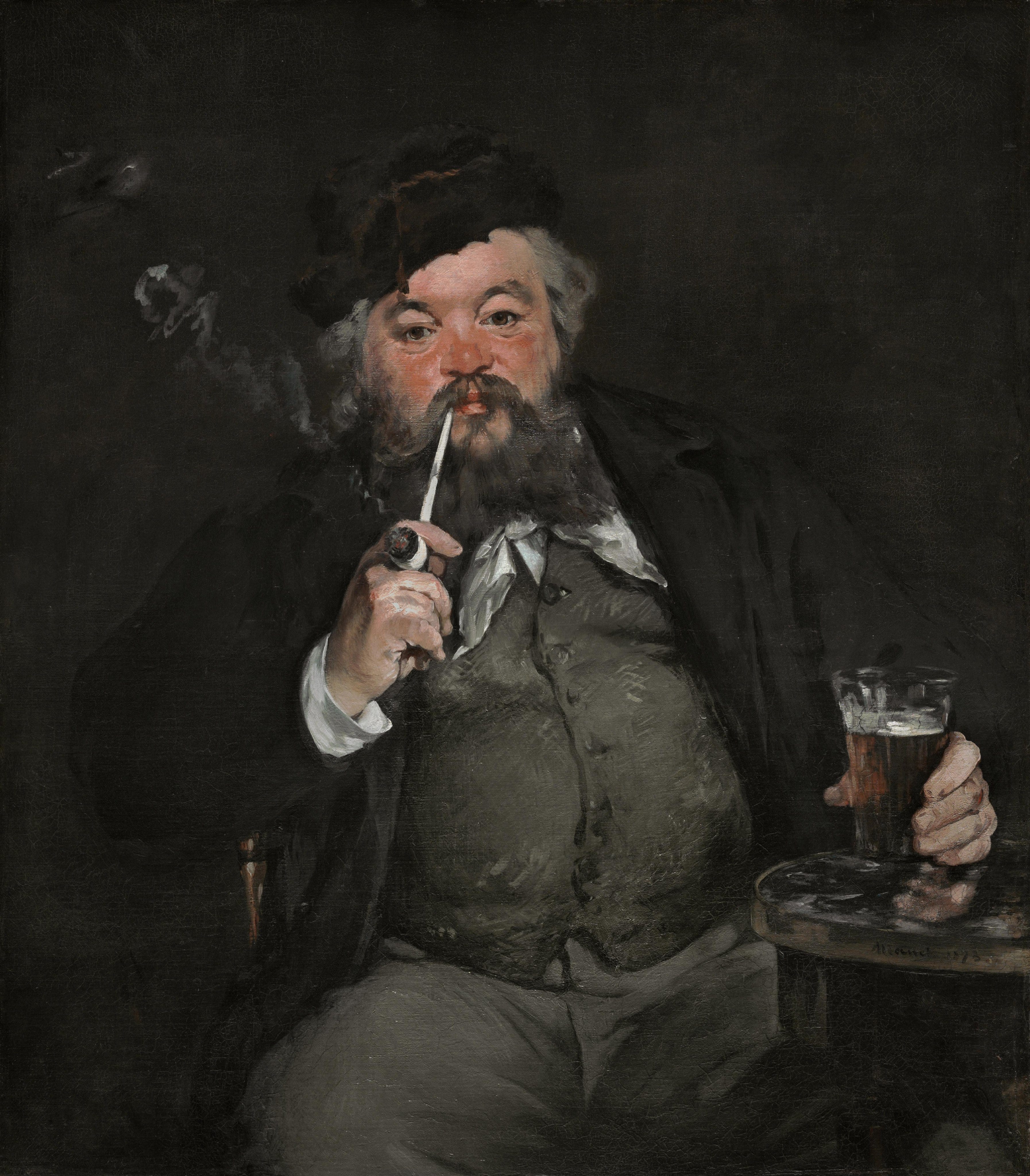
For Manet, at least, things seemed to be looking up. He managed to place two paintings in the 1873 Salon. His portrait of Berthe Morisot (Repose, 1871) received the usual sneers from the press, but his Le Bon Bock (above) was widely celebrated. Bock is a dark beer traditionally made in the spring, a time of renewal. While the image of a portly beer drinker smoking a pipe may seem too jarring a work of Realism for the Salon crowd, the timing worked out in Manet’s favor. Le Bon Bock was interpreted as emblematic of the new republic, a patriotic everyman (without the inconvenient radicalism of the Communards).
Soon, reproductions of Le Bon Bock could be found in bookstores and gift shops across Paris. In the Latin quarter, an inn used Le Bon Bock as the logo on its sign. Manet was accustomed to notoriety, but this was something new—for the first time in his career, was genuinely popular. Le Bon Bock became the face of the city’s feel-good liberalism, and Manet was responsible for its creation.
But his friends were growing impatient with the Salon. Monet was keen to revive an idea he had brainstormed with Bazille prior to his tragic death in the Franco-Prussian War: to create a joint-stock company and host their own exhibitions. This made Manet nervous. He was just beginning to experience real success within the establishment, and associating himself with this project could anger the Salon’s stringent jury. “Why don’t you stay with me?” he implored Monet. “Can’t you see I’m on a winning streak?”2
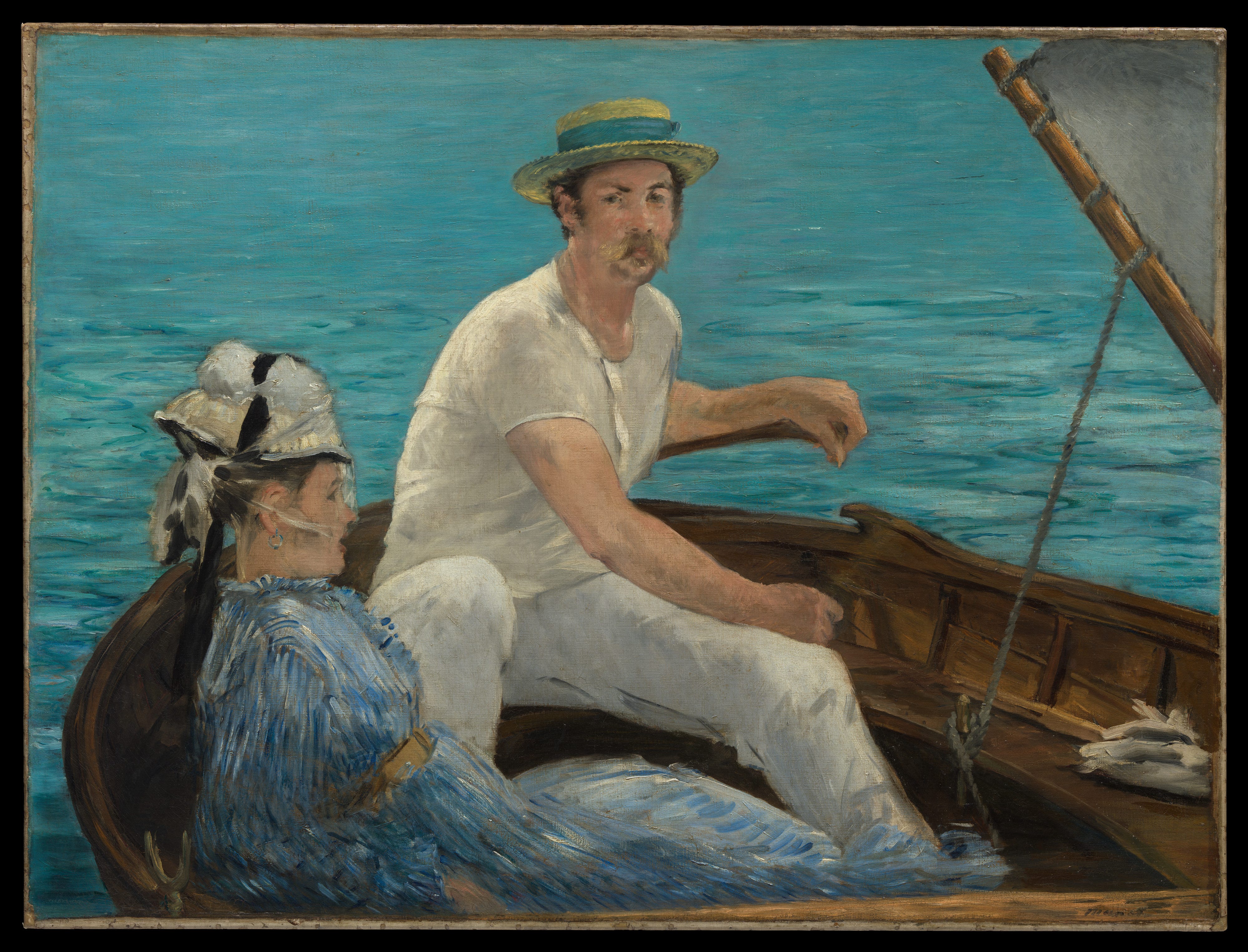
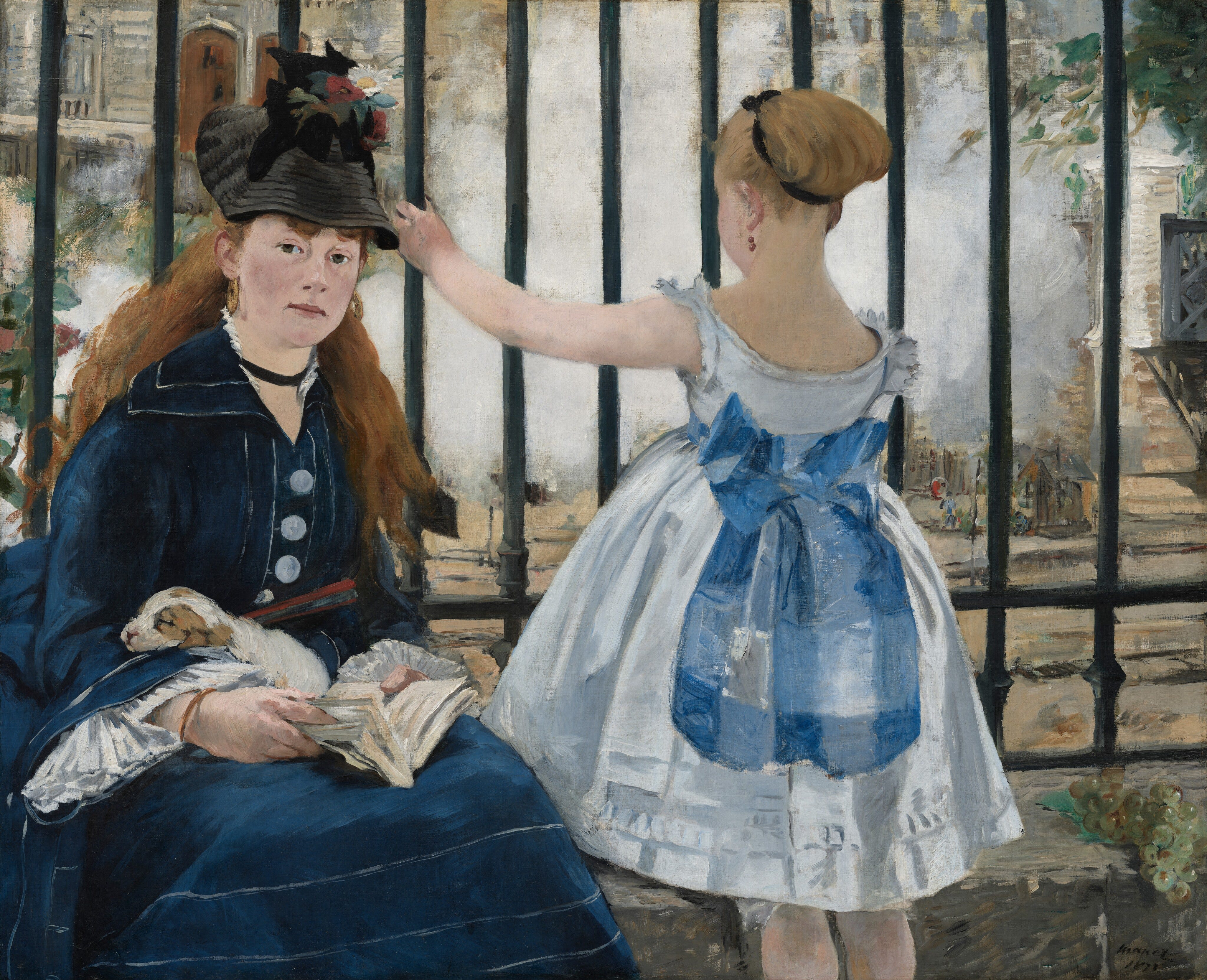
In spite of these protests, Manet’s style was changing. His works painted after the war, such as The Railway and Boating (above), straddled the line between Realism and… something else. Both of these paintings feature everyday scenes of contemporary life for which Manet was already noted, yet his brushstrokes had grown looser, his colors brighter. It was as if the viewer was walking along a bustling train station and suddenly glanced in the direction of a woman with her daughter. In the brightness of the summer sun, one might turn to the couple in an adjacent boat, and for a few seconds, one’s eyes perceived a brief impression.
Manet’s friends wanted to grasp hold of these fleeting moments—the ephemeral beauty of daily life immortalized on canvas, the vibrant expression of a changing world in a style that pushed beyond academic subject matter, or a camera’s lens.
Berthe Morisot was a founding artist of this new style. It is for that reason that Monet and Degas tried to persuade her to join the independent exhibition they were planning for 1874. (Degas even went so far as writing to Morisot’s mother for her blessing.) Morisot had a rebellious spirit, and she accepted their invitation.
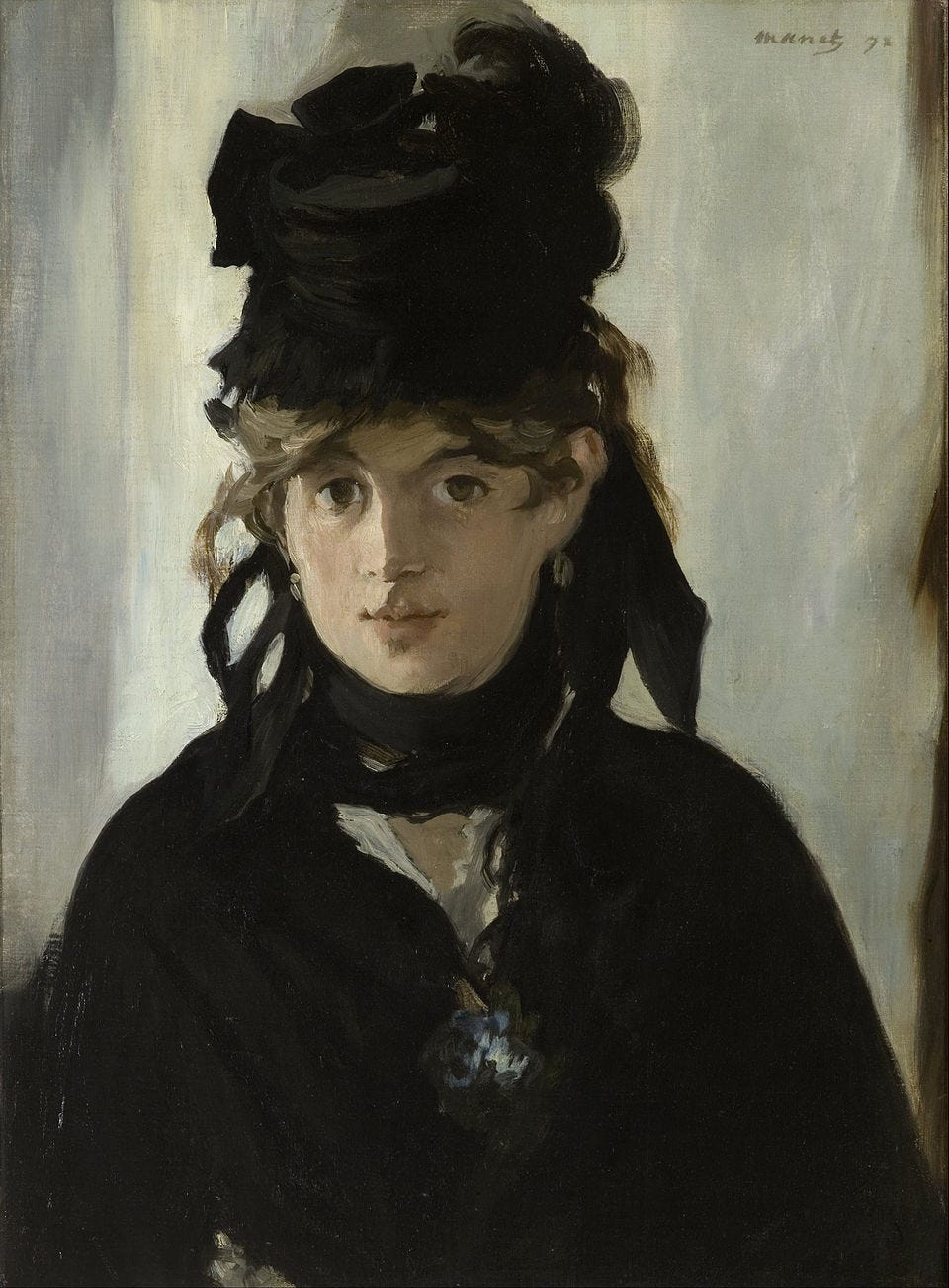

Manet was horrified. He warned Morisot that joining this “Société anonyme coopérative des artistes peintres, sculpteurs et graveurs” would endanger her chances at the Salon. He respected her talent; famously, he kept several of her paintings in his bedroom. It’s unclear whether this mutual affection resulted in an affair, though to use the parlance of our times, it was likely they had an “emotional affair.” Morisot had begun taking the risk of visiting Manet’s studio unchaperoned, and they spent many hours together painting, modeling, and discussing art.
As we’ve discussed in previous entries in this series, Morisot (like Manet) came from an upper-class family. In 1874, she was now thirty-three years old and unmarried, which was not at all the norm for women of her class. The pressure was on. Her mother knew they needed to find a man who was not only suitable in terms of social standing, but who would also be supportive of Morisot’s painting. Manet floated the idea of his younger brother, Eugène—a writer who himself was an amateur painter, and would take no issue with Morisot continuing her career. Eugène was certainly enamored with Berthe, and for Édouard, this would mean that Berthe would remain in his circle.
Despite their extraordinary closeness, Morisot ignored Manet’s warning about joining the independent exhibition. Long-time readers know what happened next. The First Impressionist Exhibition debuted from April 15th to May 15th, 1874. Several thousand people visited the show, and critics eviscerated the art in their reviews. It was at this exhibition that the word “Impressionist” was first used. Louis Leroy coined the term in his satirical review for Le Charivari—he got the idea from Monet’s 1872 painting, Impression, Sunrise.
For a time, it seemed as if Manet’s initial judgements had been proven correct. Yet years of pushing the boundaries of the art world meant that in the minds of the public, Manet’s name was inevitably tied with all-things-radical. It didn’t matter that he had refused to participate in the exhibition; some even speculated that he was behind the whole thing. As Jules Claretie wrote in L’Indépendant on April 20th, 1874:
M. Manet is among those who assert that in painting one can, and indeed should, content oneself with the impression. We have seen more of the impressionists at Nadar’s. M. Monet — a more intransigent Manet, — Pissarro, Mlle Morisot etc., seem to have declared war on beauty.3
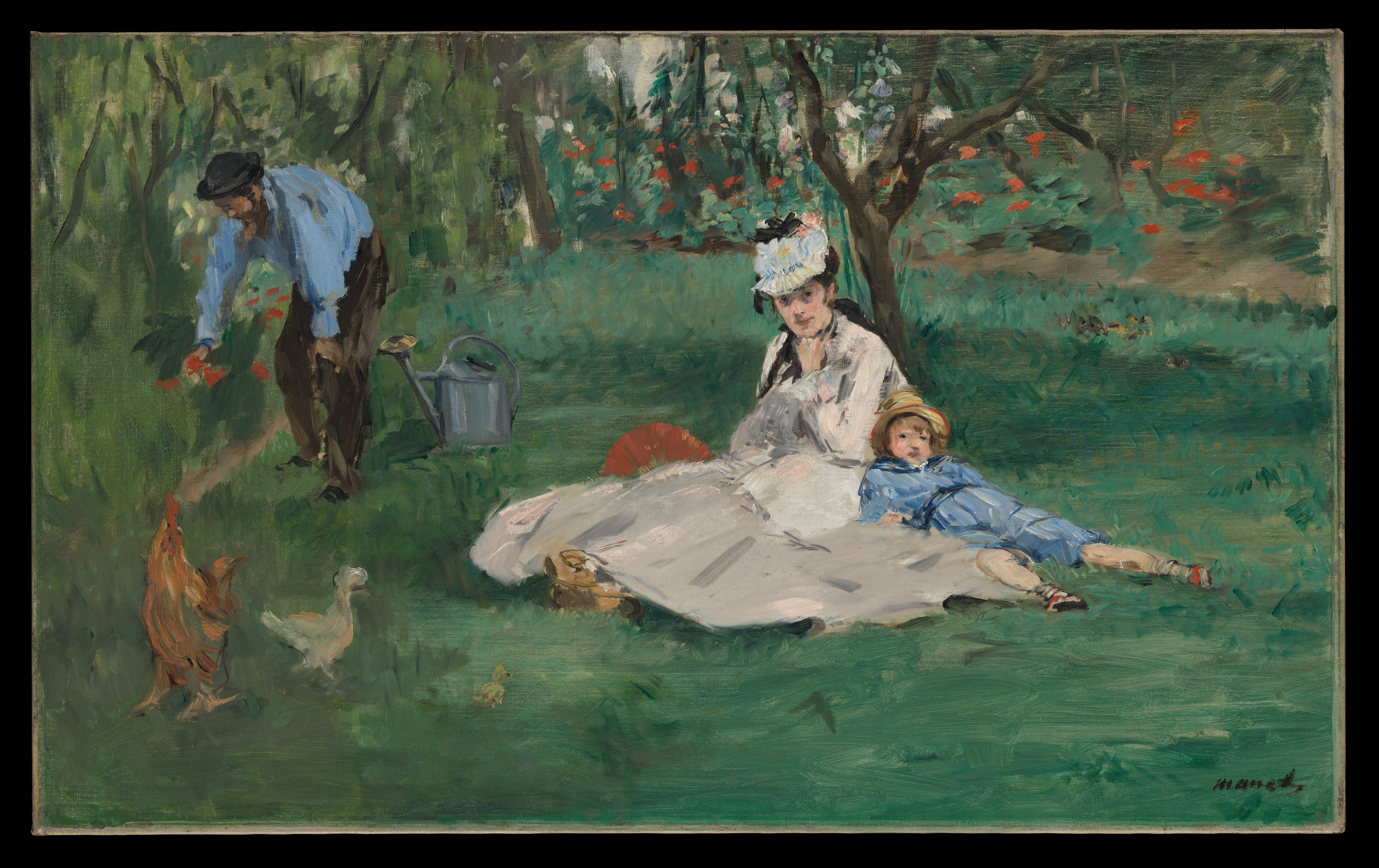
That summer, the newly-dubbed Impressionists scattered to the countryside to lick their wounds. Manet visited Monet’s family in the home they were renting in Argenteuil. (It was actually Manet who arranged the rental, as the property owner was a personal acquaintance.) There, he painted The Monet Family in Their Garden at Argenteuil—a resplendent image of summertime relaxation for which the Impressionists would become famous. Though he didn’t formally identify as a member of the group, this work shows how much his own style had evolved thanks to his friendships with artists like Monet. Compare this scene to Le Déjeuner sur l’herbe, and one can plainly see that Manet was leaving Realism behind.
Meanwhile, Berthe Morisot and Eugène Manet were heading to Fécamp on the Normandy coast, with their mothers as chaperones. (Be grateful for the times you live in. Thirty-three with a chaperone!) In recent years, the French had adopted the British affection for seaside holidays, and bathing in the sea was all the rage. Women’s swimsuits (or bathing costumes) revealed the ankles and the lower calf—with a wink and a nod, it was quietly acknowledged that these sort of vacations were the perfect getaway to initiate an engagement.
Morisot’s mother could soon breathe a sigh of relief. Berthe and Eugène were painting together at the harbor when he asked her to marry him.
Sue Roe, The Private Lives of the Impressionists (London: Vintage, 2006), 82.
Roe, Private Lives, 118.
Roe, Private Lives, 128.