

Abstract Florals and Contemporary Rococo
In recent years, Flora Yukhnovich has taken the art world by storm with her reimagining of Rococo for the 21st century.

This essay is part of the series Flowers in Art.
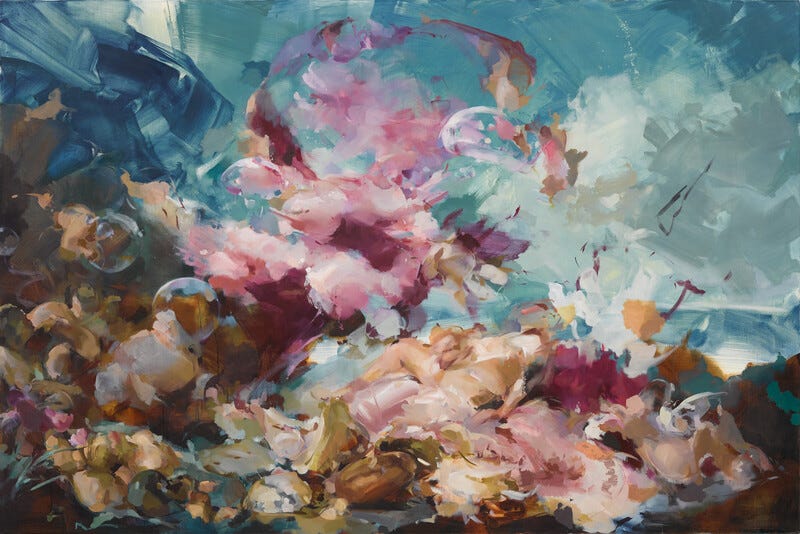
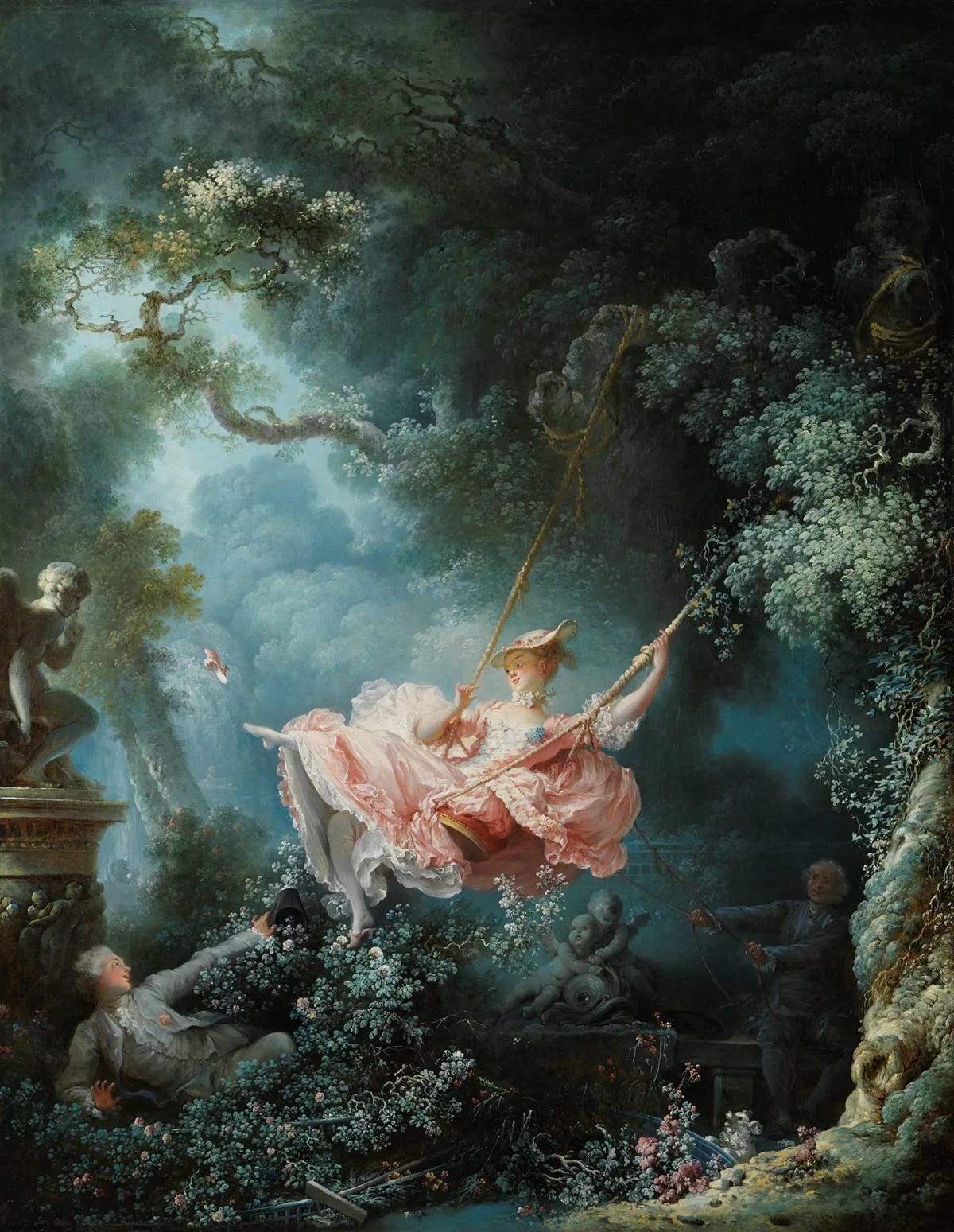
When Flora Yukhnovich was a student at City & Guilds of London Art School, she stumbled upon a book at the library that would forever change the course of her career. It was a book of paintings by the French Rococo artist, Jean Honoré Fragonard.
Of course, Yukhnovich didn’t make it to art school without knowing Fragonard. But when she was introduced to his art as a teenager in Norwich, England, she had a very different reaction to his work. She told Stephen Dubner in a 2022 interview with Freakonomics Radio:
YUKHNOVICH: I probably saw it for the first time when someone showed it to me being like, “Look how awful this is,” or, “Look how frivolous or how kitschy this is.”
DUBNER: Did you feel that yourself about Fragonard when you first saw it? Or were you impressionable and this person said, “Oh yeah, this is so tacky,” and then you just agreed?
YUKHNOVICH: I think the latter … I felt like I should dislike it immediately. There was just too much color. It’s designed to please, and I was aware of that and suspicious of it.
DUBNER: What made you suspicious of that notion?
YUKHNOVICH: When I was trying to learn what is good and what is bad, something being challenging was a good thing and you wanted to educate yourself to the point where you could enjoy something that is challenging.1
Snobbishness is an expression of fear: fear that others will discover that we are not as sophisticated or as impressive as we would like to be perceived. What Yukhnovich is describing is a common phenomenon in artistic circles, in which something that is widely enjoyed or “suspiciously” pretty is seen as déclassé. In fairness, there can be the opposite phenomenon as well—such as the visceral anger that Abstract Expressionism inspires in some viewers who, deep down, feel insecure about not “getting” it.
.jpg)
Yukhnovich knew that there were certain “complex” artists who were to be revered (she cites Frank Auerbach and Lucien Freud as examples), and others, like Fragonard, who were meant to be greeted with rolling eyes. It’s that tension between what we’re supposed to find lofty and what we actually find pretty that captivated her.
And, there’s the gendered element: “I realized that some of that has to do with the gendering of aesthetics and thinking of things as less serious because they related to femininity.”2
Flowers, of course, are culturally regarded as feminine—including the Freudian interpretations of Georgia O’Keeffe’s floral studies, which the artist just couldn’t shake off. Flowers are pretty, and so are women. But often, the things that many women enjoy, from romantic comedies to pumpkin spice lattes to the color pink, are written off as “less serious,” even in spaces that we associate with having a progressive bias (such as art school).
Yukhnovich’s paintings put a contemporary spin on Rococo, with fluid elements that hint at 18th-century imagery, from angels soaring among heavenly clouds to the fêtes galantes that populated the canvases of Jean-Antoine Watteau. Many of her works include abstract florals that, upon closer inspection, could be the shape of a beckoning arm, or an extended leg reminiscent of Fragonard’s The Swing (1757). The irony of Flora Yukhnovich’s name is not lost on me—Flora, of course, is the Roman goddess of flowers.
In her art, visually-pleasing elements such as flowers are used to make a point:
YUKHNOVICH: There’s something about using a pleasing aesthetic as almost a Trojan horse.
DUBNER: If your work is to some degree a Trojan horse, what’s inside, what’s it obscuring?
YUKHNOVICH: It’s that idea that something beautiful is lacking meaning, and I’m interested in setting it up in the right way in a fine-art setting, in a gallery setting, and seeing how people respond to it and seeing whether people get angry because they’re like, “Oh, it’s so palatable. How awful.” It’s easier to make something that is deliberately trying to be beautiful in opposition to someone who’s saying it shouldn’t be.3
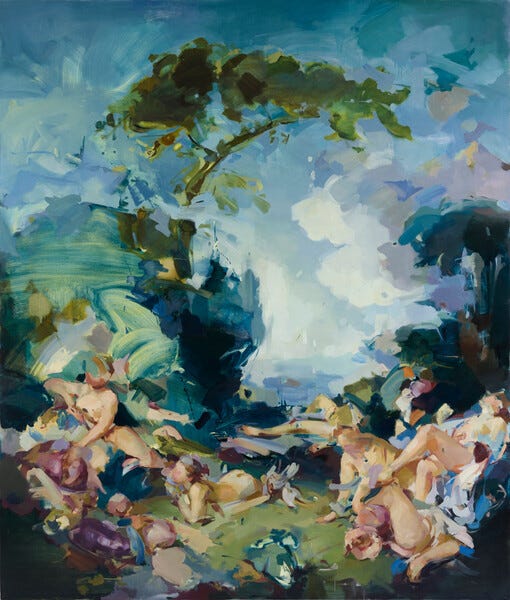
As I listened to Yukhnovich’s comments in her Freakonomics interview, it struck me that Rococo at its finest was also engaging in social critique. Several months ago, I produced a video about The Swing and Thomas Gainsborough’s Mr. and Mrs. Andrews (1750). Both Fragonard and Gainsborough used their charming aesthetics as “Trojan horses” to communicate underlying observations about their aristocratic clients. What is Yukhnovich trying to tell us about those who pay millions of dollars to acquire her work?
After all, Yukhnovich’s defiance of the “correct” taste has struck a nerve. At 35 years old, she has surprised the art market by far outselling auction estimates—in 2021, Tu vas me faire rougir (You’re going to make me blush) sold for £1,902,000, followed by Warm, Wet ‘N’ Wild, a Rococo twist on Katy Perry’s “California Girls,” which sold for £2,697,000 in 2022.4 In 2024, the Wallace Collection (home to The Swing) hosted “Flora Yukhnovich and François Boucher: The Language of the Rococo,” an exhibition that put Yukhnovich’s art in conversation with the Rococo master.
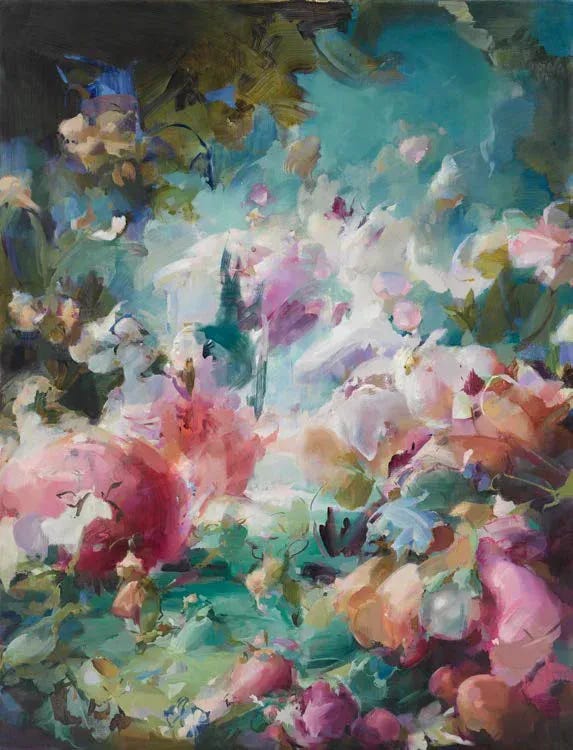
Throughout this series, we’ve seen how artists of different generations have used flowers as a vehicle for expression. Vincent van Gogh’s irises allowed him to test his ideas about color theory, Gustav Klimt crafted sunflowers with as much reverence as he conveyed in his portraits of women, and Georgia O’Keeffe applied the techniques of modernist photography to her paintings of flowers, thereby nudging the viewer to behold a humble blossom with new eyes.
I felt that Flora Yukhnovich was a fitting end to this series because her work, though far less figurative than her predecessors, operates in the same spirit. Through flowers, she can explore her own ethos as an artist, while compelling buyers and institutions to confront their own biases against the feminine.
Can beauty have a “point”? Yukhnovich’s art says yes, and declares so in the brightest of blooms.
Stephen Dubner, interview with Flora Yukhnovich, “Don’t Worry, Be Tacky,” Freakonomics Radio (podcast), April 6, 2022, https://freakonomics.com/podcast/dont-worry-be-tacky/.
Dubner, “Don’t Worry, Be Tacky.”
Dubner, Don’t Worry, Be Tacky.”
Hayley Maitland, “Stroke of Genius: How 34-Year-Old Flora Yukhnovich’s 21st-Century Spin on Rococo Turned Her Into an Art-World Phenomenon,” Vogue online, June 2, 2024, https://www.vogue.com/article/flora-yukhnovich-wallace-collection-interview.