

Crossroads Roundup: Roman Discoveries, Armenian Dragon Stones, and a 51,200-Year-Old Indonesian Cave Painting
My favorite stories on art, archaeology, folklore, and more from this past week.

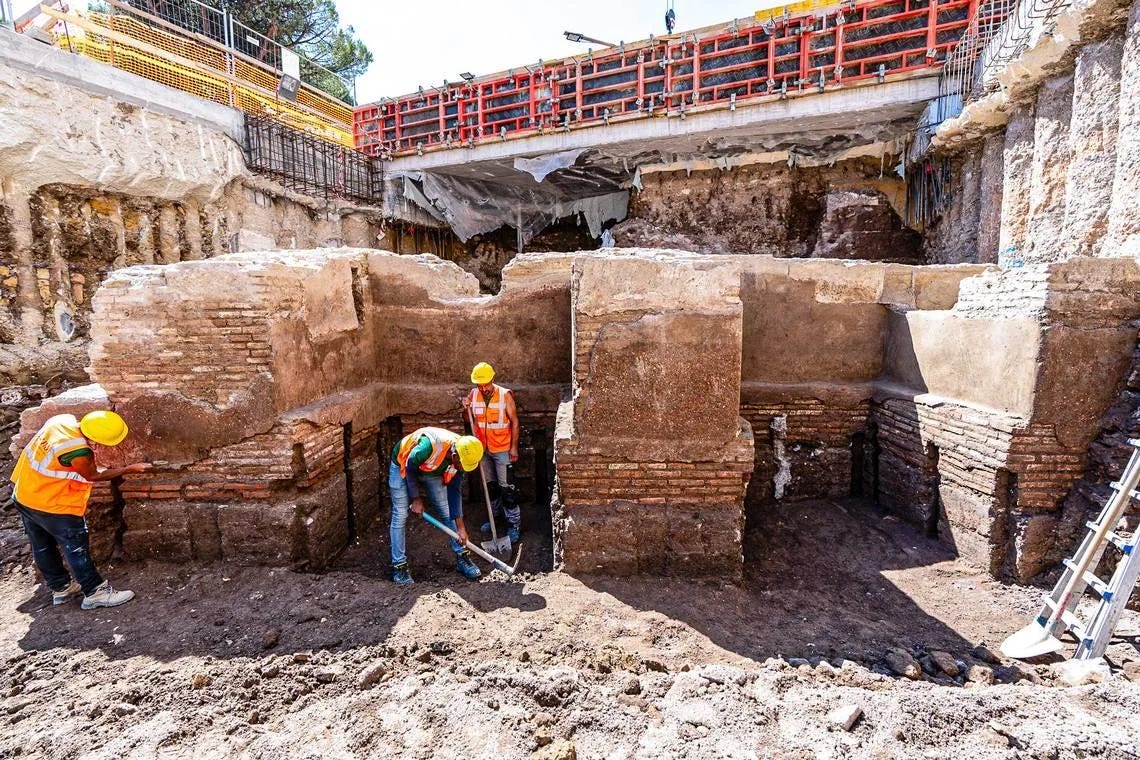
This week, researchers unveiled several major discoveries from the world of ancient Rome.
If you’ve had the chance to visit Italy, then you probably noticed that ancient ruins seem to materialize at every corner. The Romans and the Etruscans have provided us with a never-ending stream of sites to excavate, and for researchers, a steady flow of grant applications.
Sometimes, discoveries can be a source of inconvenience, such as when your construction team stumbles upon an emperor’s portico, and renovations must ground to a halt. The crew working on the Piazza Pia underpass in Rome learned this recently when they discovered a portico belonging to Emperor Caligula (see the above photo).
Caligula’s rule was very brief; he became the emperor in 37 A.D. and was assassinated about four years later. While viewed somewhat favorably or neutrally by ordinary Romans, Caligula was deeply despised by the Roman elite, as he aimed to limit the power of the Senate and rule as a god-king. (As the Senators learned, tyranny is fine, as long as it happens to other people.)
Further south, archaeologists uncovered a Roman settlement on the Palomba-Catenanuova route in Sicily. This site, like Caligula’s portico, was found thanks to a construction project—the Palomba-Catenanuova is a rail line currently being retrofitted for high-speed rail.
In the middle of the settlement is a large villa complex, which researchers believe served as an agricultural center. To the west, they found a necropolis with at least 168 burials representative of different social classes; some were monumental tombs with luxurious grave goods, and others were simple pit burials.
Finally, all the way at the northernmost frontier of the empire, archaeologists discovered the remains of two Roman villas near the ancient city of Wroxeter (Viriconium Cornoviorum), England. The team found the ruins while conducting a geophysical survey for the U.K.’s National Trust; as they told HeritageDaily, “The two rural villas, (the equivalent of a large country estate) show evidence of at least two construction or occupation phases, along with floor plans with internal room divisions and associated outbuildings.”
During the Roman occupation, Wroxeter’s population peaked at over 15,000 inhabitants and covered an area of 173 acres. Previous discoveries at the site include the ruins of several public buildings, such as a basilica, temples, a colonnaded forum, and more.
Rather poignantly, this mighty dragon has spent the past several thousand years watching over two infants buried beneath it:
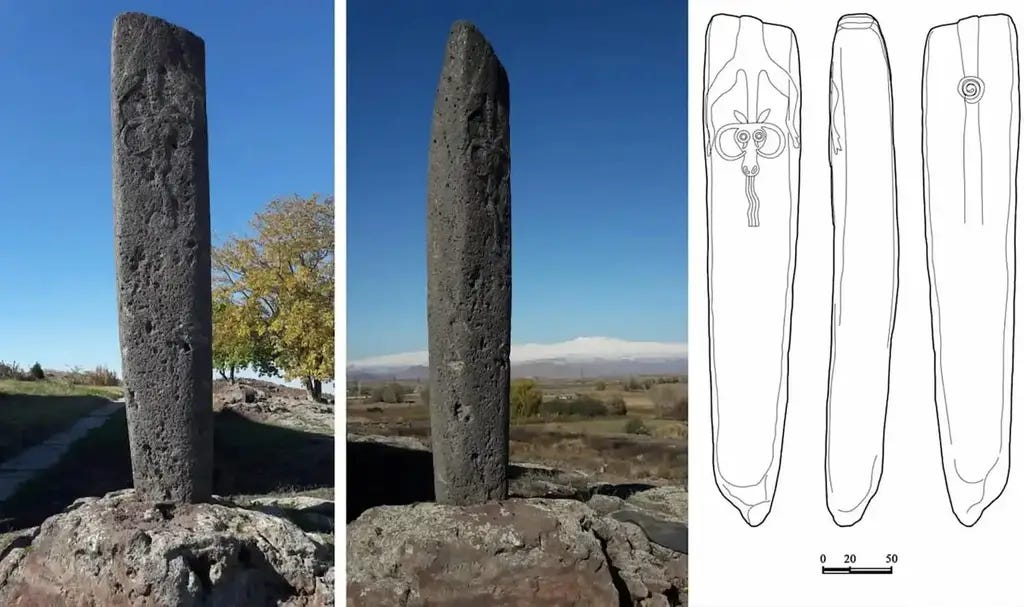
As some of you may recall, I published an essay several weeks ago about dragons, and how myths of these legendary beasts differ greatly among Eastern and Western cultures. Therefore, I was touched to read this news that an Armenian vishapakar, or “dragon stone,” was found to be guarding two infant burials. DNA testing of the infants’ remains found that the children were female and second-degree relatives. (Second-degree relatives have one member separating them, so these girls could have been half-sisters, an aunt and niece, etc.) The burials date from the 16th century B.C.
Dragon stones are basalt monoliths found in the Armenian Highlands. They feature carvings of fish heads or serpents that represent vishaps (water dragons in Armenian folklore). Almost all dragon stones can be found near springs or other bodies of water.
However, as the study published in ScienceDirect points out, it’s rare to find burials of children from Late Bronze Age Armenia, especially one accompanied by a dragon stone.
I’ll admit, I grew emotional while reading about this find. Despite the thousands of years between us and the Bronze Age community who created this monolith, I’m struck by our shared humanity. Losing an infant is devastating even if you live in a time period in which child mortality is common, and I can vividly imagine the family who wanted a little guardian to watch over their babies’ final resting place.
This 51,200-year-old rock art found in Indonesia may be the earliest example of visual storytelling.
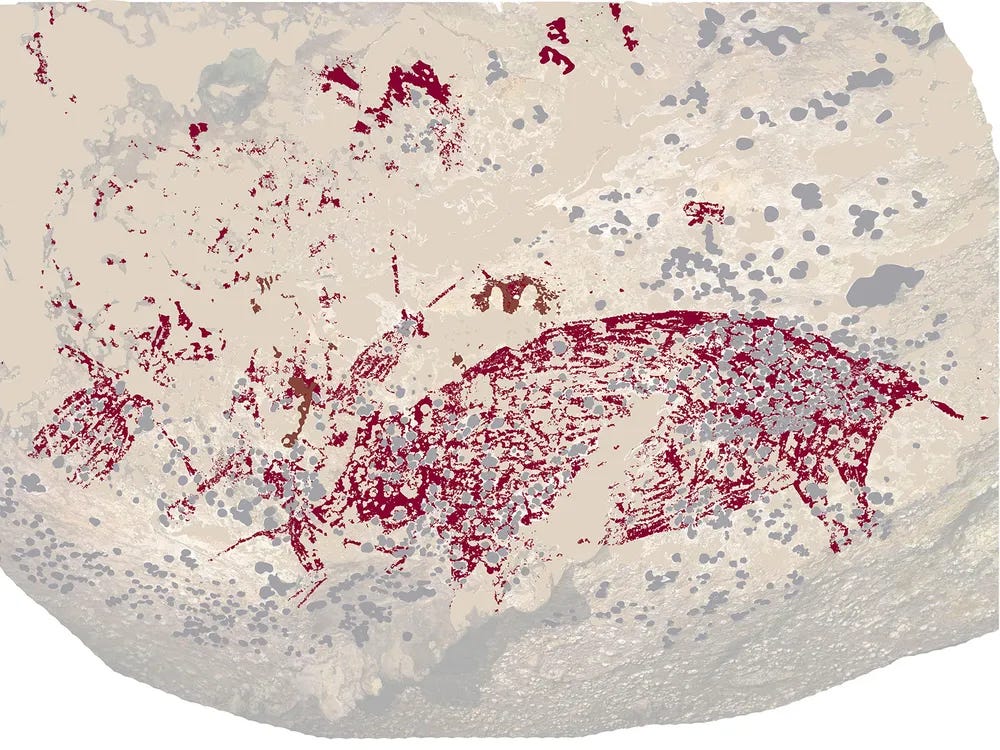
While archaeologists have found geometric cave art in southern Africa dating as far back as 75,000 to 100,000 years ago, the above image—which shows three human-like figures interacting with a pig—may be the earliest example of narrative art.
This art was found in a cave on the Indonesian island of Sulawesi. In a study published in the journal Nature, researchers described using laser technology to remove tiny pieces of the art to test its age. Prior to this discovery, the oldest known narrative art dated to about 48,000 years ago.
As early humans did not have a written language at this point, this art provides the oldest known evidence of storytelling. However, oral storytelling traditions likely stretch further back than the development of narrative art. Adhi Agus Oktaviana, one of the study’s authors, explained to the BBC, “Humans have probably been telling stories for much longer than 51,200 years, but as words do not fossilize we can only go by indirect proxies like depictions of scenes in art—and the Sulawesi art is now the oldest such evidence by far that is known to archaeology.”
A few other stories that caught my eye…
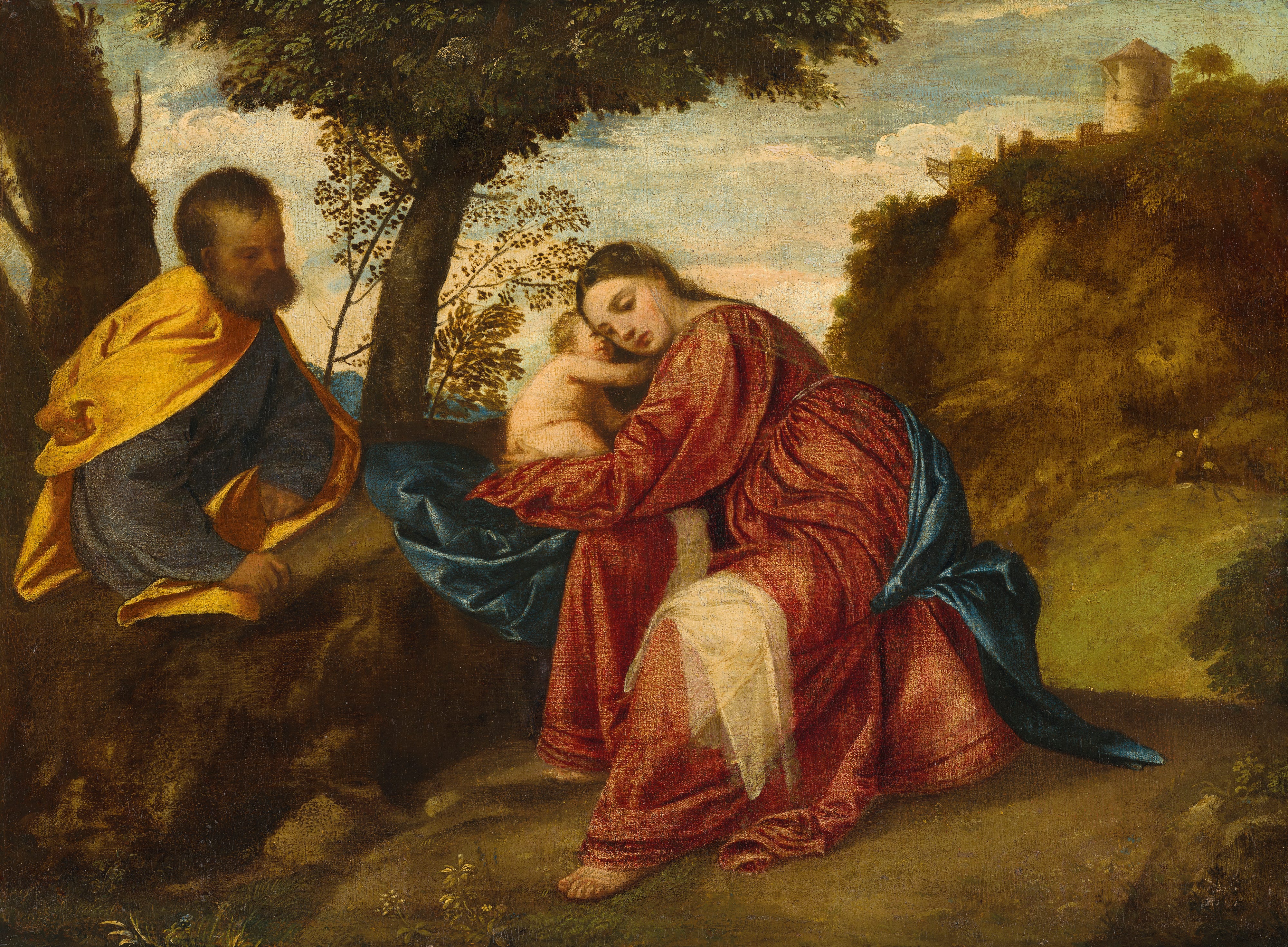
Titian’s The Rest on the Flight into Egypt (1510) has officially set the record for the most expensive sale of any Titian work. The painting sold in London this week for $22,178,280; it was last auctioned by Christie’s in 1878, when it was purchased by the 4th Marquess of Bath.
Meanwhile in Bulgaria, archaeologists found an ancient Roman statue of the Greek god Hermes in what was a Roman sewer. The statue is 6.8 feet (2 meters) tall and well-preserved.
I also came across this story about a Bronze Age roundhouse recently excavated in Cardiff, Wales. When the remnants of the structure were spotted in an aerial survey several years ago, researchers mistakenly believed that it dated between the Iron Age and early Roman occupation. However, it turns out that the house is far older—about 3,500 years old, making it the earliest home found in Cardiff.
And finally, preserving the world’s oldest mummies:
The oldest mummies to have been discovered are actually not from Egypt, but from Chile. I enjoyed this video from CBS Saturday Morning, which profiles the archaeologists who are working to preserve the mummies and ensure that future researchers will be able to learn from them.