

Evelyn De Morgan and the End of Pre-Raphaelite Art
A brilliant female artist finally gets her moment in the sun.

This essay is part of the series Art, Myth, and Literature: The Pre-Raphaelites.
We began this series on the Pre-Raphaelites with Shakespeare’s Ophelia, rendered with equal-parts opulence and despair by John Everett Millais in 1851-52. Decades later, the Pre-Raphaelite Brotherhood had long since disbanded, but the movement continued to find adherents in younger artists. Britain had changed dramatically by the end of the Victorian period: now, a majority of its citizens lived in urban areas, the nation was a leading industrial power, and in just a few years, it would face the horrors of the First World War.
From this cacophony of industrial anxiety and scientific progress came the Spiritualist movement, which blossomed first in the United States and spread its message of mediumship, psychic gifts, and the great beyond to the UK. Today’s artist was an avid Spiritualist, and her interest in mysticism and the occult would take hold in her evocative paintings.
We end our series with Evelyn De Morgan.
De Morgan, like many female artists of her time (such as the Impressionists Berthe Morisot and Mary Cassatt) is only now getting the credit she deserves. Those who live near London can see a De Morgan retrospective at Guildhall Art Gallery through April 2026 called “Evelyn De Morgan: The Modern Painter in Victorian London.” She is increasingly recognized for her precision, symbolic depth, and eye for beauty.
Take her 1894 painting Flora (below), which depicts the Roman goddess of flowers, a work heavily inspired by Sandro Botticelli’s Primavera. Starting in 1890, De Morgan and her husband William began spending every winter in Florence, a city much beloved by De Morgan for its wealth of masterpieces from the Italian Renaissance. Flora is not just an ode to a divine feminine figure but also to the city that bears her name, the city where Botticelli lived. In De Morgan’s work, the goddess’s dress is decorated with violets, several varieties of which are native to Italy. Behind her is a loquat tree, a common shrub in Italy that fruits in the spring.
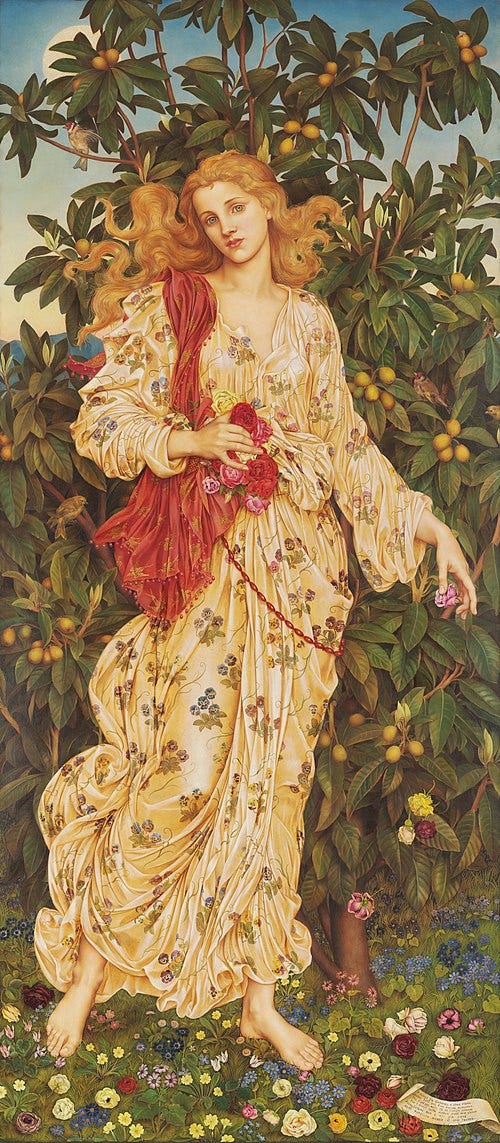

Despite its clear Italianate inspiration, the scene bears the hallmarks of the Pre-Raphaelite style: the model’s long, red hair, the adherence to Ruskin’s “truth to nature” visible in the scene’s precise details, the vibrant color scheme. Throughout this series, we’ve explored the Pre-Raphaelite connection to literature and mythology, so it is fitting that De Morgan derived ample inspiration from Greek and Roman myths. Even at the bottom of the painting, she includes a few lines in verse (here translated from the Italian by James Stewart):
I come from Florence and I am Flora.
That city takes its name from flowers,
Among flowers I was born and now I take a new home,
In the mountains of Scotland I shall reside.
Welcome me and may my treasure,
Be dear to you amid the northern mists.1
Flora was sold to one of De Morgan’s most important patrons, the Scottish shipping magnate William Imrie, who also commissioned De Morgan’s Cassandra and Helen of Troy (both painted in 1898). If Millais’s Ophelia is emblematic of the Brotherhood, then De Morgan’s Flora is the perfect representation of the Pre-Raphaelite style in its final days.
De Morgan’s success was far from guaranteed. Born Mary Evelyn Pickering in 1855, she came from a family of upper-class landowners and nobility on her mother’s side. In keeping with her class, young Evelyn was tutored at home, though her parents had her educated alongside her brothers. As a result, Evelyn was extremely well-educated in literature, science, mythology, philosophy, languages, and more.
Despite this, Evelyn’s mother actively discouraged her interest in art. Evelyn’s sister, Anna Marie Wilhelmina Stirling née Pickering chronicled this in her biography of her sister and brother-in-law. A. M. W. Stirling was a prolific author, and her books ranged from fantasy to biography to historical nonfiction. Yet in her effort to preserve her sister’s legacy, Stirling too was a woman of her time, as evidenced by the biography’s title, William De Morgan and His Wife (1922). Stirling offers a fascinating account of Evelyn’s early passion for painting—as a child, she took water from the gutters in order to paint, and grew deeply engrossed in her craft even as her parents tried to steer her towards more ladylike pursuits. Her parents grew concerned about their daughter’s “mania” for art, and her mother went so far as to tell her art instructor to pretend that Evelyn wasn’t talented in order to dissuade her.

The sexism is obvious. (Labeling a girl’s passion as a mental illness seems to have been pulled straight from a box of Victorian stereotypes.) Less obvious to a contemporary reader are the class implications. To the Victorian gentry, being a painter was certainly better than being an actor, but still too bohemian—and dangerously close to being a trade—for the upper-echelon of British society. For example, Evelyn’s uncle John Roddam Spencer Stanhope was part of the second-wave of Pre-Raphaelite artists; he was an early tutor for Evelyn and an accomplished artist in his own right. Yet despite being a man, his family strongly looked down upon his choice of profession. As Stirling humorously relates:
Artists were people who wore long hair and impossible clothes, and who affected to admire much that sensible people saw to be absurd. The Old Masters were in a different category principally because they were old… It did not matter now what had been their social status or idiosyncrasies when alive.2
But Evelyn was unflappable. She persevered in her studies, and in 1873 became one of the first women to enroll in the Slade School of Art. The Slade School offered even women an opportunity that earlier female Pre-Raphaelites lacked: the ability to attend live drawing sessions, including those of nude models, essential to an art student’s mastery of the human form (though women were banned from live drawing sessions after 5:00 PM). It was also at this time that she adopted her middle name Evelyn for her professional name, rather than her first name, Mary. During this period, Evelyn was a gender-neutral name, so she could disguise her gender and circumvent possible discrimination when submitting her work for contests.
Evelyn quickly built a portfolio of prize-winning pieces and soon had her own patrons. She further defied the conventions of her time by marrying William De Morgan, a ceramicist of the Arts and Craft movement born into a middle-class family. Their engagement scandalized her family due to class differences, though their marriage proved to be the sturdy foundation of their lives and careers. The De Morgans exhibited and networked together; early in William’s career, it was actually Evelyn who was the main breadwinner.3
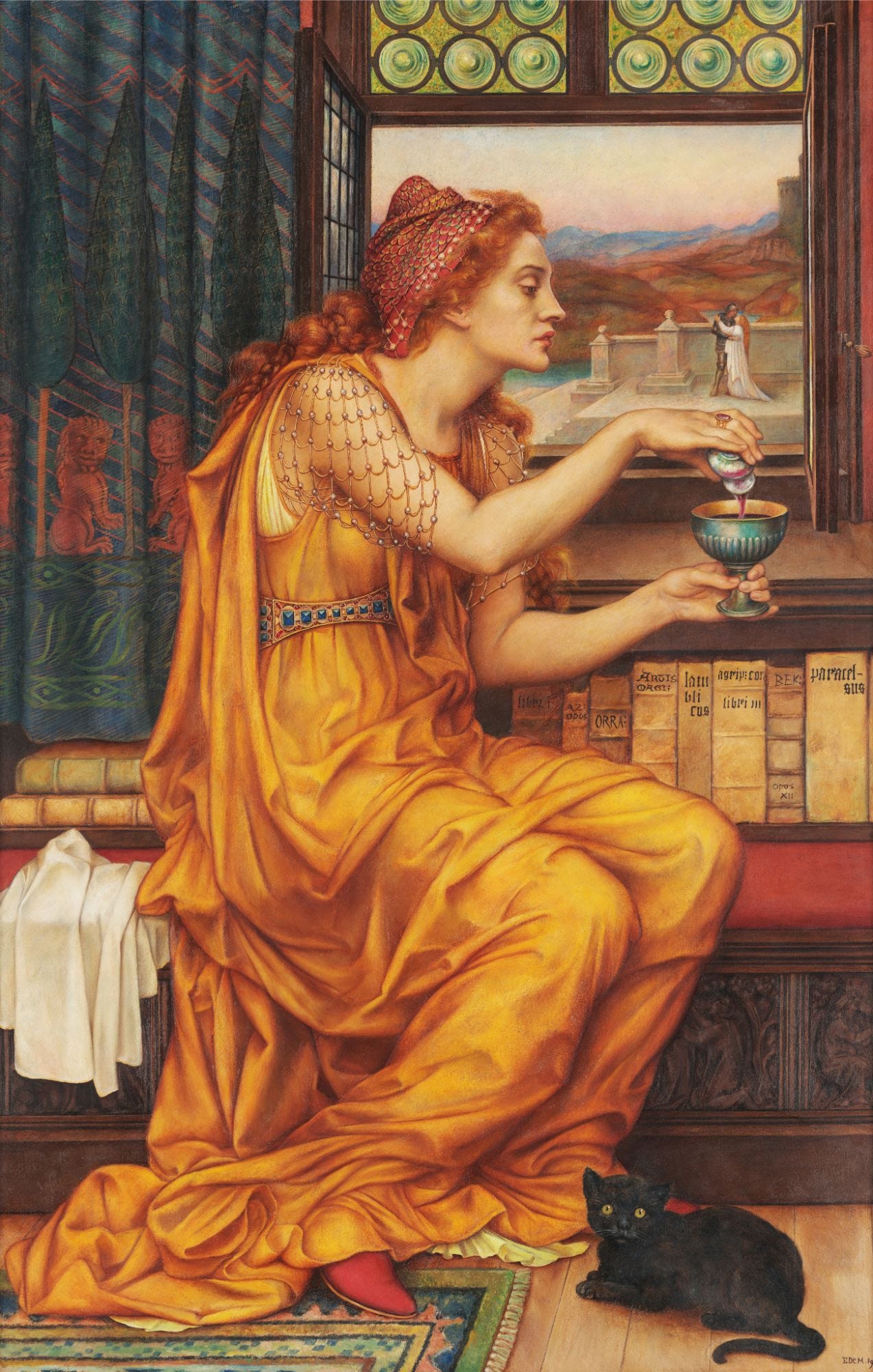
Evelyn De Morgan was clever: she embraced fashionable styles from the Pre-Raphaelite to the Aesthetic Movement in order to secure patronage, and she used that as cover to imbue these paintings with her feminist and pacifist beliefs. De Morgan almost always painted women, and she often portrayed them in positions of power and action—women brewing potions and casting spells, women as powerful spirits. As she grew more interested in Spiritualism, her works took on greater symbolic depth.
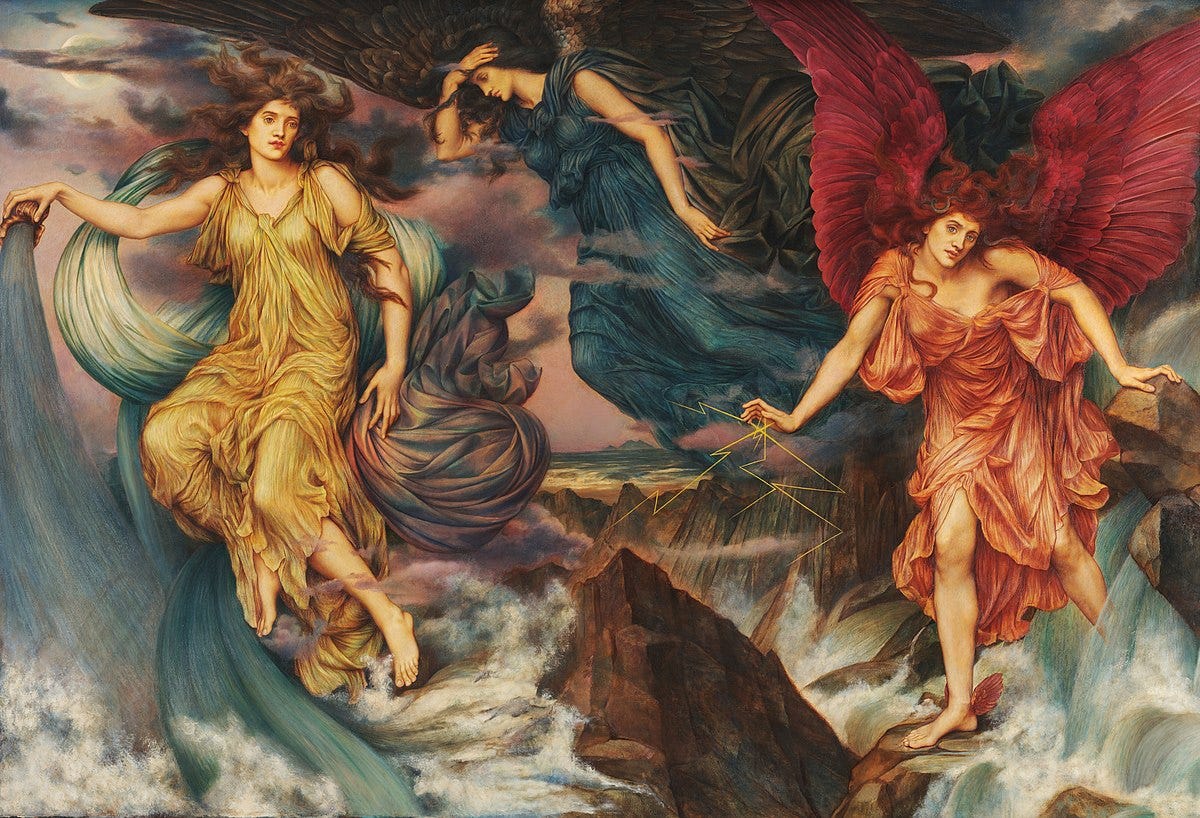
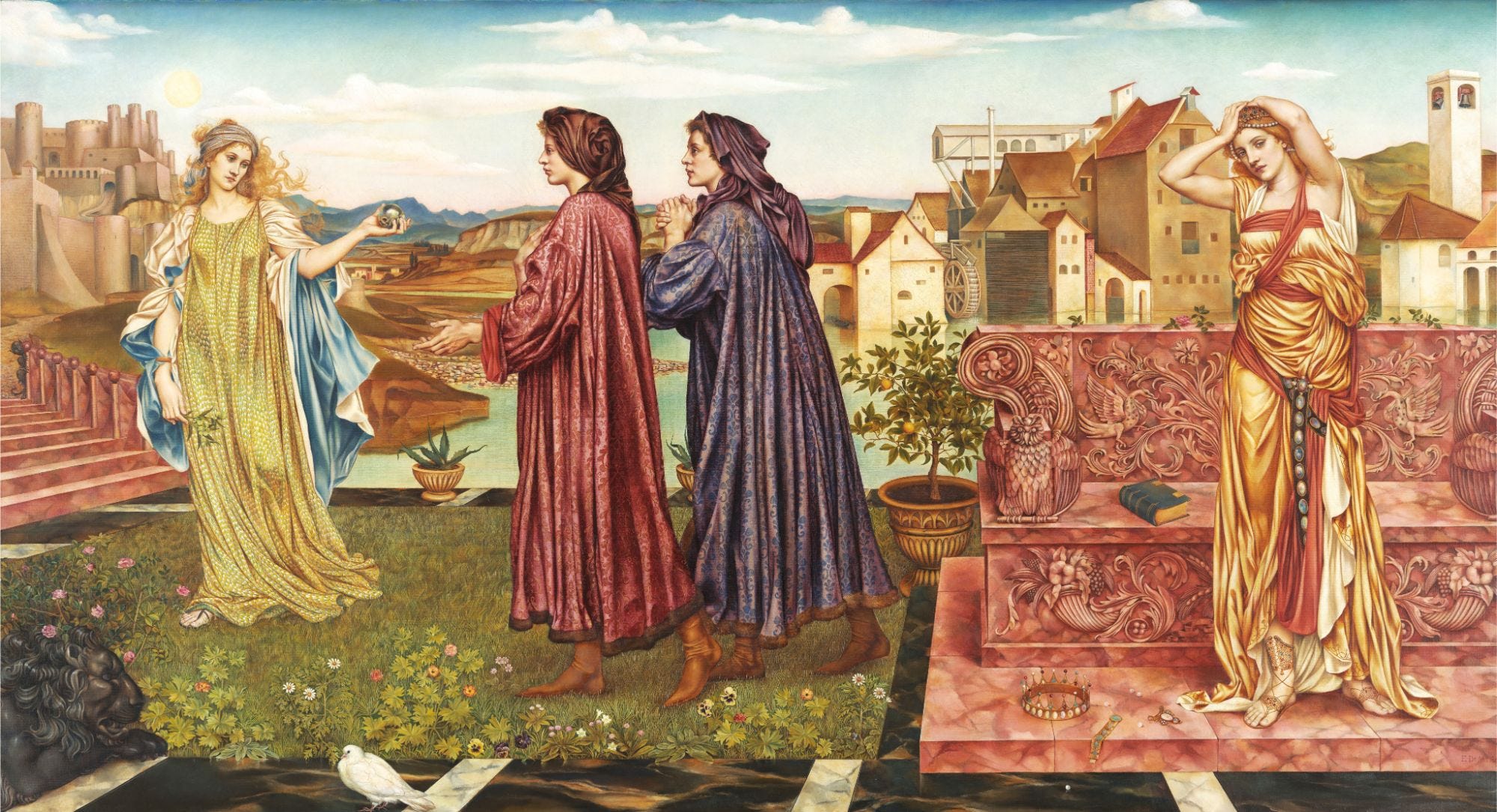
For example, in The Garden of Opportunity (1892), two students deny Wisdom (personified on the right against a backdrop of learning, industry, and spirituality represented by a church), and instead choose Folly. Folly holds out a silver ball, but the back side, which the students cannot see, is a skull. She lures them toward a castle that promises riches, though a devil hides in the background behind the bridge. During World War I, De Morgan also expressed her pacifist beliefs through her works, including S.O.S. (1914) and The Red Cross (1918). Both are courageous anti-war statements, brimming with spiritual fervor and highlighting the terror of the war and heartbreak toward the millions of lives lost.
Luckily, De Morgan would live to see the end of the conflict. She passed away in 1919, a few months after her husband. Until the late 20th century, her work was largely overshadowed in the canon by William, despite the fact that they were true partners in life, and despite her extraordinary talent. By the end of the Great War, the world she and William had known was gone for good. The Pre-Raphaelite style seemed antiquated next to new modes of expression like abstract art.
Nevertheless, De Morgan brought the Pre-Raphaelite movement to a stunning conclusion—one that embraced intricate storytelling centered on the lives and adventures of women. A century later, her work is finding new audiences, and the fantasy worlds she conjured are inspiring viewers once again.
“Flora,” De Morgan Collection, https://www.demorgan.org.uk/collection/flora/.
A. M. W. Stirling, William De Morgan and His Wife (Henry Holt and Company, 1922), 173-174. Readers can find a free copy of the biography online here.
For further reading on the subject of Evelyn and William De Morgan’s marriage and artistic partnership, I would recommend Evelyn & William De Morgan: A Marriage of Arts & Crafts, edited by Margaretta Frederick (Yale University Press).
I love learning about a female artist whose work I've never really explored before. Marry it with Pre-Raphaelite style and you can't go wrong. Thanks for the lovely piece and series!