

Flower Fairies, Photographic Hoaxes, and the Post-War Imagination
In 1920, photographs of the Cottingley fairies took the world by storm as "evidence" of an eternal, elfin realm. But the image of the flower fairy was a more modern creation.

This essay is part of a series called On the Origin of Fairies.

In December 1920, readers across the United Kingdom and around the world were shocked by an article published in The Strand Magazine. The front cover screamed a sensational headline: “FAIRIES PHOTOGRAPHED / AN EPOCH-MAKING EVENT DESCRIBED BY A. CONAN DOYLE.”
Arthur Conan Doyle… as in, the author of the Sherlock Holmes series?
If this comes as a surprise to you, dear reader, then I will direct you to an essay I published in November of last year about the many lives of the beloved mystery writer. Doyle was not just a writer. He was a doctor, a botanist, political activist, world-traveler—and, crucial to our purposes, a leading member of the Spiritualist movement.
Spiritualists believed in life after death, including the soul’s continual evolution after one’s passing, and that skilled mediums could contact the dead through séances. Though it may seem contradictory, the Spiritualists endeavored to document evidence of spiritual phenomena, as a new wave of biologists collected evidence in support of the theory of evolution. (Leading evolutionary biologist Alfred Russel Wallace was himself a Spiritualist.)1
To Doyle’s enormous delight, he now possessed the evidence that would surely persuade his peers—photographs of actual fairies, documented by two young girls in the town of Cottingley.
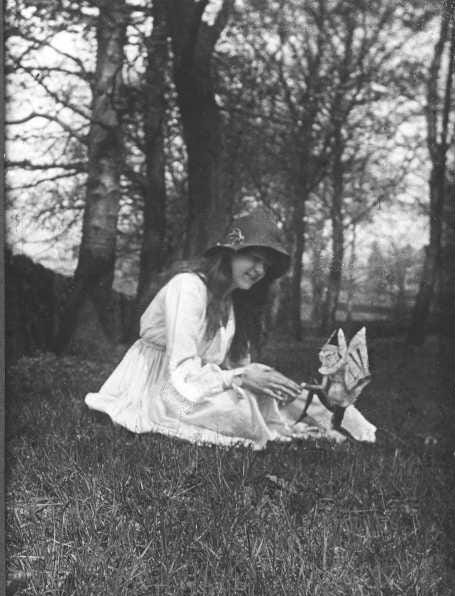

It all started in the summer of 1917. As the Great War tore apart millions of lives, as a generation of British men were wiped out to the tune of 880,000 soldiers lost, two English girls made a “discovery” that would prove incredibly enticing for a battle-hardened public.
Frances Griffiths was only nine years old, and she and her mother had moved to England from South Africa that year. They were living with Frances’s aunt Polly Wright, her husband, and their sixteen-year-old daughter Elsie. At the bottom of the Wright family’s garden was a little stream, in which Elsie and Frances loved to pass the long summer days. Incensed by her daughter’s perpetually-damp shoes, Frances’s mother demanded to know why she insisted on playing in the stream. “I go to see the fairies,” was Frances’s reply.2
Frances and Elsie, determined to prove their story to be true, used Mr. Wright’s camera to take a photo of these alleged fairies. Several weeks later, they took another.
Mrs. Wright was interested in Theosophy, a 19th-century occult tradition adjacent to Spiritualism. After the war ended, she took prints of the photos to the Theosophical Society in Bradford. In 1920, the society’s president, Edward Gardner, hosted a series of lectures on the photos in London, where they caught the attention of Arthur Conan Doyle. That same year, Elsie and Frances took three more photos.
In some ways, this “coming of the fairies” was a blast from a time gone by. Fairy enchantment seemed incompatible with a world of wireless radios, automobiles, and modern warfare. (Doyle himself lives forever in our imaginations as a Victorian gentleman, despite the fact that he actually lived until 1930.)
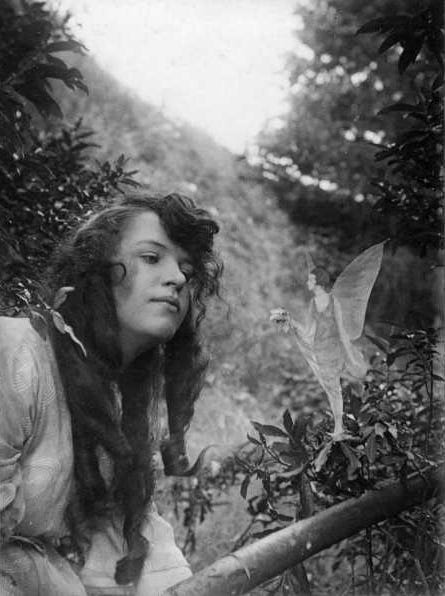

But keen observers noticed that there was something decidedly modern about these fairies. In March 1921, the Daily Mail commented that one of the fairies (above) wore an “up-to-date dress” and bobbed hair.3 (Imagine that—a fairy flapper!)
Doyle pushed back against the chorus of non-believers, as he wrote in his 1922 book, The Coming of Fairies:
I must confess that after months of thought I am unable to get the true bearings of this event. One or two consequences are obvious. The experiences of children will be taken more seriously. Cameras will be forthcoming. Other well-authenticated cases will come along. These little folk who appear to be our neighbours, with only some small difference of vibration to separate us, will become familiar. The thought of them, even when unseen, will add a charm to every brook and valley… The recognition of their existence will jolt the material twentieth-century mind out of its heavy ruts in the mud, and will make it admit that there is a glamour and a mystery to life.4
After the horrors of World War I, people needed the fairies. (Doyle himself had lost a son and a brother during the war.) Perhaps that is why it took so long for the girls to admit to the hoax—a childhood scheme made from illustrations held up with well-placed hatpins. It wasn’t until the 1980s that Frances and Elsie, now senior citizens, finally confessed.
In my previous patron essays for Crossroads, our stories have unfurled chronologically. (Proceeding in any other fashion would be difficult for me to write and difficult for my readers to follow.) But the fairies present a unique opportunity for us to sink further and further back in time together. Like a lost human traveler who stumbles into Faerie, we will begin in the familiar terrain of the 20th century and wander deep into the mystifying past.
To the average person living in 1920, fairies were for children. Even with the Cottingley photographs, most adults did not believe in fairies, and those who did were often elderly residents of rural villages. The oral stories that Walter Evans-Wentz recorded for posterity in 1911 came almost entirely from these older villagers throughout Britain and Ireland, and such individuals had been brought up during the Victorian period. (We will read their fascinating accounts in next week’s essay.)
.jpg)
The 1800s saw the shrinking and infantilizing of the fairy; by the time readers in 1920 encountered the Cottingley fairies, they were primed to think of the creatures as tiny and harmless.
This characterization followed the public into the Edwardian era. In 1904, at the Duke of York’s Theatre in London, J.M. Barrie’s Peter and Wendy made its high-flying debut to a rapt audience, one that eagerly clapped along as the actress who played Peter (the role is traditionally played by a female actor, who can more easily emulate a child’s high-pitched voice) implored the audience to proclaim their belief in fairies in order to save Tinker Bell.
Years later, the adults in the audience were still clapping. As one critic wrote in 1909, “Either we are a nation of hypocrites, or we have a secret belief in the supernatural, for the torrent of hand-clapping which came to the rescue of the expiring Tinker Bell was so overwhelming that even Peter seemed surprised.”5
Tinker Bell was portrayed not by a petite performer, but a tiny light projected onto the stage. Already, the fairy was too small to be anything more material to the spectators in the velvet seats.
Nevertheless, fairies in the 20th century belonged to children. It is amazing, considering that in the pre-industrial world, fairies were best known for kidnapping children and bringing them to Faerie or Fairyland: that nebulous realm that was imbedded within our world and yet somewhat removed, a wrong turn down a fairy road or a misguided picnic on a fairy hill. The fact that the fairies “appeared” in Cottingley—hardly a remote outpost, but a suburb of the West Yorkshire city of Bradford—demonstrates how far removed we are from the forest primeval.
It was the children’s author Rose Fyleman who made famous the concept of “fairies at the bottom of the garden” in a poem first published in May 1917:
There are fairies at the bottom of our garden!
It’s not so very, very far away;
You pass the gardener’s shed and you just keep straight ahead—
I do so hope they’ve really come to stay.6
Her work swiftly gained popularity with young readers, many of whom had likely lost a father, brother, or cousin in the First World War. One has to wonder if Elsie Wright and Frances Griffiths had also come across Fyleman’s poem, for just several months after its publication, they claimed to have found flower fairies at the bottom of their own garden.
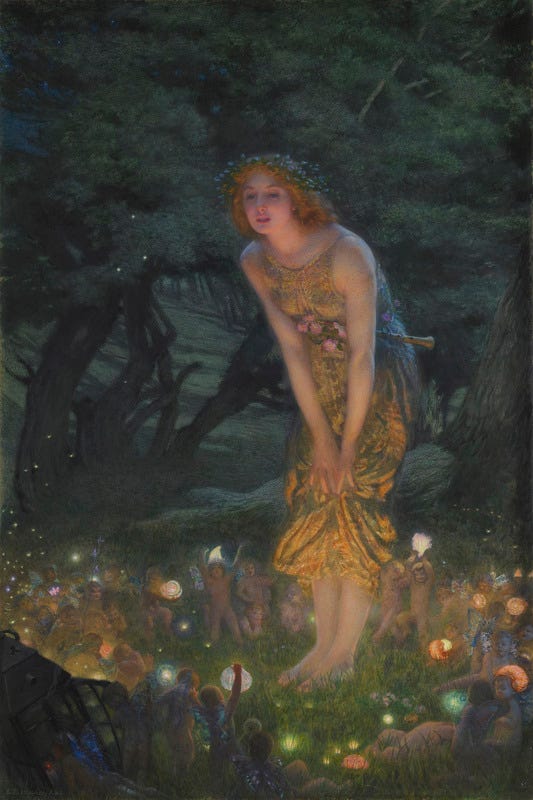
Fairies were now not only the domain of children, but increasingly, flower fairies and elves were depicted as children. An earlier example includes Edward Robert Hughes’s Midsummer Eve (1908); though difficult to see clearly, the Good Folk dancing in a circle around a human woman resemble cherubs.
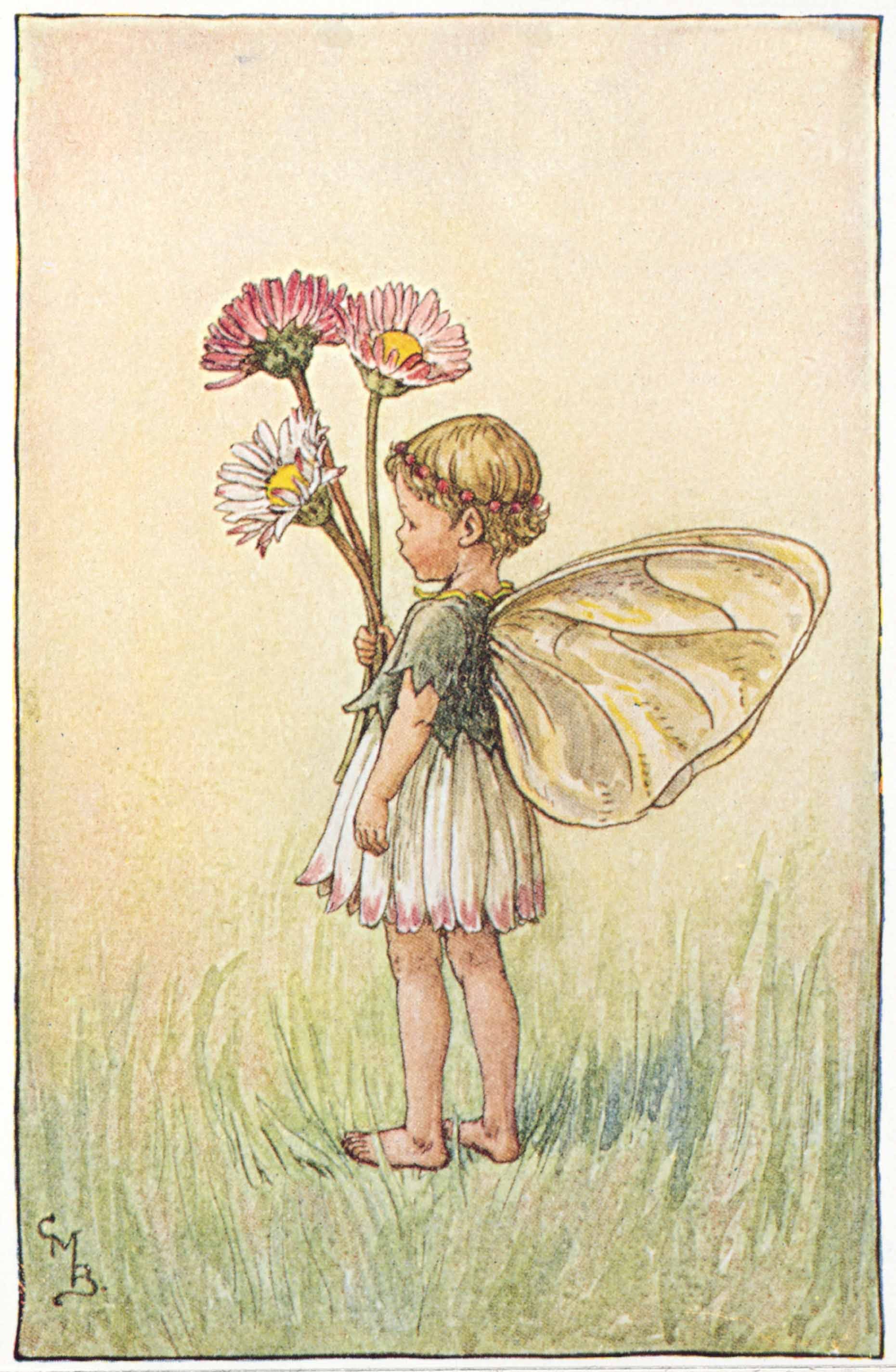
In the 1920s, Cicely Mary Barker became famous for her own depictions of flower fairies, and her illustrations launched a decades-long career. Her sister Dorothy was a teacher, and Barker used the children at the school as models for her work. In the innocence of her flower fairies, one can see the schoolchildren playing outside, taking in the splendor of flowers and trees and ponds. Arthur Conan Doyle was still alive when Barker’s first collection, Flower Fairies of the Spring, was published in 1923. By the time she passed away in 1973, the U.S. military was just several weeks away from leaving Vietnam.
We’ve started our journey, as I noted earlier, in familiar territory. Those who grew up watching Disney movies will no doubt recognize the little, winged fairies in classic films such as Peter Pan (1953) or Sleeping Beauty (1959). In next week’s entry, we’ll discover how this transformation occurred during the 19th century, and how the emerging flower fairy of Victorian middle- and upper-class childhoods collided with the unpredictable figure still known to rural communities.
Francis O’Gorman, “The dead,” The Cambridge Companion to Victorian Culture (Cambridge University Press, 2010), 263-264.
“Cottingley Fairies: How Sherlock Holmes’s creator was fooled by hoax,” BBC, December 4, 2020, https://www.bbc.com/news/uk-england-leeds-55187973.
Richard Sugg, Fairies: A Dangerous History (Reaktion Books, 2018), 225.
Sugg, Fairies, 224.
Sugg, Fairies, 206.
Oh, fun! I love this, and look forward to drifting back in time with you on this topic. The Crossroads Gazette and your Notes are some of the best parts of being on Substack for me. Have you read Photographing Fairies, by Steve Szilagyi? It was published in the early 90s. Not the best book I ever read, but inspired by the Cottingley fairy stories.