

Gustav Klimt's Sunflowers
Gustav Klimt is best known for his sumptuous portraits of Vienna's bourgeoisie. However, his contributions to floral painting shouldn't be overlooked.

This essay is part of the series Flowers in Art.
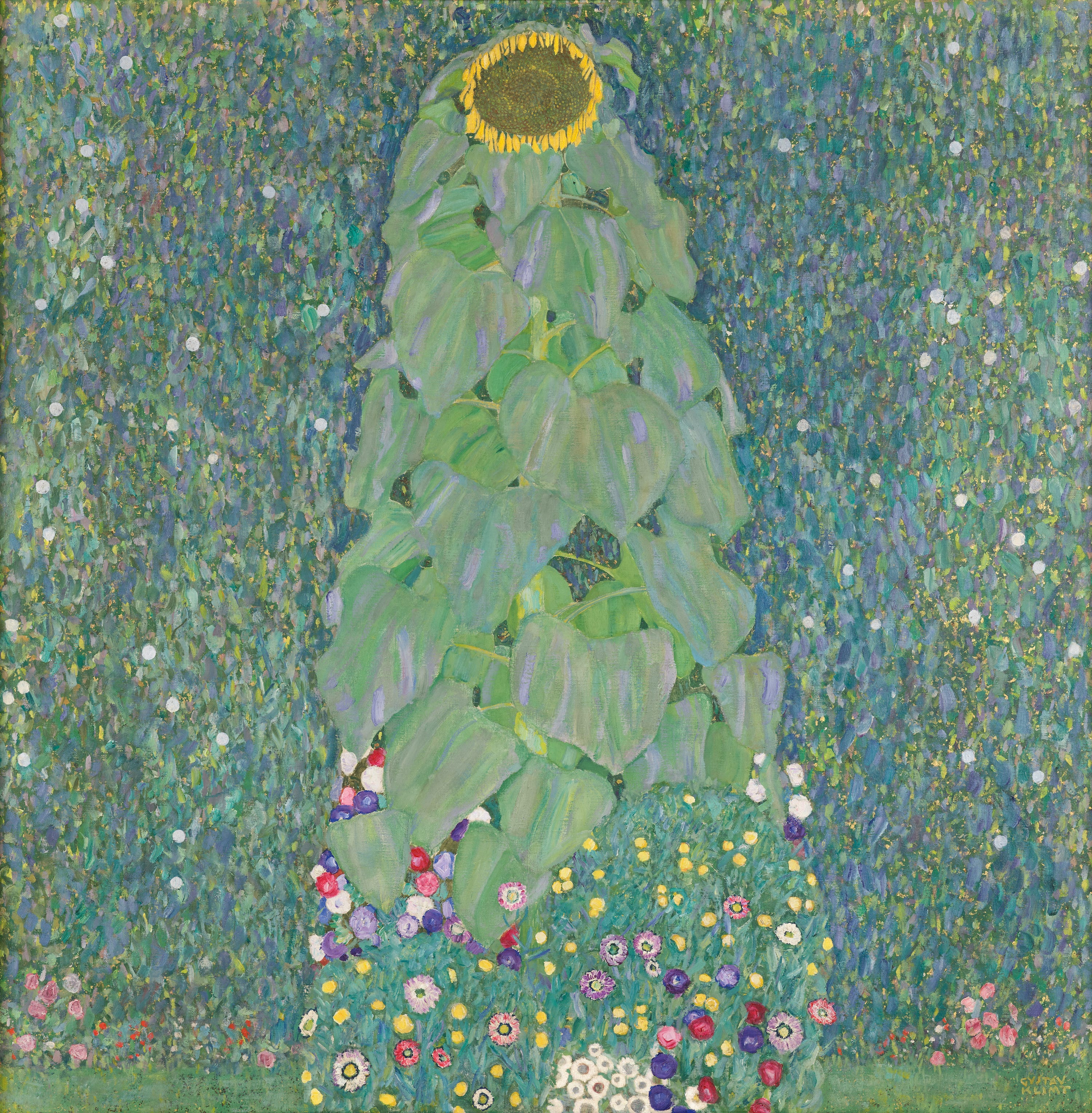
One tall sunflower stands against a hedge. Its head looks down at its cascade of leaves, which end in a flurry of delicate wildflowers along its roots.
One would be forgiven, standing far enough away (or in my case, without glasses), for thinking it was a woman—glancing bashfully at her scalloped gown and richly-embroidered hem. Gustav Klimt painted many beautiful outdoor scenes toward the end of his life, including an earlier image featuring several sunflowers (Farm Garden with Sunflowers, below). But what makes his Sunflower (1907-1908) unique is its composition. It is a layout typically reserved for his beloved portraits of Vienna’s bourgeois women in their resplendent gowns.
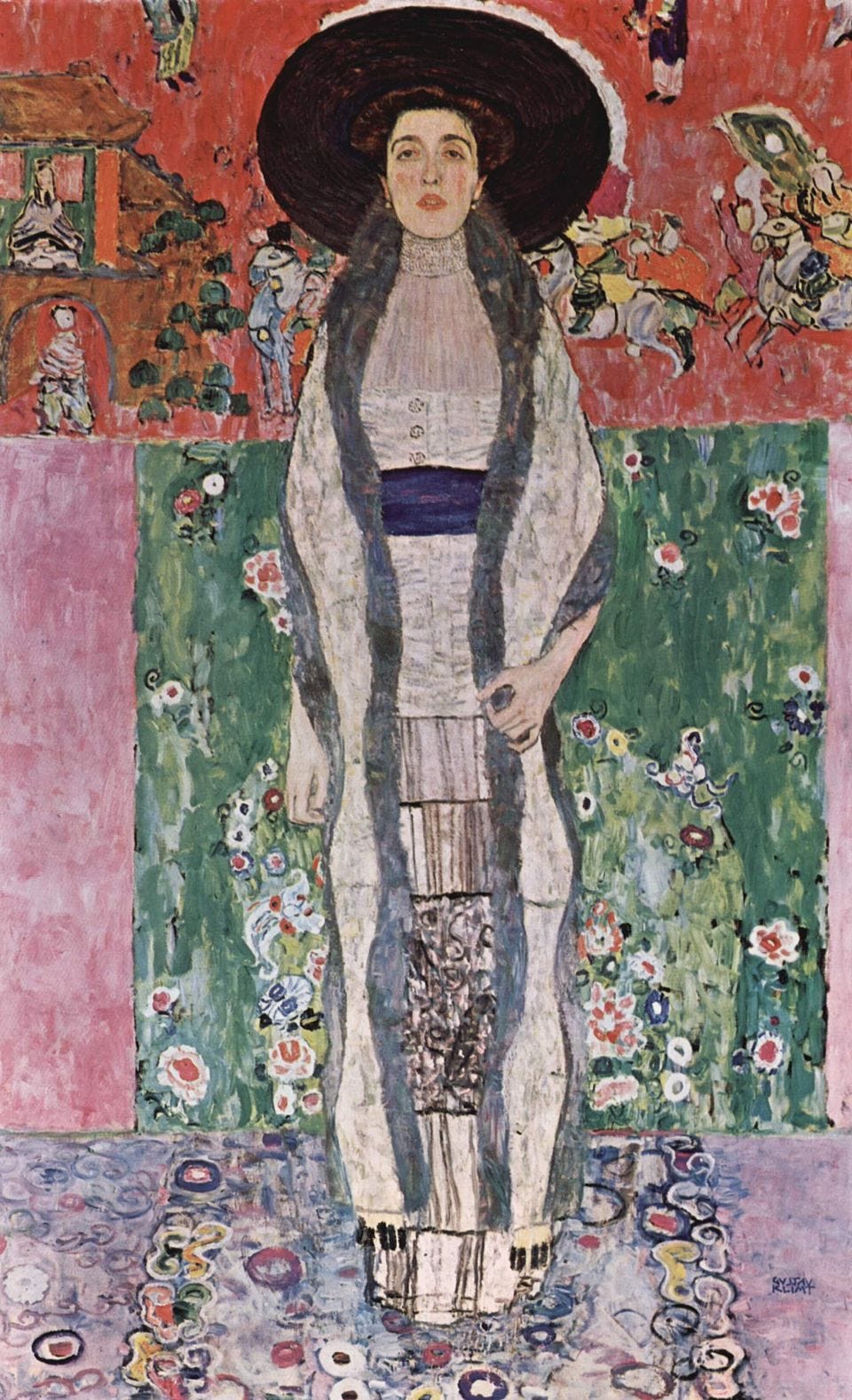
In his later years, Klimt moved away from the use of gold leaf that we associate with his most famous paintings, including The Kiss (1907-1908) and Portrait of Adele Bloch-Bauer I (1907). Though painted in the same year, Sunflower offers us a preview of what those post-Golden Phase works would be like: the absence of gold leaf, greater interest in nature, and a looser style of painting. Compare his first Portrait of Adele to his second (below), and the contrast is stark.

From the year 1900 to 1916, Klimt spent his summers in Attersee, a picturesque lake in Upper Austria that became a popular holiday destination at the turn of the century. The artist would begin his works en plein air and often finish them later in his studio in Vienna. These works, as art critic Eva di Stefano notes, “effect a sort of indefinite suspension of time.”1 There are no people or signs of animal life, and the compositions often include expansive backgrounds or foregrounds that swallow the canvas.
Like Vincent van Gogh, whose Irises we explored in last week’s essay, Klimt was very interested in Japanese art. In a letter to Marie “Mizzi” Zimmermann, with whom he shared an illegitimate child, Klimt wrote of his process:
In the morning, I get up early, around six. If the weather is nice, I go into the woods near here and paint a small beechwood in the sun interspersed with firs. I carry on this way until eight, time for breakfast, then I go to the lake where I have a swim, with all due caution, and paint a little bit more: a view of the lake if there is sun, a landscape seen from my room if the sky is overcast; some mornings I do not paint, and study my Japanese books in the open, instead. Then it is noon. After eating, a nap and some reading until it is time for a snack, before or after which I have another swim in the lake, not always, but fairly frequently. After the snack, I continue painting, a great poplar at twilight, while a storm is on its way.2
(I, too, understand the great importance of snacks.)
One can see from the above letter that the artist had grown more set in his ways—or perhaps a more generous description is that he had developed a process that worked well for him. He was a great lover of outdoor sports, and when he wasn’t painting (or eating), he was swimming, rowing, or riding his motorboat, a new technology of which he was an enthusiastic adopter.3
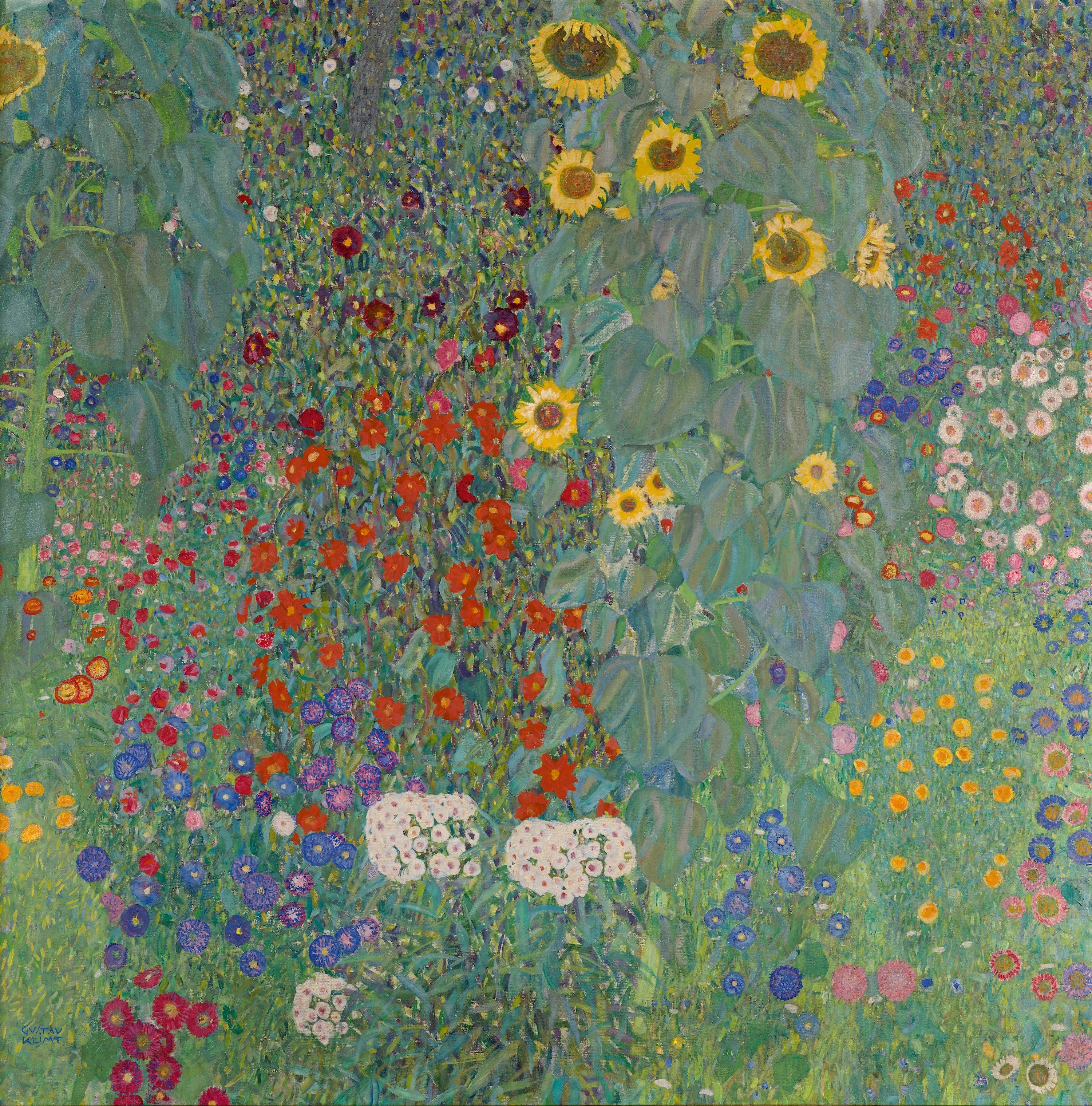
Klimt also found inspiration in the Impressionists and Post-Impressionists. In the year 1907, when Sunflower was painted, he attended an exhibition of Vincent van Gogh’s work in Vienna; Klimt had also seen Van Gogh’s art several years before at the Vienna Secession’s Sixteenth Exhibition in 1903.4 Though it usually took Klimt years to synthesize various influences in his art, it’s possible that he derived inspiration from Van Gogh even in these earlier floral paintings. Van Gogh, of course, has his own famous series of sunflowers.
Portraiture endured as a major feature of Klimt’s body of work. Sunflower sits at the intersection of his portraits and landscapes; the central flower in the painting possesses an anthropomorphic quality and displays the towering aura of many of his female subjects. Upon noticing this, I found myself going back through his other landscapes, and while the trees and flowers aren’t as blatantly human-like, they do seem to have greater personality than one typically finds in landscapes of the period. I’m reminded of the flower garden in Lewis Carroll’s Through the Looking-Glass—I half expect the sunflower to lift its head and start speaking to me.
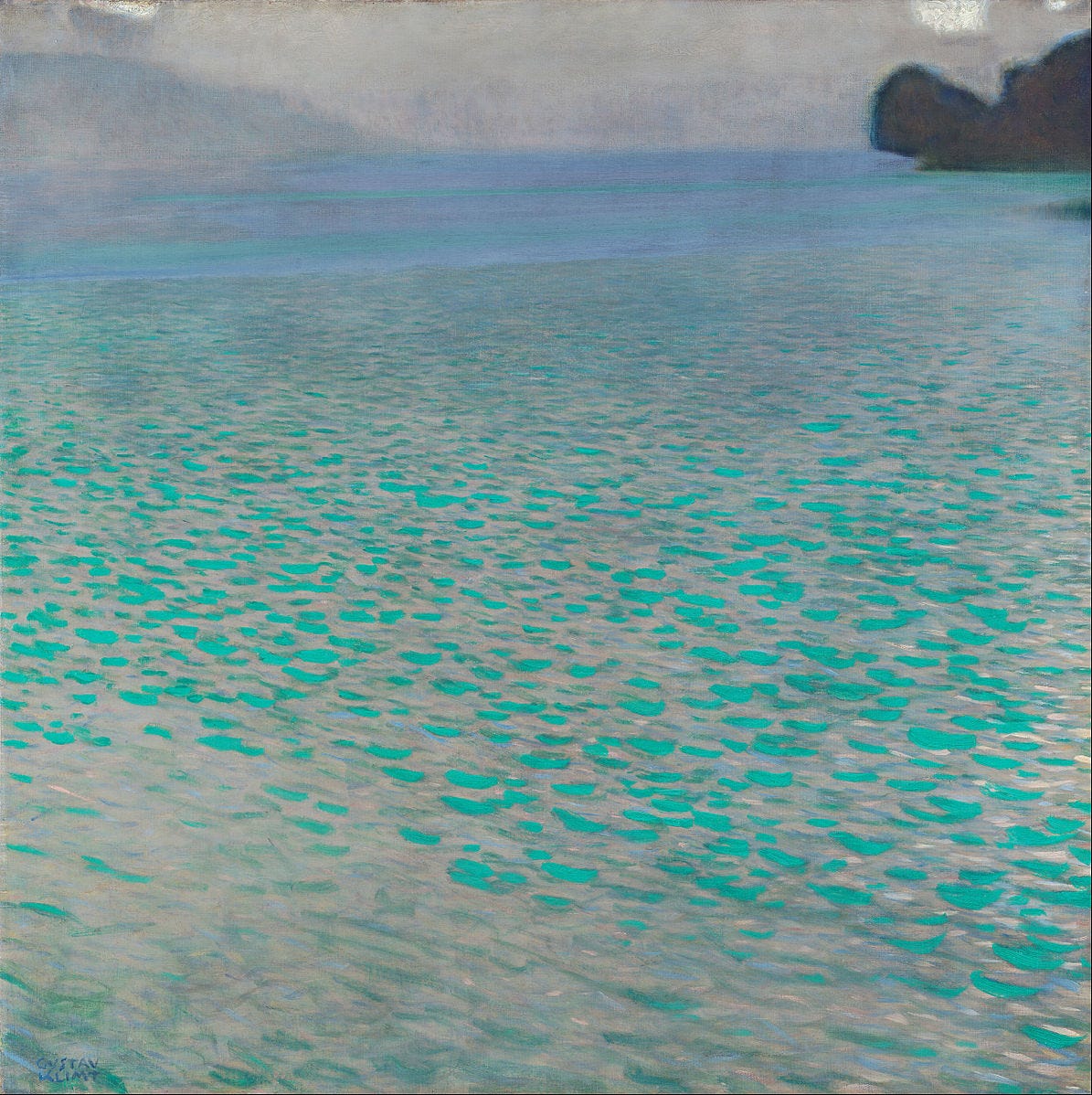

The sense of peace in these later works is interesting when one considers their wider context. Europe’s geopolitical stability was hanging by a thread, and every summer, Klimt retreated to Attersee. The Great War arrived in 1914, and still, Klimt retreated to Attersee. The “indefinite suspension of time” observed by Eva di Stefano seems more poignant given that backdrop. Gazing at Klimt’s flowers, or the heavenly blue of the lake, one would never know that the outside world was falling apart.
Klimt would not live to see the transformation of the art world after World War I. He died on February 6th, 1918, leaving him squarely in Stefan Zweig’s “world of yesterday.” In his fifties, Klimt was too old to have been drafted in the war, unlike several leading artists of the period, including Egon Schiele and Oskar Kokoschka. It’s hard to imagine Klimt reckoning with Cubism, Abstract Expressionism, and the like. Would he have lamented the end of the Secession Movement, as Claude Monet mourned the end of Impressionism?
Perhaps not—in the final months of his life, Klimt’s work began to evolve again, with compositions that placed greater emphasis on geometric structures (such as in The Bride, one of his final paintings that remains unfinished). In the end, we’ll never know.
Though he’ll always be best known for his portraits, one shouldn’t overlook Klimt’s landscapes. His ability to render flowers and trees with outsized personality make works like Sunflower distinctive contributions to the genre of floral painting—one that will grow stranger as we venture into the 20th century.
Eva di Stefano, Gustav Klimt: Art Nouveau Visionary, translated by Stephen Jackson (Sterling, 2008), 158.
Di Stefano, Gustav Klimt, 170.
Peter Vergo, Art in Vienna 1898-1918: Klimt, Kokoschka, Schiele and their Contemporaries, fourth edition (Phaidon Press, 2015), 255.
Vergo, Art in Vienna, 261.