

How a Volcano Gave Us the Bicycle
From the invention of the "running machine," to the birth of meteorology, let's examine a few bright spots that appeared after Tambora's tragic eruption.

This essay is part of the series The Year Without a Summer.

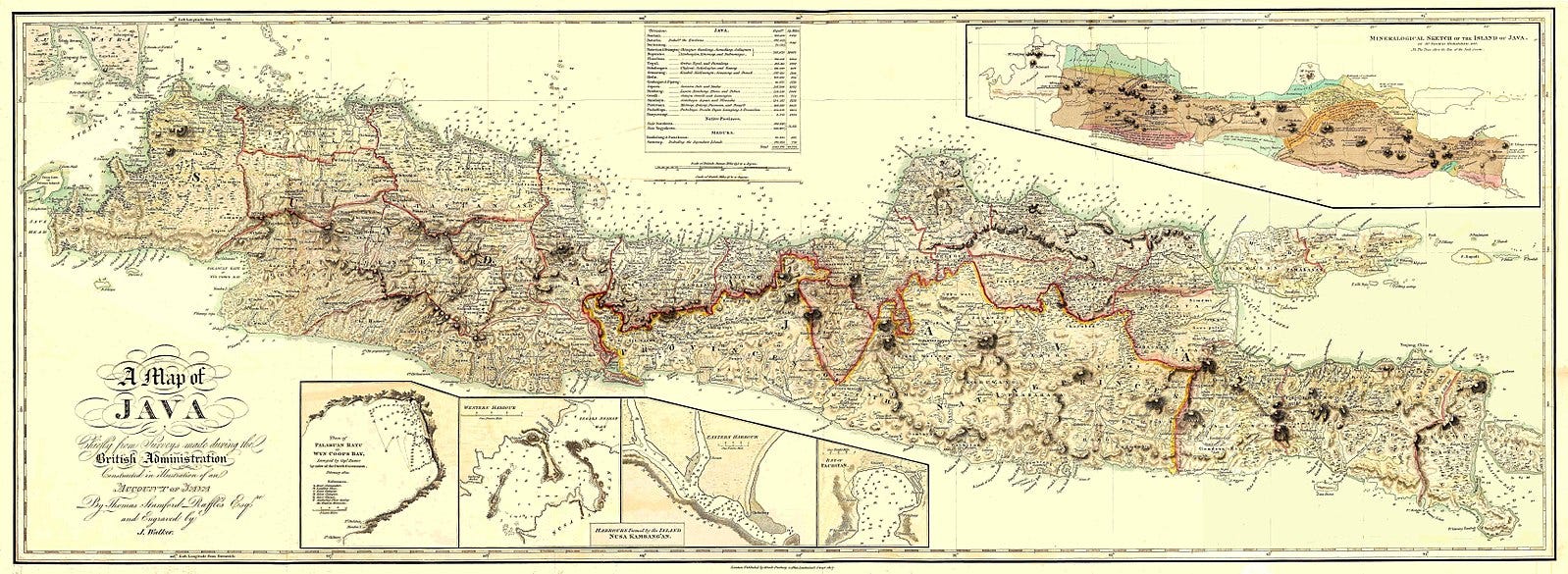
Only one person in history has left a paper trail of both the eruption of Mount Tambora in 1815 and Europe’s Year Without a Summer.
Readers may recall Stamford Raffles, governor of the British colony of Java and author of History of Java (1817). Raffles’s account of Tambora is shockingly brief given the magnitude of the disaster: a mere footnote after an essay on Java’s “Mineralogical Constitution.” This makes more sense when one considers that Raffles was lobbying for expanded colonization of Southeast Asia, particularly to compete against the Dutch East India Company. Offering gory details of a volcanic eruption on an island just 200 miles away could prompt his audience to ask pesky questions. Are there other active volcanos in the region? Could the same event happen again?
Throughout his life, Raffles pursued his goal of colonizing more land in the region for the British Empire, including establishing the colony of Singapore in 1819. But in 1816, he was compelled to return to England to explain Java’s poor financial management. When he wasn’t fighting allegations of fraud, he was doing what many young, rich men of the era did to pass the summer—traveling the European continent.
In previous eras, the Grand Tour was a rite of passage for upperclass men when they came of age. Raffles’s early twenties coincided with the Napoleonic Wars, making the Grand Tour difficult, if not impossible. Now turning thirty-five, Raffles and his peers could once again explore the countries of Europe in the fair weather of summer.
Except, as we know, the summer of 1816 was a season unlike any Raffles had witnessed.
Raffles was accompanied by his brother Thomas, who wrote of their experiences in his journal. He noted that the villages of France were overwhelmingly deserted:
We could not but notice the almost total absence of life and activity… There was an air of gloom and desertion pervading them. The houses had a cheerless and neglected appearance. No one was seen in the streets—they looked as if deserted by their population.1

In the years 1816 and 1817, crop yields in Western Europe and the British Isles dropped by 75%. We investigated the ramifications of agricultural failure in Europe and in Asia in my previous essays; for today’s entry, I’d like to explore a few glimmers of hope.
One effect of the Year Without a Summer is that communities began to take food preservation far more seriously. Canning was invented by Nicolas Appert, a French confectioner. He started experimenting with food preservation techniques in 1795 in response to an ad from the French army, who would award 12,000 francs to anyone who could invent a method of preservation more reliable than drying, fermenting, or pickling.
Appert worked on his inventions for the next decade, opening a bottling factory in 1804 and finally perfecting his canning technique in 1810. He was awarded the 12,000 francs on the condition that he published his canning process for the benefit of the public. Though canning took a few years to become widespread, it grew more popular after the horrors of 1816. Now, peasants could safely store part of their harvest for the winter, or for leaner years. August’s tomatoes could be saved and enjoyed in January.
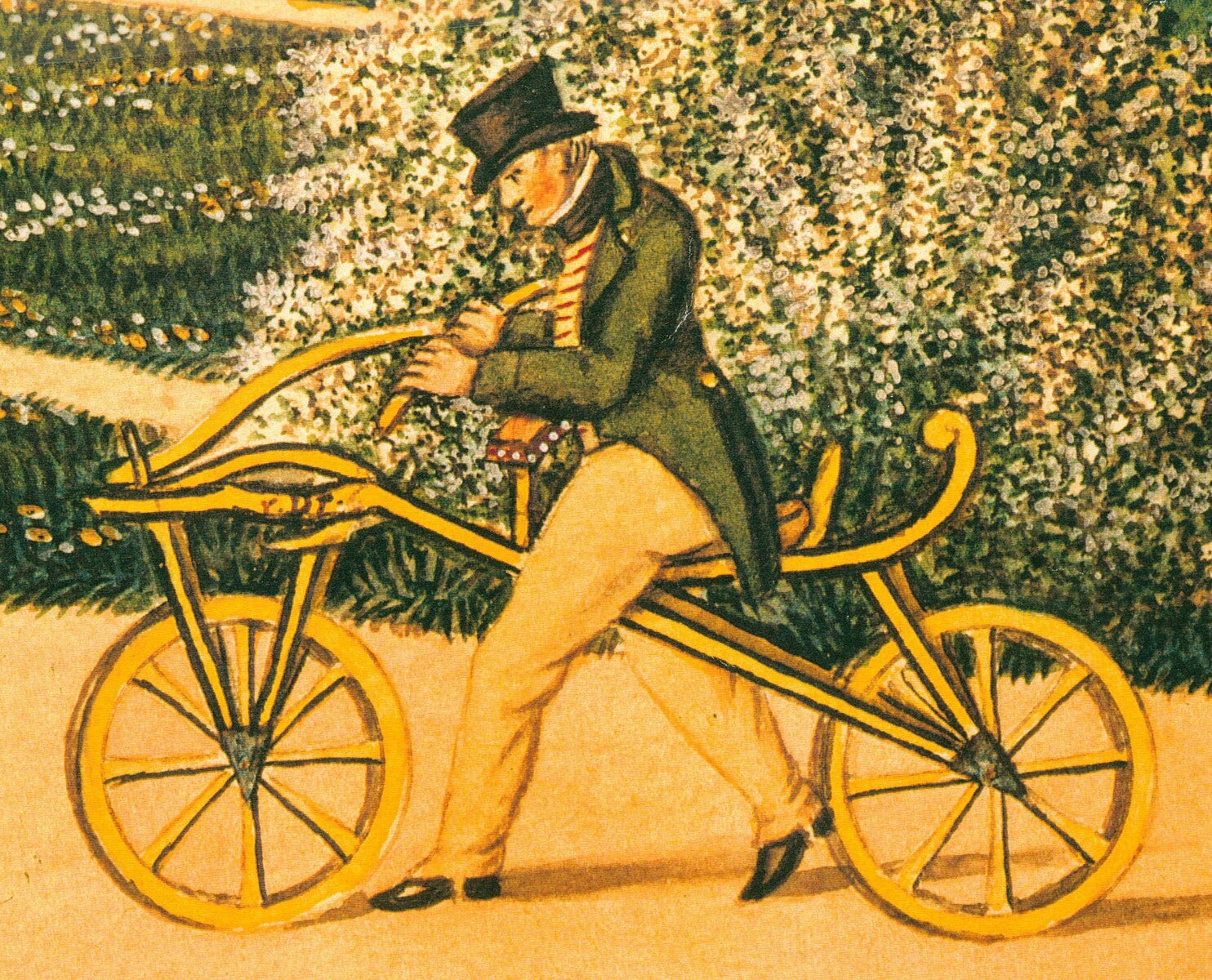
Another key innovation was Baron Karl von Drais’s Laufsmachine or “running machine,” the precursor to the bicycle.
Drais was a German aristocrat-turned-republican activist, mathematician, and inventor who was living in Mannheim during the Year Without a Summer. Mannheim faced terrible flooding from the Rhine. Not only did thousands die of starvation, but livestock perished as well. Cows and horses were slaughtered for food or died due to the lack of available grains.


Drais was eager to create a machine that could replace horses. (Keep in mind that horses were still the main method of transportation, not to mention essential for plowing fields.) Drais also recognized of the potential use for his machine in war:
In wartime, when horses and their fodder often become scarce, a small fleet of such wagons at each corps could be important, especially for dispatches over short distances and for carrying the wounded.2
The Laufsmachine was an instant success. Debuting in 1817, the “running machine” inspired copies in Britain and the United States. Was it a perfect machine? Of course not. Drais’s invention lacked pedals or gears, which gave riders less control. Safety concerns led to bans in some cities. However, the Laufsmachine was an essential step toward the development of the bicycle in the 1860s, and prompted other inventors to dream up other methods of personal transportation that did not involve horses.
Finally, we can’t discuss the Year Without a Summer without mentioning the birth of meteorology as a scientific discipline. Prior to Tambora, weather was studied locally, but the 1816 climate emergency prompted some scientists to evaluate climatic trends across the continent.
One example was Luke Howard, an English Quaker who introduced cloud classifications we still use today (nimbus, cumulus, etc.) in his Essay on the Modification of Clouds (1803). He also founded Britain’s first professional almanac on weather conditions; during the 1816-1818 period, his almanac The Climate of London recorded for posterity the extreme weather conditions witnessed throughout the country. But he began to make broader connections when he spent the summer traveling throughout the continent:
From Amsterdam to Geneva, I had ample occasion to witness the fact that the excessive rains of this summer were not confined to our own islands, but took place over a great part of the continent of Europe. From the sources of the Rhine among the Alps, to its embouchure in the German ocean, and through a space twice or thrice as broad from east to west, the whole season presented a series of storms and inundations.3
This prompted a shift in his writing for The Climate of London. Instead of restricting his reporting to Britain, he began tracking news of climate and weather phenomena throughout Europe.
Simultaneously, the German polymath Heinrich Brandes concluded that scientists should be studying broader trends in climate in order to better predict catastrophes like the Year Without a Summer. In December 1816, he argued:
…more precise reports of the weather, even if only for the whole of Europe, would surely yield instructive results. If one could draw maps of Europe according to the weather for all 365 days of the year, then it would show, for instance, where the boundary of the great rain-bearing clouds, which in July covered the whole of Germany and France, lay.4
Brandes put his idea into motion by designing and compiling the first weather maps. Between Brandes and Howard, the discipline of meteorology was born.
Of course, these developments and inventions came too late for the hungry masses. Those who had even the slightest of means to leave Europe (but not enough wealth to stay) took flight for the New World. It is that wave migration, and the expansion of the American frontier, that we will explore in the final entry of this series.
Gillen D’Arcy Wood, Tambora: The Eruption That Changed the World (Princeton University Press, 2014), 62-63.
Chris Townsend, “Year Without a Summer,” The Paris Review online, October 25, 2016, https://www.theparisreview.org/blog/2016/10/25/year-without-summer/.
Wood, Tambora, 56-57.
Wood, Tambora, 59.