

How Manet Became an Artist
In the first essay of the series "The Life of Édouard Manet," we learn how Manet finally embraced his passion for painting.

This essay is the first in the series The Life of Édouard Manet.
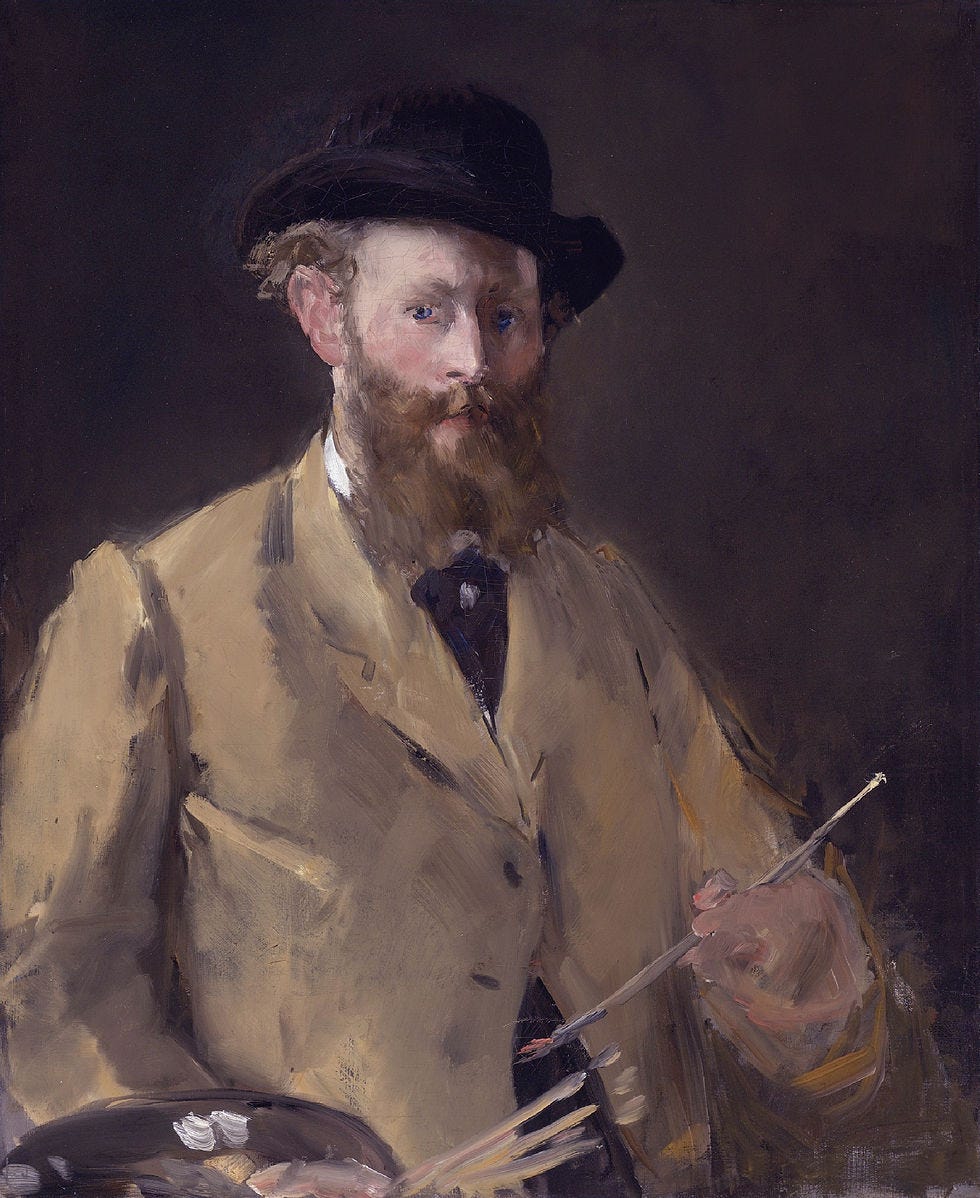

Once again, Édouard had failed the entrance exam. He would not become a naval officer.
Auguste Manet didn’t know what to do with his eldest son. He thought his plan was sensible: Édouard should study law at the University of Paris, as he had years before, and his own father had done before him. Alas, Édouard was not academically-inclined. He cared little for school—he even had to repeat the fifth grade.1
Auguste landed on another idea: the navy. Becoming a military officer was a respectable choice for an upper-class man, and with this in mind, Auguste sent Édouard on a training vessel to Brazil when the boy was sixteen. Two years later, what did he have to show for it?
Much to Auguste’s dismay, there was only one thing that his son wished to do.
Édouard Manet was born in Paris in 1832. His parents were among the landed gentry—wealthy families who had owned country estates for generations, though they technically didn’t hold aristocratic titles. There existed a set of professions that were permissible for men of this class to pursue: the military, civil service, politics.
Auguste himself was a judge and a chevalier of the Legion of Honor. He kept his moderate republican beliefs to himself, for to take a public stance against monarchy would cost him his career in the Ministry of Justice. Otherwise, he dressed soberly, behaved properly, and managed the family investments. He also married the right kind of woman: Eugénie-Désirée Fournier, a goddaughter of the king of Sweden.
Some professions were simply beyond the pale for people like them. The fact that their son Édouard, a boy of impeccable breeding, would dream of being an artist was all too much.
Artists were bohemians. Eccentrics. Not respectable.
But Édouard had returned home, and the family reached a turning point. The boy was eighteen. He wouldn’t be a judge, and he couldn’t be a naval officer. All he wanted was to create art.
Finally, Auguste relented.
Several weeks ago, I shared an essay in which I contrasted Rosa Bonheur’s Realist masterpiece The Horse Fair (1852-55) with Edgar Degas’s Impressionist take on the horse races. In it, I explored the two artistic movements that stood on either side of the border of modernity. Both embraced ordinary people and contemporary life as valid subject matter for artists, though the style and techniques used by each movement belonged to different worlds. No artist better represents this transition than Édouard Manet.
Those who followed my series on the Impressionists may also recall an essay I wrote as an introduction to Manet. In this series, we will be expanding upon this subject to explore Manet’s life in greater detail—his triumphs, failures, and his complex relationship with the artistic establishment.
When Manet began his studies, the establishment was, of course, the École des Beaux-Arts and its Salon, where the artists of Paris vied to display their work. Art was a top-down affair, in which the tastes of an elite governing body held enormous power over artists’ careers. In many ways, Manet’s upbringing positioned him to be a product of that establishment. He came from a family of wealthy landowners. His father worked for the Ministry of Justice. Official accolades and titles were the cornerstones of Manet’s world.

During Manet’s youth, the ultimate rivalry at the top of the art world was between the academic artist Jean-Auguste-Dominique Ingres and the Romantic artist Eugène Delacroix, who was a consistent exhibitor at the Salon despite the jury’s initial suspicion towards Romanticism. (Delacroix played a major role in forcing the jury to overcome their objections.) Manet’s instructor, Thomas Couture, would not ally himself with either the Delacroix or Ingres camp, though his careful draughtsmanship and traditional subject matter put him squarely in the realm of academic art. As the American painter Ernest W. Longfellow observed:
…his faults were a certain dryness of execution…and a want of unity in his larger compositions, arising in part from his habit of studying each figure separately, and in part from a lack of feeling for the just relation of values.2
Couture’s style as a teacher was less strict than the École, which was why Manet decided to join his studio in the first place. (Henri Fantin-Latour was another prominent student of Couture.) But Manet discovered that Couture was still quite traditional; after six years of study, Manet decided to open his own studio. It is at this point that Manet began experimenting in earnest with Realism, the controversial movement fighting for its place in the competitive world of French art.
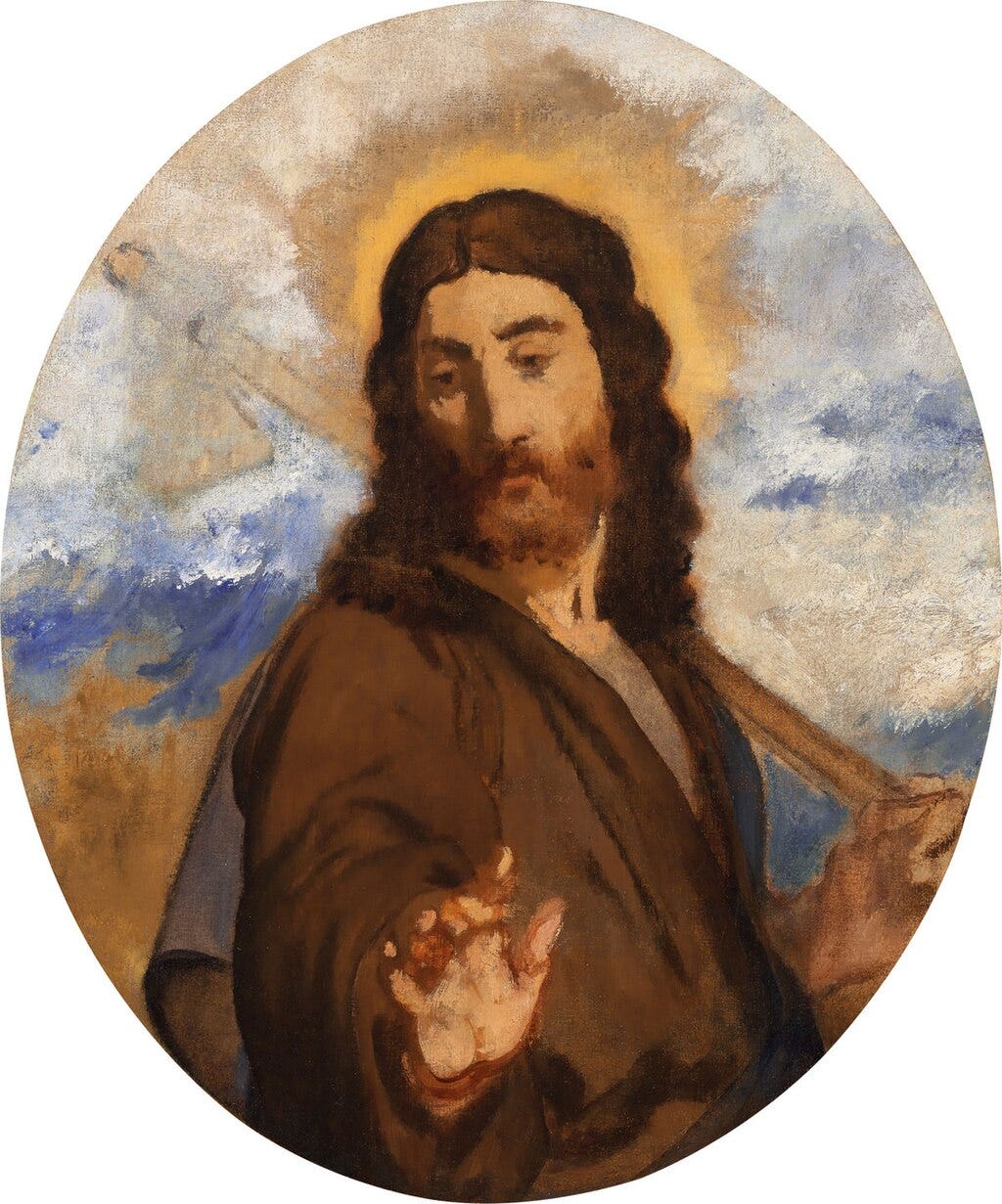
Unfortunately, few of Manet’s earliest works survive. But even in the above Christ as a Gardener, painted shortly after leaving Couture’s studio, we get a sense of Manet’s sensibilities. By choosing to depict Jesus Christ as a humble gardener, Manet rejects the grandiosity of the history paintings of his era, and instead delivers a scene that makes Jesus familiar to the viewer. There’s a real intimacy to this early portrait—and as we’ll discover next week, it is a thread that winds throughout his entire career.
Beth Archer Brombert, Edouard Manet: Rebel in a Frock Coat (University of Chicago Press, 1997), 8.
John Rewald, The History of Impressionism: Fourth, Revised Edition (Museum of Modern Art, 1973), 24.