

It's Never Too Late to Start
Julia Margaret Cameron (1815-1879) was 48 years old when she was given her first camera as a Christmas present. Today, she is known as one of the defining artists of early photography.

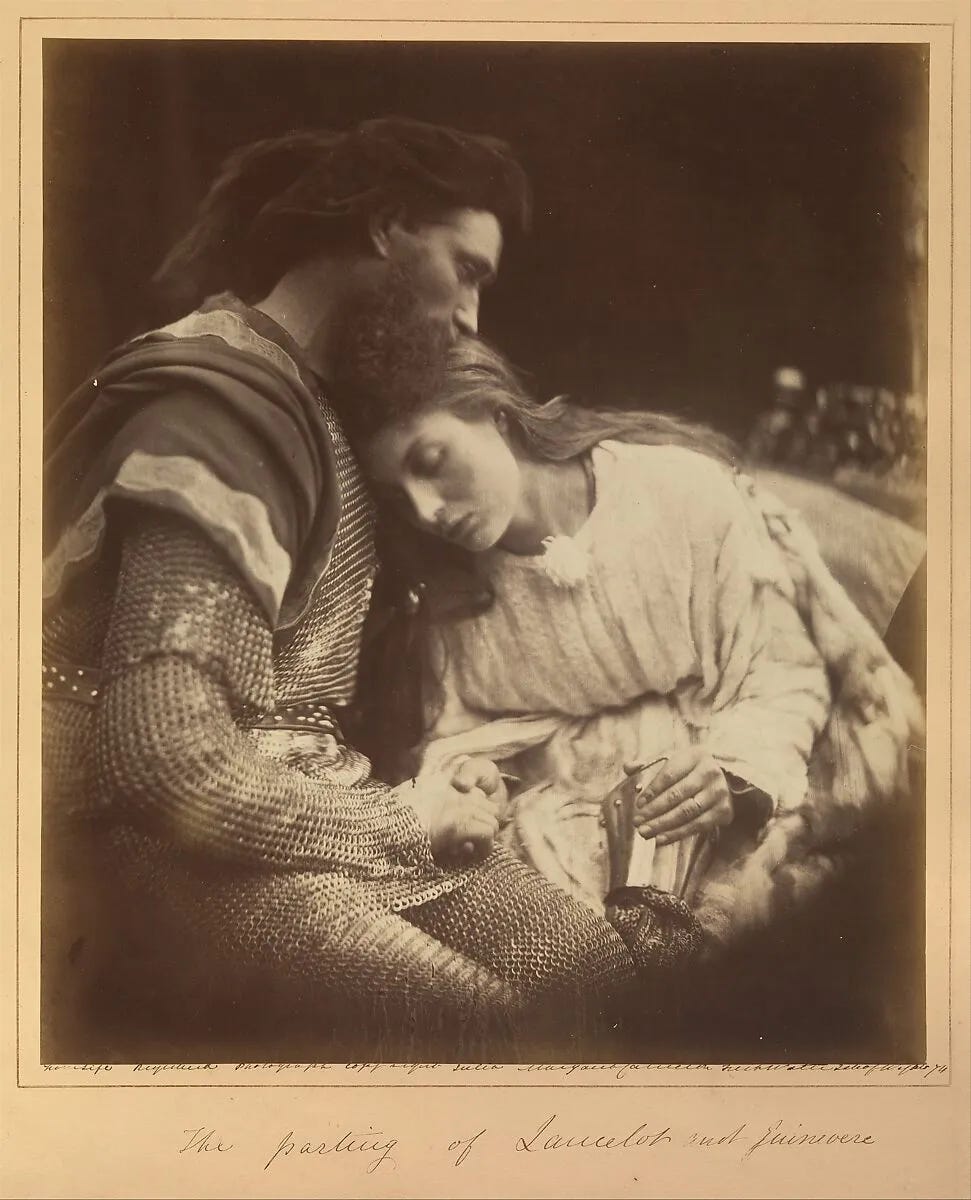
I first came across the above photograph when I was writing the essay, “The Real St. Valentine.” In it, I explored how Valentine’s Day became associated with romance during the late medieval period, and I was looking for artworks depicting chivalric romances to accompany the piece. This 150-year-old photograph, The Parting of Lancelot and Guinevere by Julia Margaret Cameron (1874), immediately stood out to me, as did the story that accompanied it on the Metropolitan Museum’s website:
In 1874 Tennyson asked Cameron to make photographic illustrations for a new edition of his Idylls of the King, a recasting of the Arthurian legends. Responding that both knew that ‘it is immortality to me to be bound up with you,’ Cameron willingly accepted the assignment. Costuming family and friends, she made some 245 exposures to arrive at the handful she wanted for the book. Ultimately—and predictably—she was unhappy with the way her photographs looked reduced in scale and translated into wood engravings, and she chose to issue a deluxe edition, at her own risk, that included a dozen full size photographic prints in each of two volumes.
I was intrigued. Who was this woman, whom Lord Tennyson trusted to produce these photographic illustrations? I loved the fairytale quality of the scene, and I found there to be something modern in how the subjects were posed—not to mention, the photo’s extraordinary depth of emotion.
I quickly began looking through Julia Margaret Cameron’s work, and the images I found likewise possessed that modern, ahead-of-their-time quality. Had I not known the photographer was a Victorian woman, I might have wondered if the image below (Zoe, Maid of Athens ca. 1866) was from the 1950s or 60s, intentionally aged to appear Victorian, rather than the real thing.
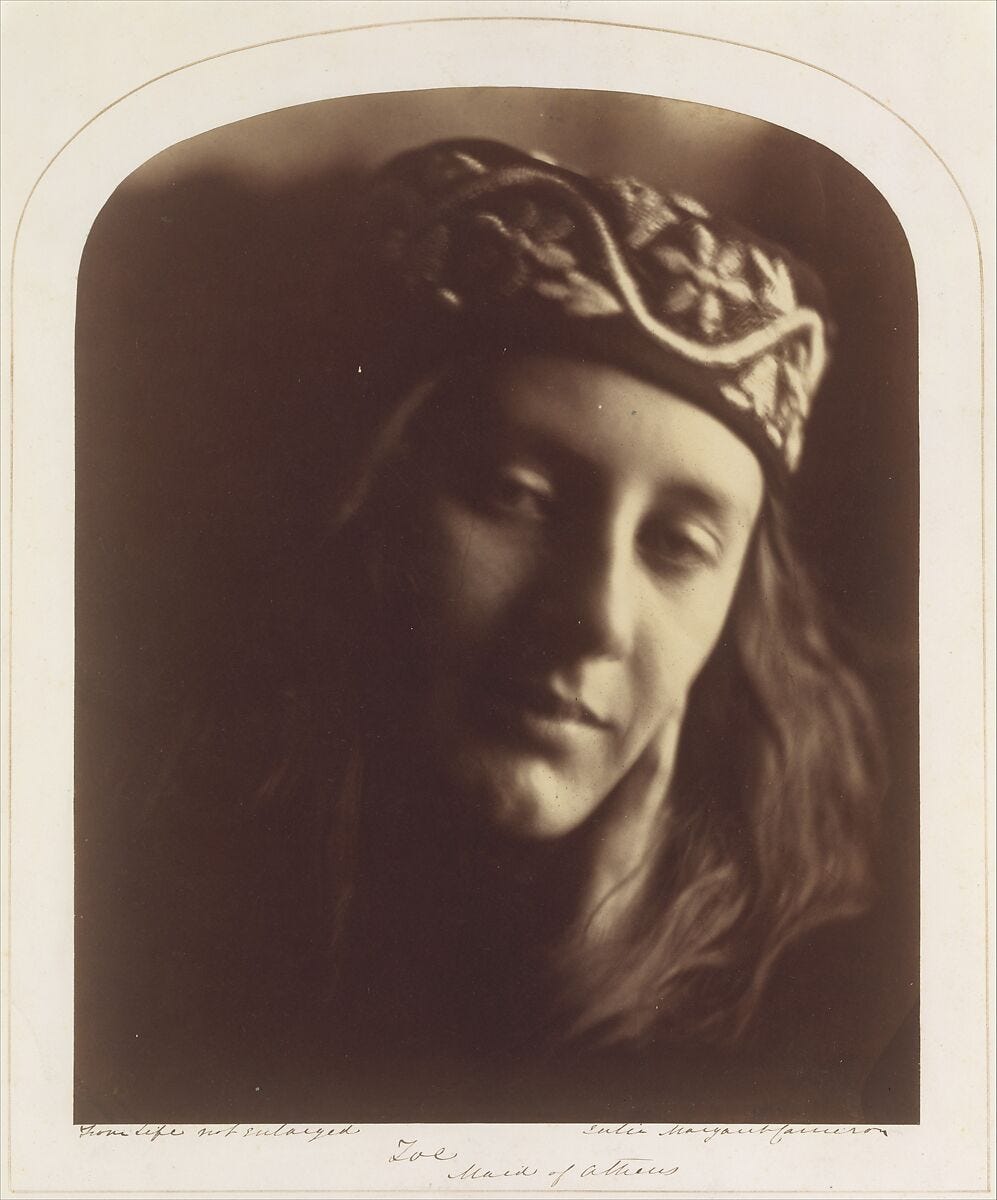
The truth is that Julia Margaret Cameron was wildly ahead of her time, as her photos often incorporated literary and biblical themes and played with movement. Rather than simply showing the world as it was, Cameron used the medium of photography to tell stories in ways that were unprecedented for the period. What makes her story even more compelling is that she received her first camera as a present when she was 48 years old.
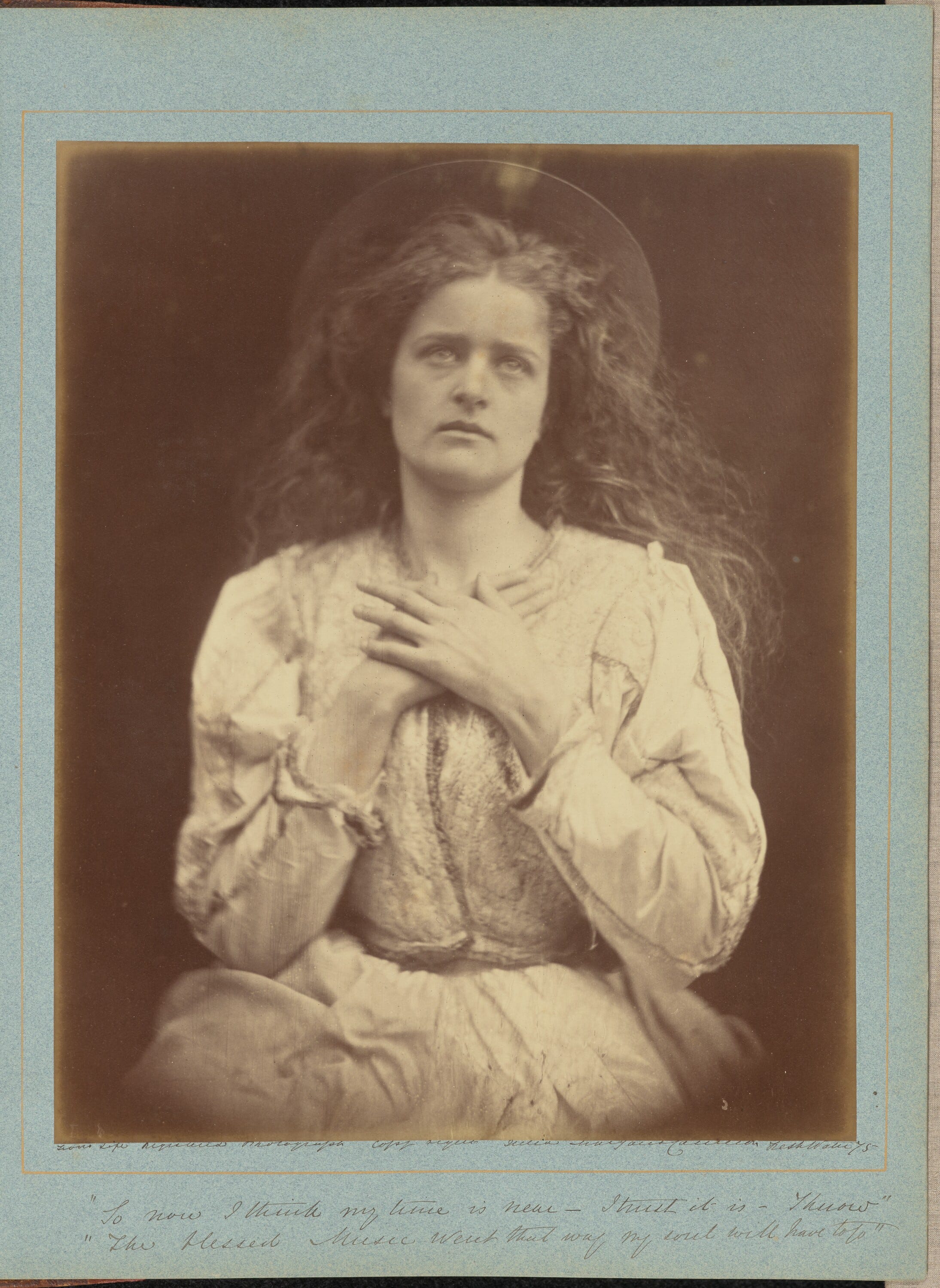
Our culture fixates heavily on youth, especially in the arts. While I do think this is changing, it’s always important to remind people that life (God willing) is long, and your passions and interests aren’t set in stone the moment you hit thirty. Sometimes, the best discoveries happen later in life.
Julia Margaret Cameron was born in 1815 in Kolkata (formerly Calcutta), India to a wealthy family. Her father was an official of the East India Company and her mother was a French aristocrat. Her husband, Charles Hay Cameron, was an English jurist and member of the Council of India who invested heavily in the coffee industry in Ceylon (now Sri Lanka). It must be acknowledged that Julia Cameron’s family money was significantly tied up in the British colonization of India and Southeast Asia. I point this out not because I expect people who lived 200 years ago to have the same standards and morals that we do today, but because like Cameron’s photographs, history unfurls not in black-and-white, but in shades of gray. By only including the good or the bad, one misses the full picture.
Due to her family’s status in British society, Cameron and her husband were friends with many leading Victorian thinkers and artists, including Charles Darwin, Thomas Carlyle, and the poets Henry Taylor, Henry Wadsworth Longfellow, and Alfred, Lord Tennyson. And because her husband would occasionally travel to Sri Lanka after they moved back to England in 1845, Cameron experienced periods of solitude that would prove creatively stimulating.
One such occasion occurred in December of 1863; knowing that Mr. Cameron would be away, Mrs. Cameron’s daughter and son-in-law gave her a camera as a Christmas present, along with the note, “It may amuse you, Mother, to try to photograph during your solitude at Freshwater.” (Freshwater was the village where Cameron lived on the Isle of Wight.)
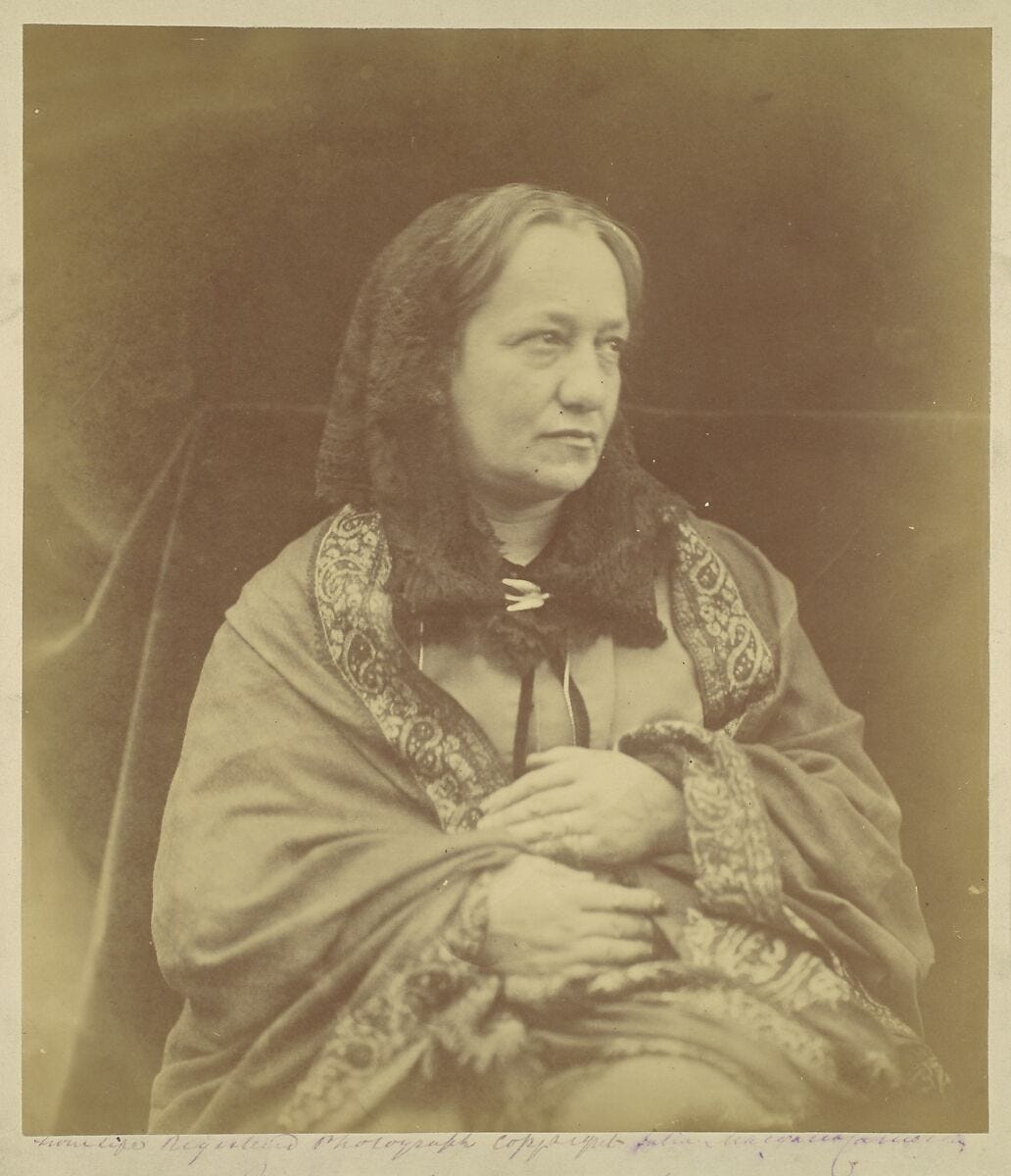
In many ways, Cameron was an unlikely candidate to become a giant among Victorian photographers—up until the age of 48, she had not expressed prior interest in the visual arts. But she was deeply connected in intellectual circles, along with being a devoted mother to her six children. When she received the gift of her first camera, she took to the art form passionately, and her lack of formal artistic training gave her a unique perspective that allowed her to break the norms of photography that preceded her.
While she photographed many notable portraits of famous Victorians (including a portrait of Charles Darwin you may recognize—see below), her deep devotion to her Christian faith and her literary friends inspired her to create vivid scenes rich in symbolism and story. Rather than running a formal studio with a commission-based business, Cameron mostly photographed friends, family, and household staff. As Linda M. Shires notes in her essay “Glass House Visionary: Julia Margaret Cameron Among the Writers” (The Princeton Review Library Chronicle):
We can consider ourselves lucky that Julia simply served bacon and eggs three times a day to free her cook and maid for camera modeling and that she put Oxbridge first-time visitors to work “carrying footpans full of photographs across the garden in the moonlight,” instead of entertaining them with port.
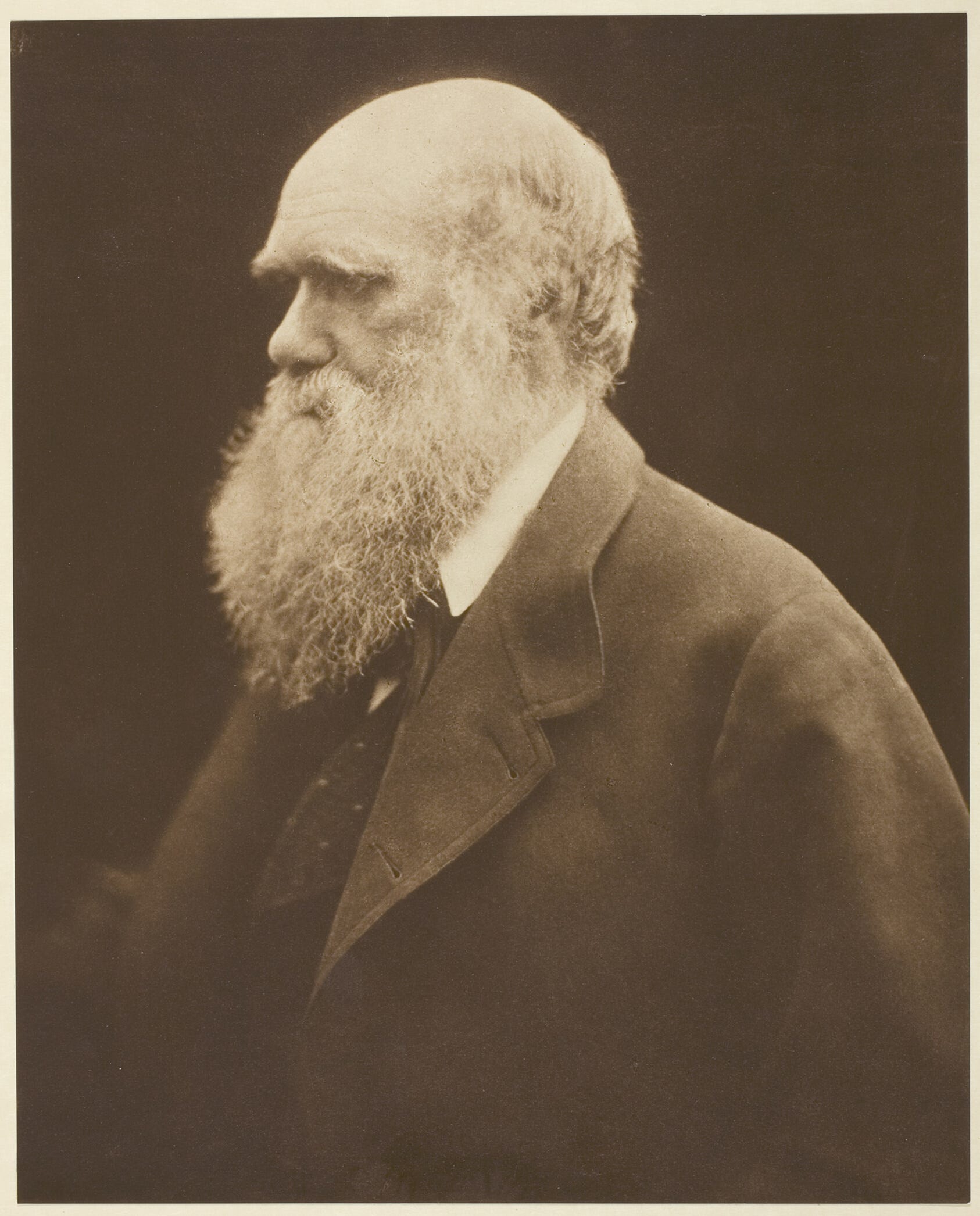
As with many visionaries, her photographs received mixed reviews. When Cameron rose in prominence, the dominant school of thought regarding photography was that “good” photos needed to be crisp, well-lit, and precise. Interestingly, while she was rejected by the photographic establishment, who often critiqued the lack of technical precision in her photos, her work was beloved by artists and poets of the age, who saw the merit of storytelling and the purpose behind the “imperfections” in her images.
For example, the Illustrated London News described her work as “the nearest approach to art, or rather the most bold and successful applications of the principles of fine-art to photography.”
But the Photographic Journal countered, “Slovenly manipulation may serve to cover want of precision in intention, but such a lack and such a mode of masking it are unworthy of commendation.”
As fellow photographer Hermann Wilhelm Vogel reported when Cameron won the gold medal of a major photography competition in Berlin,
Those large unsharp heads, spotty backgrounds, and deep opaque shadows looked more like bungling pupils’ work than masterpieces… But, little as these pictures moved the photographers who only looked for sharpness and technical qualities in general, all the more interested were the artists … [who] praised their artistic value, which is so outstanding that technical shortcomings hardly count.
And if you ask me, the artists were right. Take for instance the image below—Vivien and Merlin (1874), which Cameron captured as part of her work to illustrate a new edition of Lord Tennyson’s Idylls of the King, a collection of poetry based on Arthurian legends. By this point, Tennyson was very close friends with Cameron, and hilariously, referred to Cameron’s subjects as her “victims.”
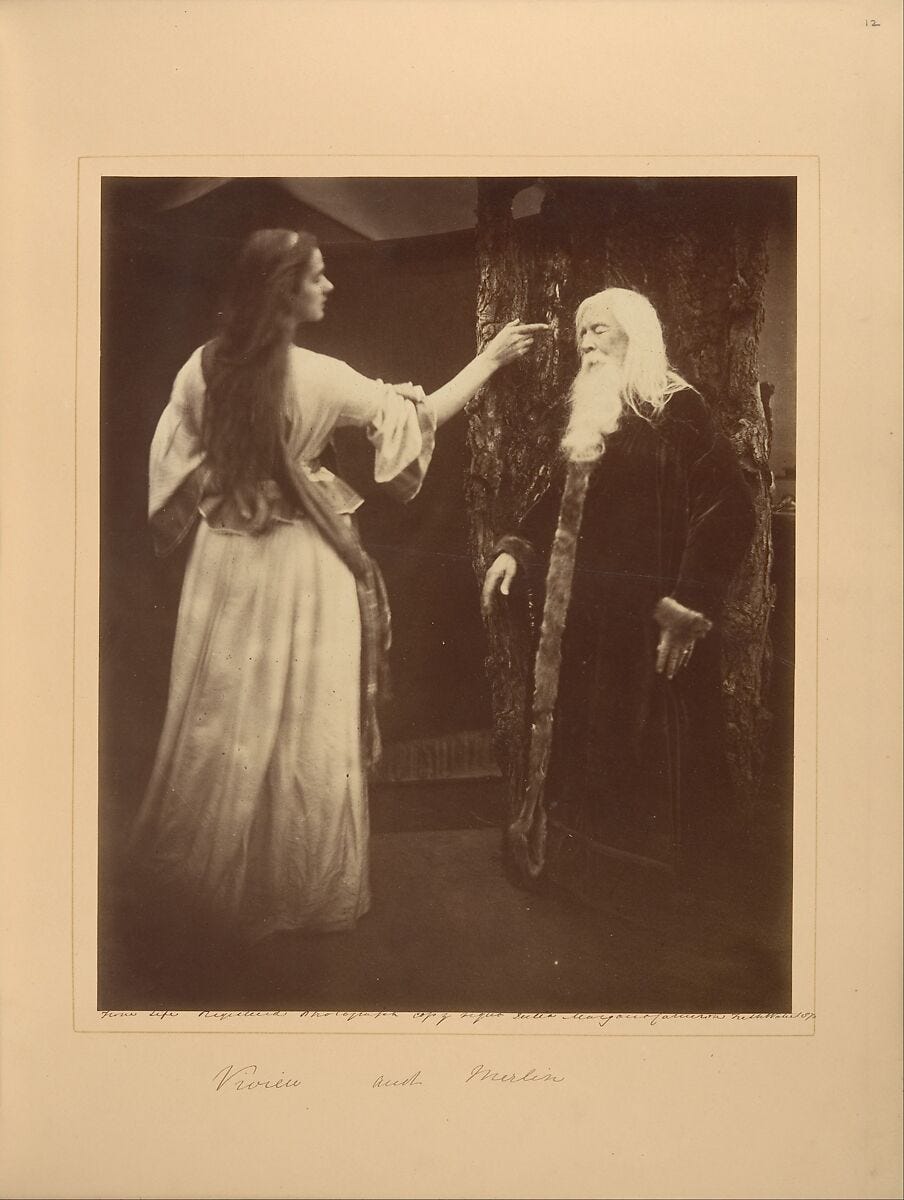
The photo above features Cameron’s husband as the wizard Merlin and an unknown woman as Vivien (who in some versions of Arthurian legend is a fairy and in others a human, and in some of the French romances is the Lady of the Lake herself). Notice how Cameron captures Vivien’s movement as she curses Merlin—technically, Vivien is blurred. But as the viewer, we gain a sense of what is happening in the scene, and we can witness the plot progressing.
By the time Julia Margaret Cameron passed away in 1879, she had produced about 900 photographs, and her home in Freshwater provided an essential meeting space for the artists and intellectuals, both male and female, of her age. (I was also delighted to learn that among her descendants was the author Virginia Woolf.)
While I wish I had known of Cameron’s work sooner, I’m grateful to have explored it now. I hope it inspires you to keep dreaming, and if you have a new interest or passion burning in the back of your brain, know that it’s never too late to start.
I just read a novel set in British-colonized India where one of the characters was a woman who photographed friends and family like this. I very much appreciate now knowing one the real people who inspired that story! What an incredible woman.
Thank you for introducing me to such a phenomenal woman!