

Love on the Eve of St. Agnes
The Pre-Raphaelite William Holman Hunt brings to life John Keats's story of forbidden romance.

This essay is part of the series Art, Myth, and Literature: The Pre-Raphaelites.
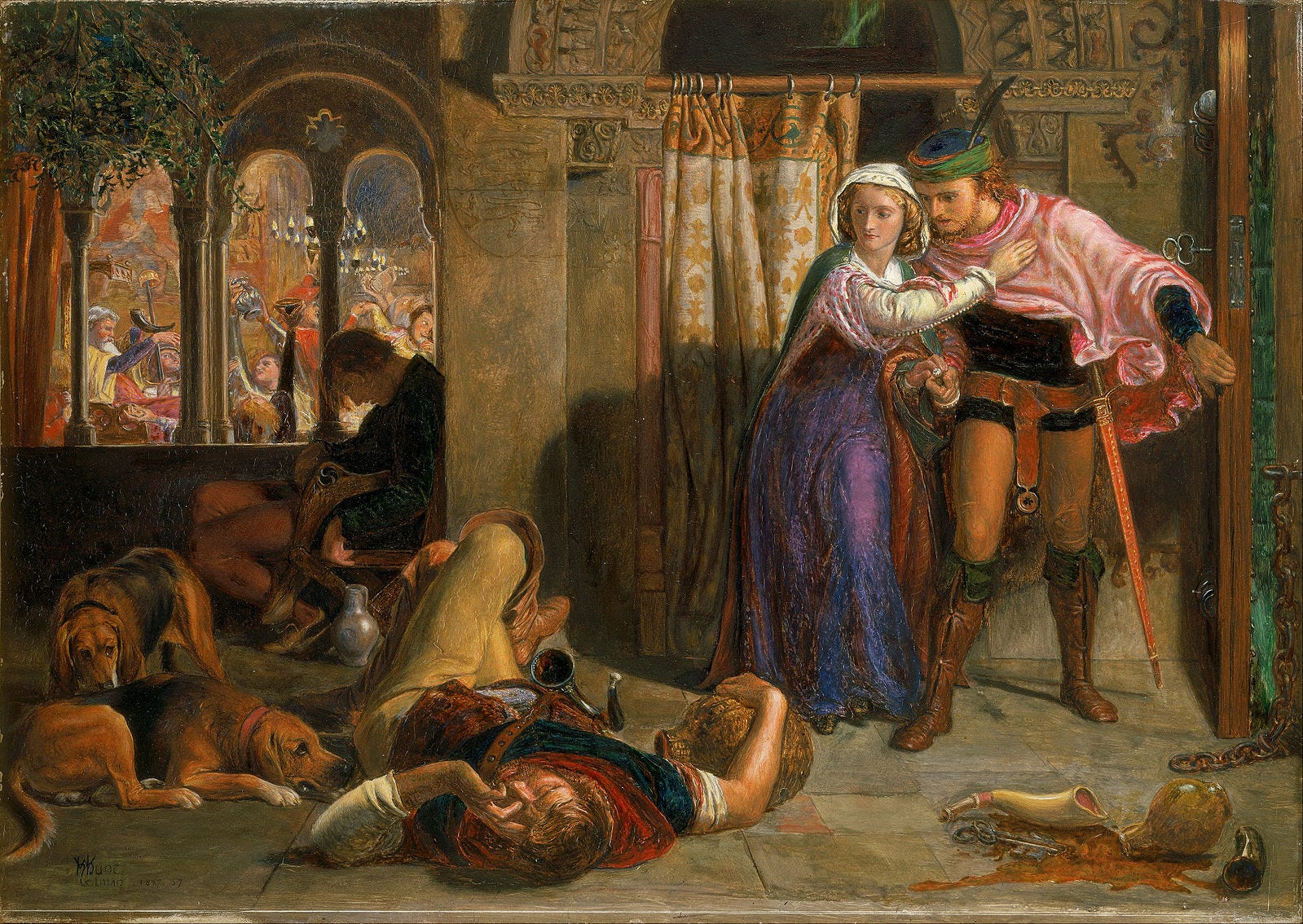
_-_Google_Art_Project.jpg)
On the Eve of St. Agnes, a long time ago, a beautiful maiden closes her eyes and dreams of her beloved.
St. Agnes Eve, a celebration for the martyr in the darkest depths of winter, is a night for divination. Young women can perform rituals—they might go to bed without dinner, or recite the Lord’s Prayer while pinning a sleeve, or throw grain into a field while praying to the saint—and that night, they just might see their future husband as they dream.
The maiden Madeline knows exactly who she hopes to meet in her dream: the handsome Porphyro, a knight of a rival household. All the while, Porphyro is sneaking into the castle, risking that he will be caught by the feasting revelers, in the hopes of seeing Madeline:
My Madeline! sweet dreamer! lovely bride!
Say, may I be for aye thy vassal blest?
Thy beauty’s shield, heart-shap’d and vermeil dyed?
Ah, silver shrine, here will I take my rest
After so many hours of toil and quest,
A famish’d pilgrim,—sav’d by miracle.1
John Keats’ The Eve of St. Agnes, written in 1819 and published the following year, takes a page from Shakespeare’s Romeo and Juliet. As Romeo’s lips are “two blushing pilgrims” eager to worship at Juliet’s shrine, Porphyro assumes the role of the devotee to his own forbidden love. Before declaring his feelings, Porphyro rouses Madeline from her dream. Not quite asleep, not quite awake, she marvels at the vision before her:
Her eyes were open, but she still beheld,
Now wide awake, the vision of her sleep:
There was a painful change, that nigh expell’d
The blisses of her dream so pure and deep
At which fair Madeline began to weep,
And moan forth witless words with many a sigh;
While still her gaze on Porphyro would keep;
Who knelt, with joined hands and piteous eye,
Fearing to move or speak, she look’d so dreamingly.2
We are in the realm of the Romantics. Romanticism is an artistic and literary movement that developed during the late 18th and early 19th centuries. The movement evolved as a reaction to the Enlightenment and the Industrial Revolution, which brought technological advancements as well as horrific labor conditions and increasing disconnection from the natural world. (In the face of social media fatigue and anxieties regarding artificial intelligence, several writers on Substack have argued that we are entering a new Romantic era today.)
The Romantics, as we’ve explored in previous essays, believed in the value of individual, subjective experience. They were fascinated by the sublime, the uncanny, and all-things medieval. They found beauty in ruins.
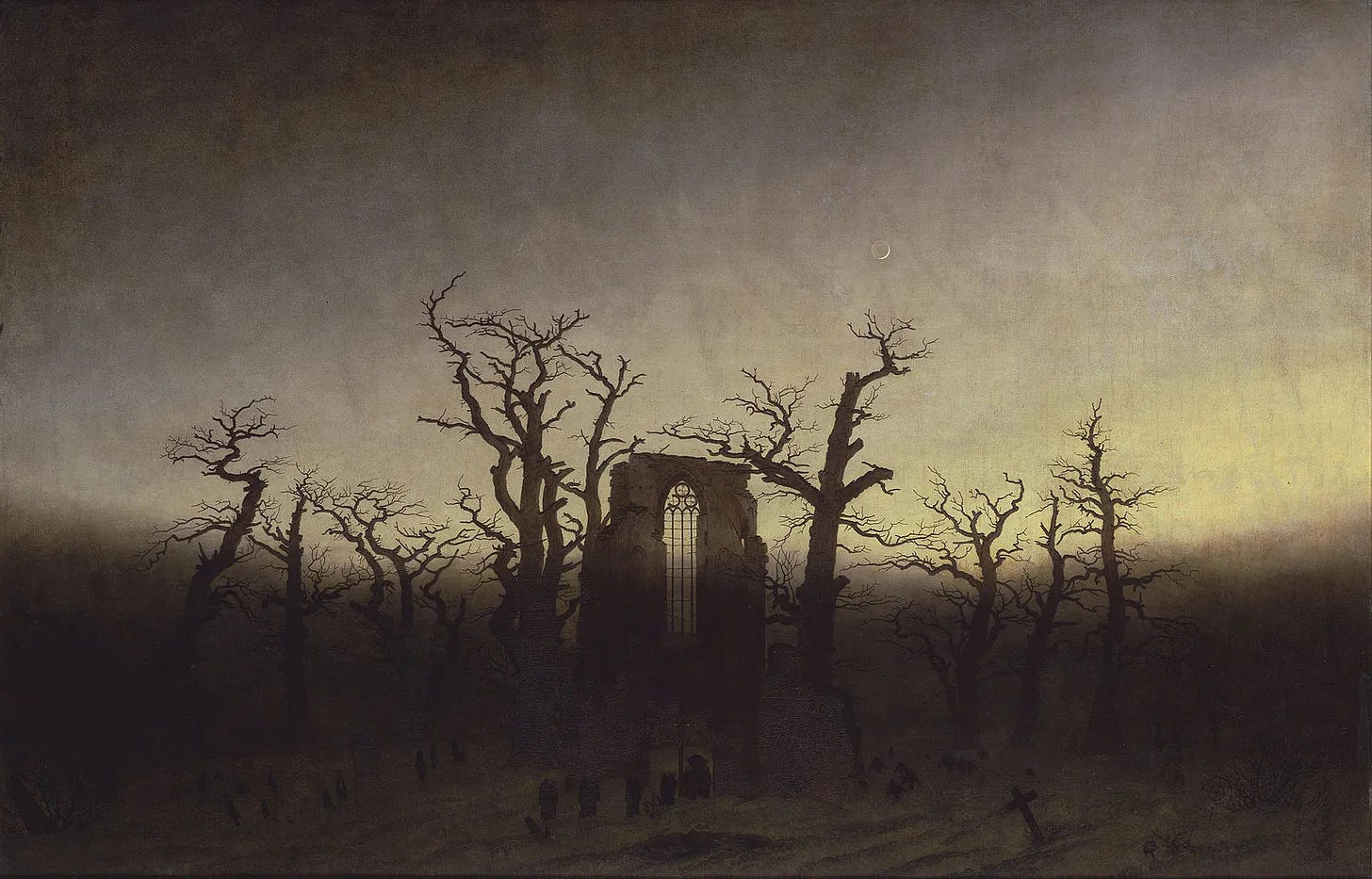

Keats’s The Eve of St. Agnes is thus a quintessential example of Romantic poetry, one in which the liminality of Madeline’s dreamscape is encased within a medieval setting. Several decades later, another artistic movement would find inspiration in the Middle Ages, and like the Romantics, the medieval world represented by its artists would be a highly idealized portrait.
In his 1848 painting (above), The Eve of Saint Agnes, or The Flight of Madeline and Porphyro During the Drunkenness Attending the Revelry, the Pre-Raphaelite William Holman Hunt immortalized the scene in which the couple ran away together:
They glide, like phantoms, into the wide hall;
Like phantoms, to the iron porch, they glide;
Where lay the Porter, in uneasy sprawl,
With a huge empty flaggon by his side…3
It was painted the same year that the Pre-Raphaelite Brotherhood formed in an official (though short-lived) capacity. When we explored John Everett Millais’s Ophelia (1851-1852), a painting that could easily be the poster-child for the Pre-Raphaelite sensibility, I noted that this group of artists prized detail to such a degree that elements in the background were treated with the same care as the main subject.
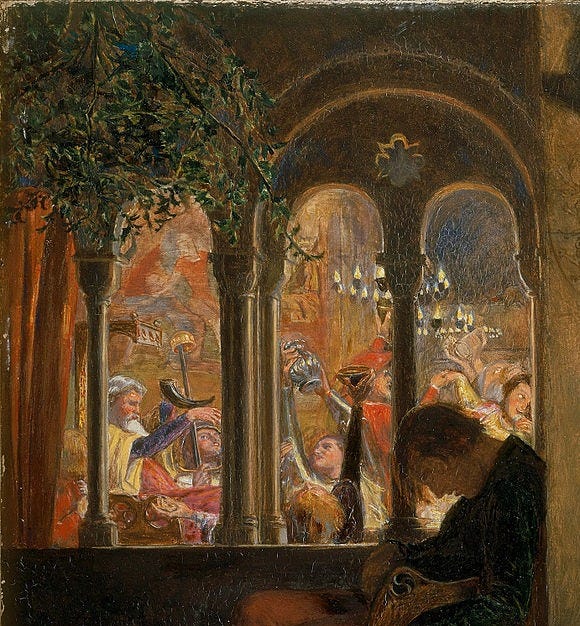
Hunt’s Saint Agnes Eve is no exception. The play of light and shadow on the left side of the composition allows the banquet scene to shine, and the drunken guards sleep in the foreground. The right side of the painting reverses this—the lovers in the foreground are bathed in light. They have just fled through a darkened hall, and they will flee into darkness once again to escape into the night. Hunt also makes lavish use of Keats’s medieval setting. The lovers emerge beneath a Romanesque arch with Gothic ornamentation. Their costumes, though not pinpointed to a specific period in the vast Middle Ages, evoke the aura of the times in a manner that would have resonated with a 19th-century audience.
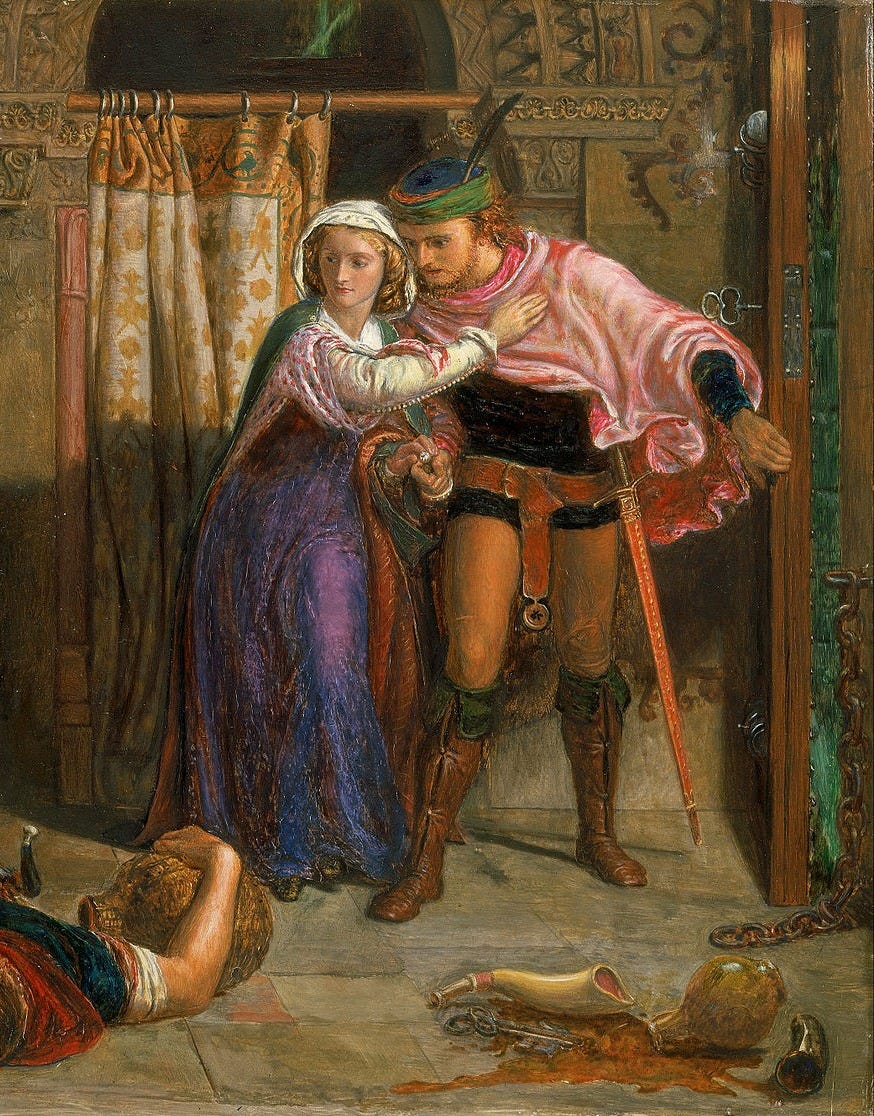
Keats’s ode to chivalric romance had a great impact on readers, and it comes as no surprise that Hunt would choose this scene to declare his allegiance to artistic styles of a glorified past. Keats’s vision of the medieval world is not a carbon-copy but a Romantic reimagining; similarly, Hunt and the other Pre-Raphaelites do not abandon perspective or realistic dimensions, but borrow rich colors and themes from medieval art and reinterpret them for the era in which they live.
Hunt was not immune to this kind of myth-making in his own life. The early days of the Pre-Raphaelite Brotherhood are cloaked in mystery—little can be found of the Brotherhood’s formation in contemporary accounts. In a series of essays in the 1880s, Hunt laid out a version of events that no doubt suited his self-image. He very much positioned himself as the movement’s leader, and he describes his deep friendship with Millais as a driving force. They were both young art students at the Royal Academy Schools in the 1840s, and they gave each other feedback on their work. After seeing The Eve of Saint Agnes at the Royal Academy exhibition in 1848, Dante Gabriel Rossetti introduced himself to Hunt and joined their informal cohort. Together, Hunt and Rossetti drew up a “List of Immortals”—artists and writers whom they revered.4
By that summer, they had the original group of seven members who made up the Brotherhood, all in their late teens or early twenties. In Hunt’s account decades later, he states that the group agreed to formally join together on one fateful day, after examining engravings of the late medieval and early Renaissance frescoes in the Campo Santo at Pisa:
The innocent spirit which had directed the invention of the painter [of the Campo Santo frescoes] was traced point after point with emulation by each of us who were the workers, with the determination that a kindred simplicity should regulate our own ambition, and we insisted that the naïve traits of frank expression and unaffected grace were what had made Italian art so essentially vigorous and progressive…5
Like his Eve of Saint Agnes, Hunt presents a detailed narrative, which feels right and true as the best tales do… but perhaps, not entirely accurate. For example, William Michael Rossetti and Frederic George Stephens later said that they couldn’t remember being there, even though they feature in Hunt’s story.
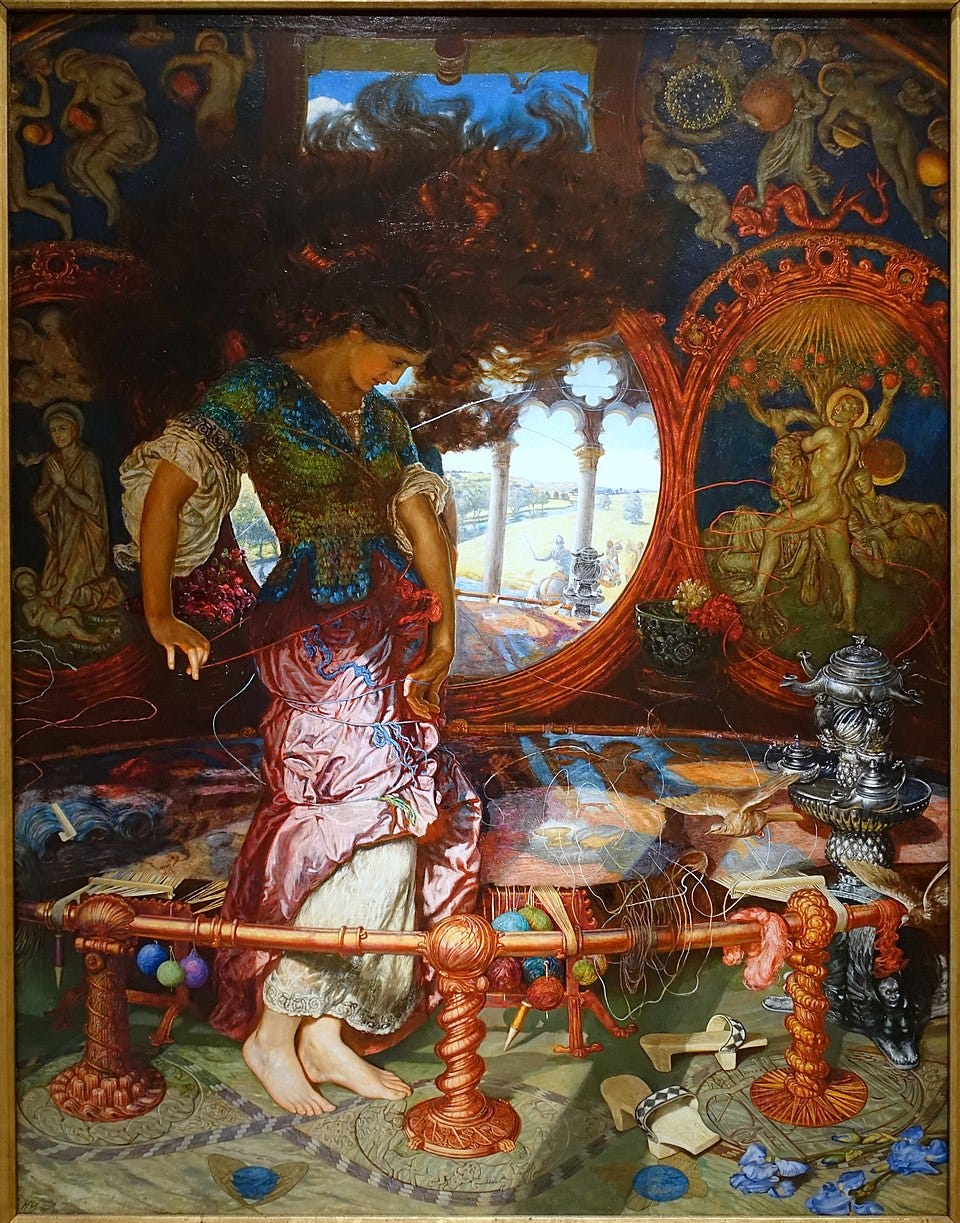

Along with biblical subjects, Hunt would continue to paint scenes inspired by literary works. Though John William Waterhouse’s The Lady of Shalott (1888) remains the more famous of the two, Hunt’s own take on Alfred Lord Tennyson’s 1832 poem is a stunning work. It showcases how much Hunt’s style evolved by his later years; though it is still in keeping with the Pre-Raphaelite aesthetic, the painting contains hints of Art Nouveau in the line work.
The fact that Hunt took such care to write about the Brotherhood towards the end of his life, including the publication of an autobiography in 1905, marks his own literary turn. He had spent decades bringing stories to life in his art, and he understood how powerful it was to be in control of one’s narrative. Madeline and Porphyro find that power, too, by the end of Keats’s poem. Though we never learn how their tale ends, we know that the lovers leave on their own accord:
And they are gone: ay, ages long ago
These lovers fled away into the storm.6
John Keats, The Eve of St. Agnes (1820). https://www.poetryfoundation.org/poems/44470/the-eve-of-st-agnes.
Keats, The Eve of St. Agnes.
Keats, The Eve of St. Agnes.
Elizabeth Prettejohn, The Art of the Pre-Raphaelites (Princeton University Press, 2000), 23-25.
Prettejohn, The Art of the Pre-Raphaelites, 27.
Keats, The Eve of St. Agnes.