

Manet Breaks the Fourth Wall
After the 1865 Salon, Édouard Manet befriends a young group of painters with wild ideas, and finds himself again at the center of controversy.

This essay is part of the series The Life of Édouard Manet.
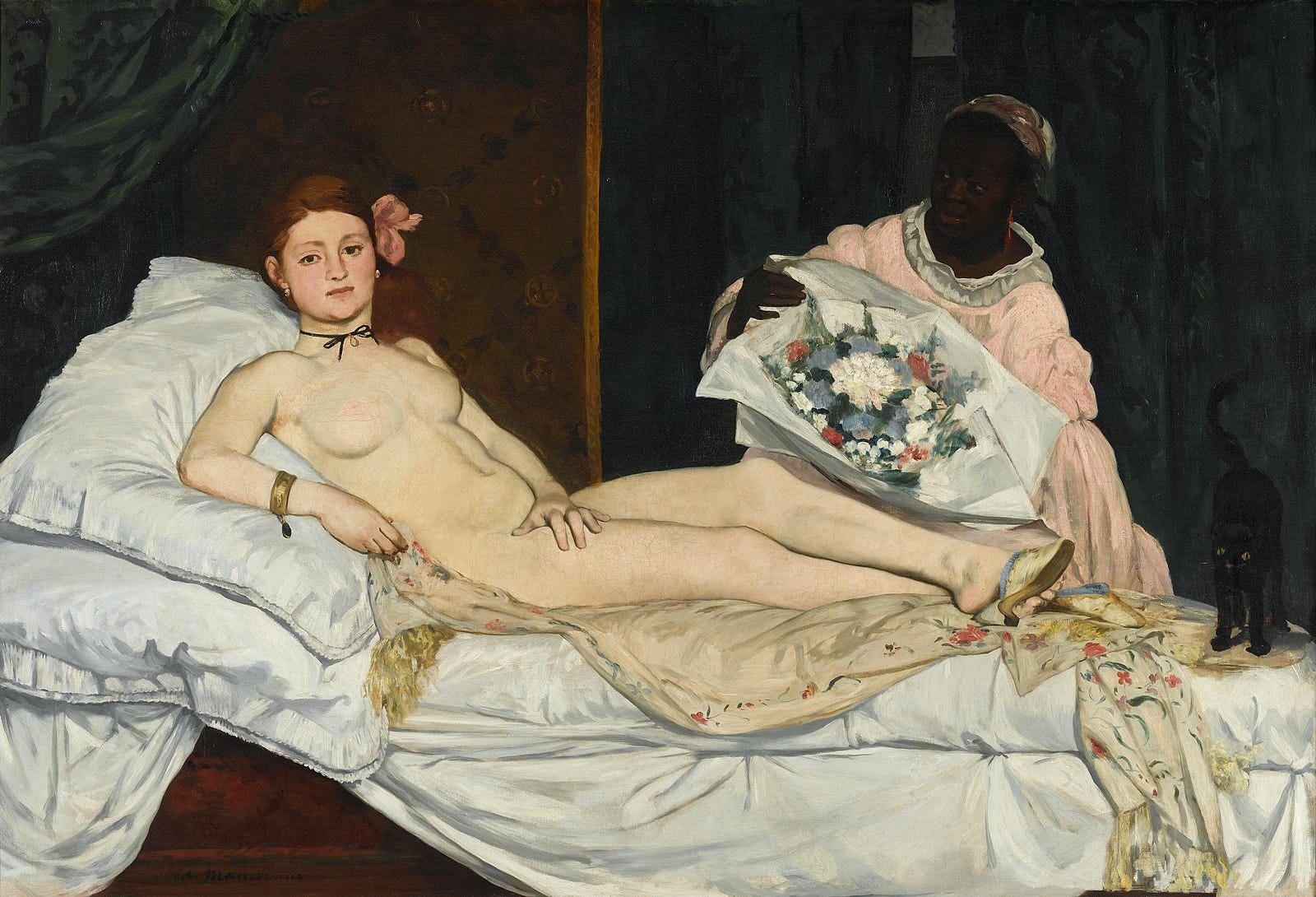

A woman reclines on a daybed—completely naked, save for a bracelet, a ribbon around her neck, a slipper dangling off her left foot, and a flower in her hair. An African woman, fully-clothed, presents her with an embroidered fabric. From the shadows, a black cat watches the scene unfold.
The naked woman stares at us. She is thin, and we know from looking at her that she is not luxuriously fed. But she’s not starving, either.
The patrons of the 1865 Salon would have known exactly what they were looking at.
Prostitution was big business in Paris, and some of the Salon’s male attendees were intimately familiar with the scene depicted in Édouard Manet’s Olympia (1863). Unlike his equally-shocking Le Déjeuner sur l’herbe, he actually managed to get this painting into the Salon. (The models for Olympia are the French artist Victorine-Louise Meurent, who also modeled for Le Déjeuner, and a Black art model named Laure, whom we unfortunately know very little about.)
Why in God’s name would the Salon display such a controversial painting? Like Le Déjeuner, Olympia takes inspiration from the Old Master Titian. Given the work’s obvious parallels to Titian’s Venus of Urbino (1538), it’s possible that the jury felt this work could just barely pass. Manet’s other painting shown that year was Jesus Mocked by the Soldiers (1865), one of his last history paintings. In this case, the subject matter was in keeping with the Salon’s usual standards, though painted in his signature, vivid color scheme.
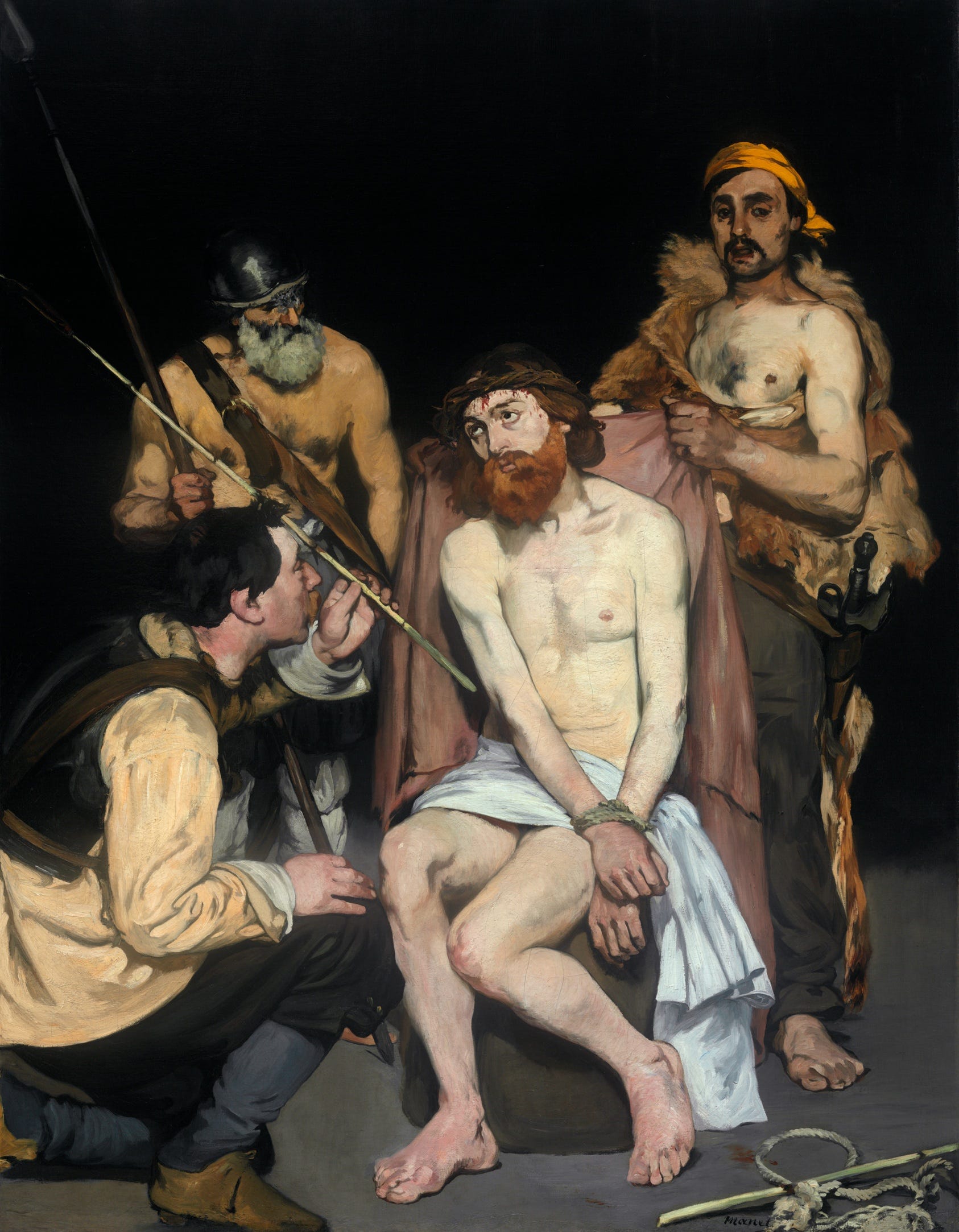
Both works were brutally criticized, particularly (and unsurprisingly) Olympia. “The crowd, as at the morgue, throngs in front of the gamy Olympia and the horrible Ecce Homo of M. Manet,” wrote Paul de Saint-Victor in La Presse. Louis Leroy, the critic for Le Charivari who would coin the term “Impressionist” in 1874, wrote, “If I ever write a single line in praise of Olympia, I authorize you to exhibit me some place with that bit of my article tied around my neck, and I would have amply deserved it.”1
Meanwhile—horror of horrors—displayed in the same room was the work of a painter with a very similar name. Even worse, this younger artist’s seascapes were receiving far more praise than Manet’s paintings. “Who is this Monet whose name sounds just like mine, and who is taking advantage of my notoriety?” Manet fumed.2 He later complained to his friends, “I am being complimented only on a painting that is not by me. One would think this to be a mystification.”3

Claude Monet was only twenty-four years old, and Manet was something of a hero to his cohort. Monet was among the young students from Gleyre’s studio who saw Manet’s Le Déjeuner sur l’herbe at the Salon des Refusés in 1863. To be compared to Manet would have been a great compliment.
After the beating by critics at the 1865 Salon, Manet left Paris for a trip to Spain. Spanish artists like Diego Velázquez and Francisco Goya had a profound impact on Manet’s earlier work, and as you may recall from previous entries in this series, he often painted musicians and dancers from an imagined Spain. But when he arrived, he quickly discovered that Spain was not a fantasy land—it was, indeed, a real country with many of the same problems of modern life that afflicted France. He largely stopped painting Spanish scenes after this trip. He was a Parisian, and it was time to devote himself to the subject that would occupy his work for the rest of his life: scenes of France’s Belle Époque, the good, the bad, and the beautiful.
When he returned to Paris, Manet set to work, and he found his circle expanding. In 1866, he received a visit from Émile Zola (who was a close childhood friend of Paul Cézanne). Zola was so taken with Manet’s work that he wrote a passionate defense of the artist in an article for L’Evénement. His writing, along with a scathing review of the 1866 Salon, prompted outrage from readers. Hundreds of angry letters poured into L’Evénement’s offices.
Around this time, Manet also grew acquainted with Monet, Cézanne, and Pissarro. These artists loved painting in the open air, something that Manet found utterly bizarre. Nevertheless, they shared a desire to move the art world in a new direction, one that examined the present with equal passion and care as the academic painters reserved for the mythological past. They persevered while the group faced rejection after rejection (including Manet’s heavily-criticized solo exhibition at the 1867 World’s Fair—a show that he organized himself). The following year, Manet reflected in a letter to Henri Fantin-Latour:
I believe that, if we want to remain close together and above all not to grow discouraged, there would be a means of reacting against the mediocre crowd that is strong only because of its unity.4
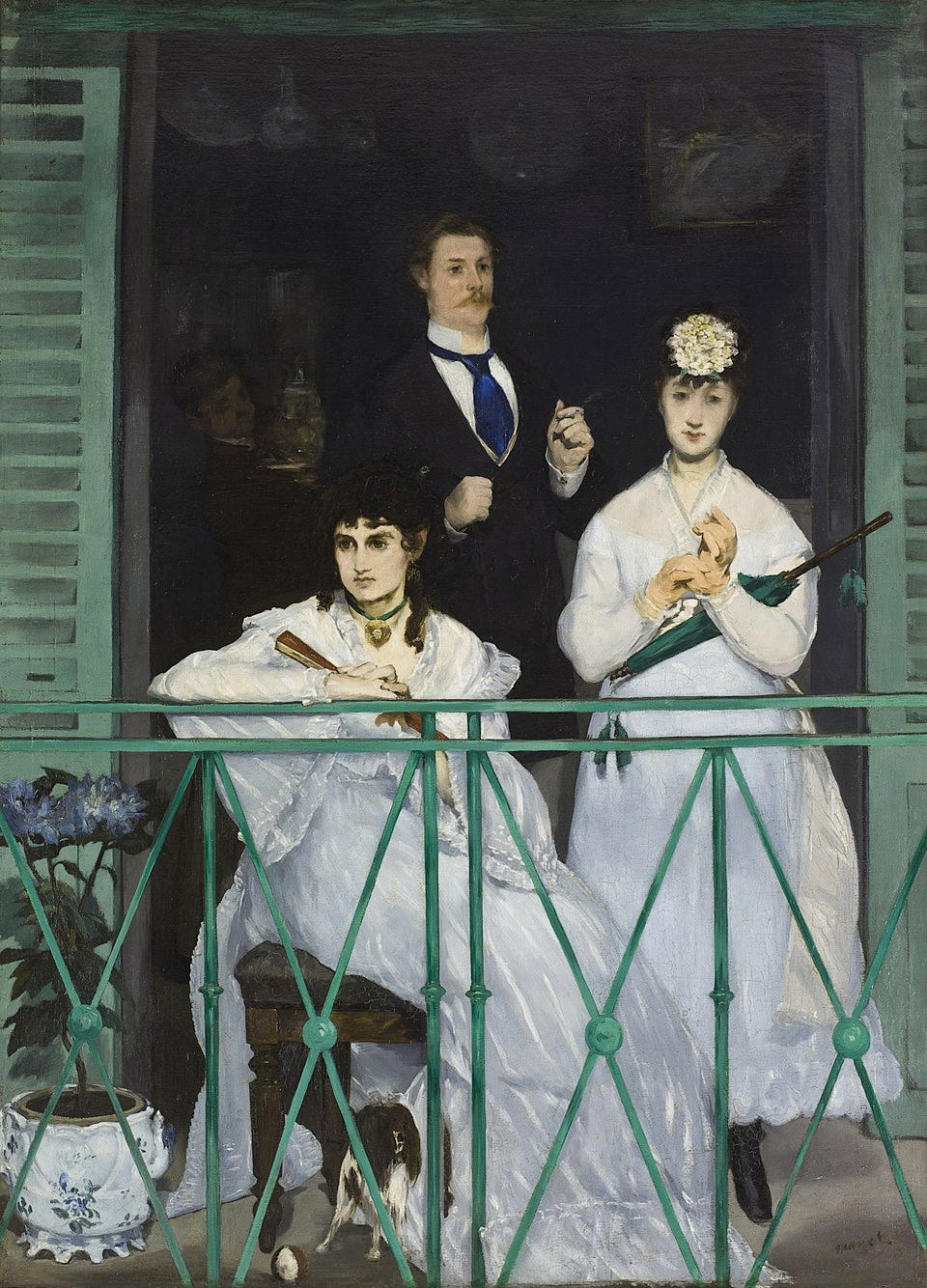

In 1868, Manet met another painter who would play a major role in the remainder of his life: Berthe Morisot. He met her while she was drawing at the Louvre, and he was immediately taken with her talent and charm. Soon, Morisot began attending Édouard and Suzanne Manet’s Thursday evening soirées, and they in turn were frequent guests at parties hosted by Morisot’s mother. When Manet asked Morisot to pose for The Balcony (1868), she eagerly accepted.
Something you’ll notice in The Balcony, along with all of the paintings featured in this essay, is the artist’s habit of breaking the fourth wall. In quite a few of his works, there is one subject who stares at the viewer. (In The Balcony, it is the woman on the right—the violinist and art model Fanny Claus.) Even in a more traditional painting like Jesus Mocked by the Soldiers, one of the soldiers looks directly at the viewer, as if he’s been caught in the act. This gritty Realism contributed to the painting’s notoriety, as some critics felt it was inappropriate for a religious scene.
This breaking of the fourth wall is what aided Manet in being a brilliant painter of contemporary life. We’re not often allowed to just look at his paintings: we are being watched, and therefore, we are participants in the scene. Today, Manet’s works offer a window into a world that has long since vanished, but what about the first people to see these paintings? What about the horrified onlookers at the Salon, who found themselves face-to-face with their own lives and their own circumstances (even in the most sordid of places, as in Olympia)?
The Parisian bourgeoisie didn’t attend the Salon to have a mirror placed before their society. They went to see exalted images from mythology, from history, from biblical tales. Whatever this new avant-garde was called, that which seemed to move beyond even the Realist style—the public simply wasn’t ready.
John Rewald, The History of Impressionism: Fourth, Revised Edition (New York: Museum of Modern Art, 1973), 124.
Sue Roe, The Private Lives of the Impressionists (London: Vintage, 2006), 41.
Rewald, History of Impressionism, 122.
Rewald, History of Impressionism, 174.