

"My God Makes Known Your Thoughts Unto Me"
Were the accusers in the Salem Witch Trials mentally ill? Poisoned by a strange disease? This week, we delve into the accusers, the accused, and the potential roots of mass hysteria.

This essay is part of a series on the Salem Witch Trials.
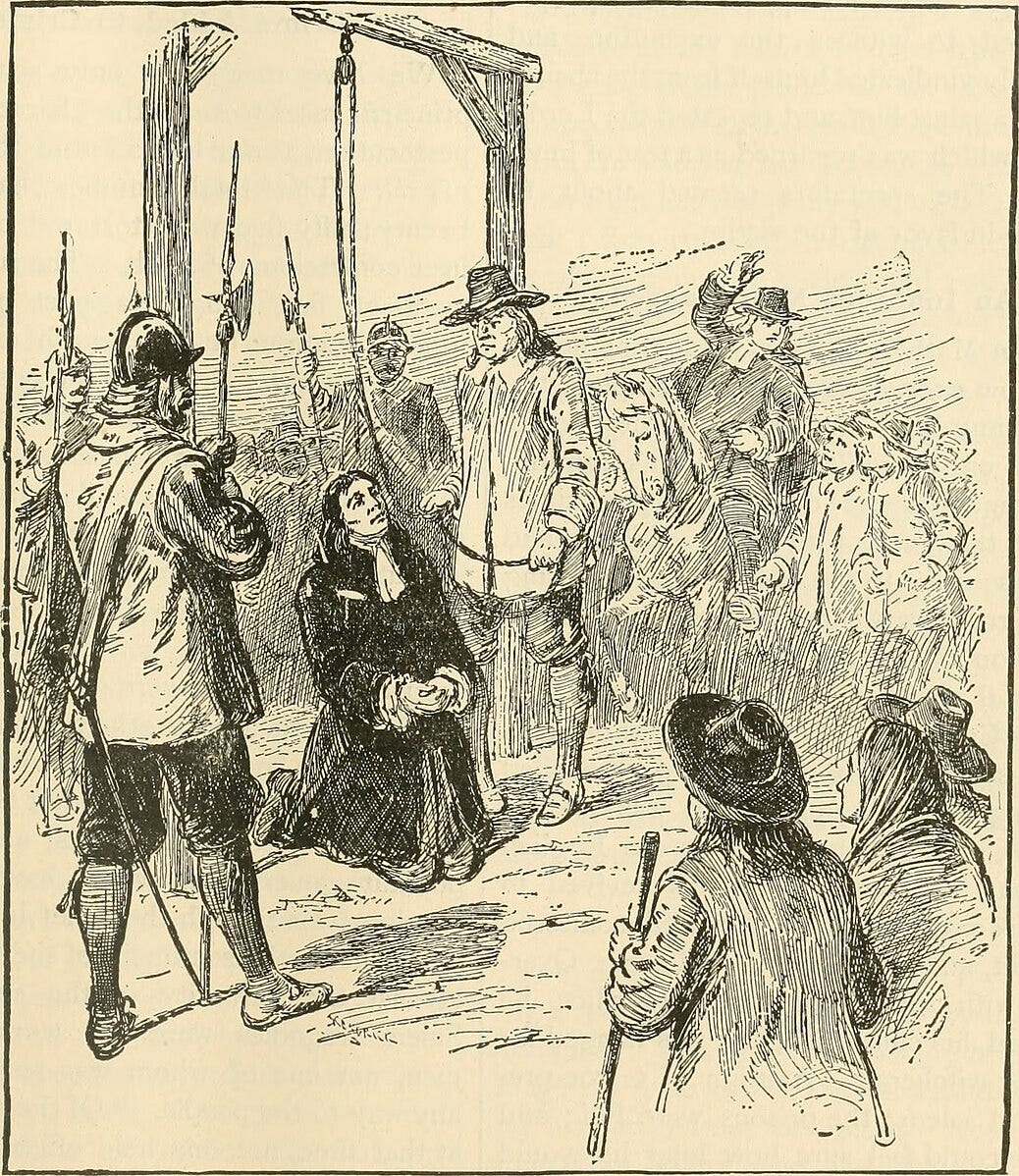
On August 19th, 1692, the next group of victims from the Salem Witch Trials were executed at the bottom of Gallows Hill. The location where the hangings took place is now called Proctor’s Ledge.
Proctor’s Ledge received its name from John Proctor, one of the five accused witches who died that day in August. A month had passed since the previous group of “witches” were killed, and the list of accused individuals now included dozens of names. Indeed, by the time the Salem trials finally came to an end, over 150 people from around the Massachusetts Bay Colony would be accused of witchcraft.1
What made the August executions unique is that four of the five victims were men. As we’ve explored in previous entries, the early victims fit the typical profile of witches from European trials. They were mainly older women with poor reputations, who had angered their neighbors due to their foul tempers, perceived slights, or for their refusal to conform to the expectations of their rigid society. But the execution of Rebecca Nurse marked a turning point. With the exception of a neighborly dispute over a property fence, Nurse enjoyed a strong reputation as a member of the saintly-elect. From that point onward, no one was immune: even several ministers would be suspected of witchcraft, and one—George Burroughs—was killed.
Before we delve further into the accused, I would like to address the characteristics of their accusers. In exploring the potential causes of their mass hysteria, we will be better positioned to understand why the accused witches increasingly came from loftier parts of society.
First, let’s rule out a common myth: that the girls were suffering from convulsive ergotism, a theory initially suggested in 1976. Ergot is a fungus that will grow on cereal grains if they are not properly dried. Rye is quite susceptible to this. Considering that rye was a staple crop in New England, and ingesting ergot can cause tics and hallucinations reminiscent of an LSD trip, some theorized that this could have caused the girls’ symptoms.
But that theory has since been disproven, because most of the symptoms of convulsive ergotism are not present in the historical record. We have no evidence of the girls vomiting or experiencing diarrhea or gangrene. Furthermore, their symptoms came and went, which is not consistent with ergot poisoning. Some of them experienced almost a year of on-and-off symptoms, yet the other members of their households, who were eating the same foods, did not. Finally, such prolonged ergot exposure can leave one mentally disabled, yet most of the girls went on to live long and healthy lives.2
This theory also discounts the fact that to most people in the 17th century, magic was a fact of life. It did not require such a leap for the people of Salem to conclude that the girls were bewitched.
So, what in the world was going on?
Today, most historians think several factors were at play: conversion disorder, mental illness (particularly post-traumatic stress disorder), and outright fraud. Other suggested causes include instances of sleep paralysis, as well as genuine fear of folk magical practices (such as Mary Sibley’s witch cake). It’s still debated which of these factors were most prominent, but all seemed to have influenced the witch craze in Salem.
Conversion disorder is a mass psychogenic illness that can “convert” large groups of people to believe they are afflicted by some ailment. Adolescents are especially susceptible. A modern example of conversion disorder occurred during the COVID pandemic, when thousands of teenagers suddenly claimed to have Tourette’s syndrome. To be clear, Tourette’s is a very real disorder, one that affects about 0.5% of the population. But the vast, vast majority of these children did not have Tourette’s syndrome. They were under the influence of TikTok—bewitched, one might say.3
Like the young girls in Salem, who were living in times of great religious and economic uncertainty, teenagers during the pandemic were in a horrendous position. They were locked in their homes, glued to their screens, and predictably, rates of mental illness skyrocketed. Given all the environmental factors we explored in previous essays, it’s not surprising that the first crop of accusers in Salem Village may have also been suffering from conversion disorder.
As we’ve explored before, many of the accusers and some of the accused were refugees from Maine, who had lost their homes and countless family members during the ongoing frontier conflict, King William’s War. Today, we understand that the settlers in Maine were occupying and encroaching upon indigenous territory, but that doesn’t change the extreme violence they experienced, and participated in themselves, against the allied Native and French troops.
One of the accusers, Mercy Short, seemed to be suffering from a pronounced case of PTSD. Her pastor, Cotton Mather, recorded her experiences:
There exhibited himself unto her a devil having the figure of a short and black man… he was not of a negro, but of a tawny, or Indian color… [The devil’s book was] somewhat long and thick (like the waste-books of many traders)… and filled not only with the names or marks, but also with the explicit… covenants.4
Mercy was undoubtedly traumatized. In a combined French and Native raid, the troops burned her home, murdered her parents, and brought her to Quebec as a captive, where they forced her to convert to Catholicism. Her hallucinations of being forced to sign away her soul to the Devil illustrates how Puritans viewed Catholics’ allegiance to the Pope.
There is also the possibility of PTSD due to domestic violence. With the exception of Samuel Wardwell, who was executed that September, the five other men executed in the trials had a history of serious violence toward their wives and servants. Domestic abuse was accepted in Puritan society, so for these men to have gained a sordid reputation, they were likely extreme in their violence. Giles Corey, who would be pressed to death in September, beat a male servant so viciously that when the man died later, many in Salem felt it was Corey’s fault. George Jacobs, executed in August, was also fined for beating a young man. (The girls would later allege that Jacobs’ specter beat them with his cane.) John Willard, also killed in August, was notoriously abusive to his wife.5
Like Willard, the Reverend George Burroughs had a reputation for being an abusive husband. Burroughs, readers may recall, was one of several ministers whom the people of Salem Village hired and fired before Samuel Parris won the job. Burroughs was always a suspicious preacher: he was never ordained, and many felt he was not up to Puritan standards of piety. He was also well known for his paranoid and controlling nature. It didn’t help his case that he claimed to know what his wives said when he was away—a clear sign of sorcery!
His own brother-in-law, Thomas Ruck, testified against him. Once, when Burroughs somehow “knew” the details of a conversation between his wife and her brother Thomas (Burroughs was likely eavesdropping), Thomas said that “the devil himself did not know so far.”
Burroughs’ shocking reply: “My God makes known your thoughts unto me.”6
While it was never proven, many suspected that Reverend Burroughs’ abuse of his wives had caused both of their premature deaths.
And then, we come to John Proctor. Proctor never believed the witch craze, and his vocal skepticism landed both him and his wife with accusations of witchcraft. Elizabeth Proctor survived the trials; she was pregnant, so her execution was delayed and never materialized. John Proctor was not so lucky.
While it’s unclear if he acted upon it, he was heard threatening to “thresh the devil out of” his servant, Mary Warren, for her role in the trials. Rather disturbingly, he referred to her as his “jade,” which was slang for a disreputable or flirtatious woman.7 (Note that Mary and John had a forty-year age difference.) Her testimony that Proctor’s specter would climb onto her lap has made some historians speculate whether Proctor was sexually abusing his servant, though there isn’t conclusive evidence.
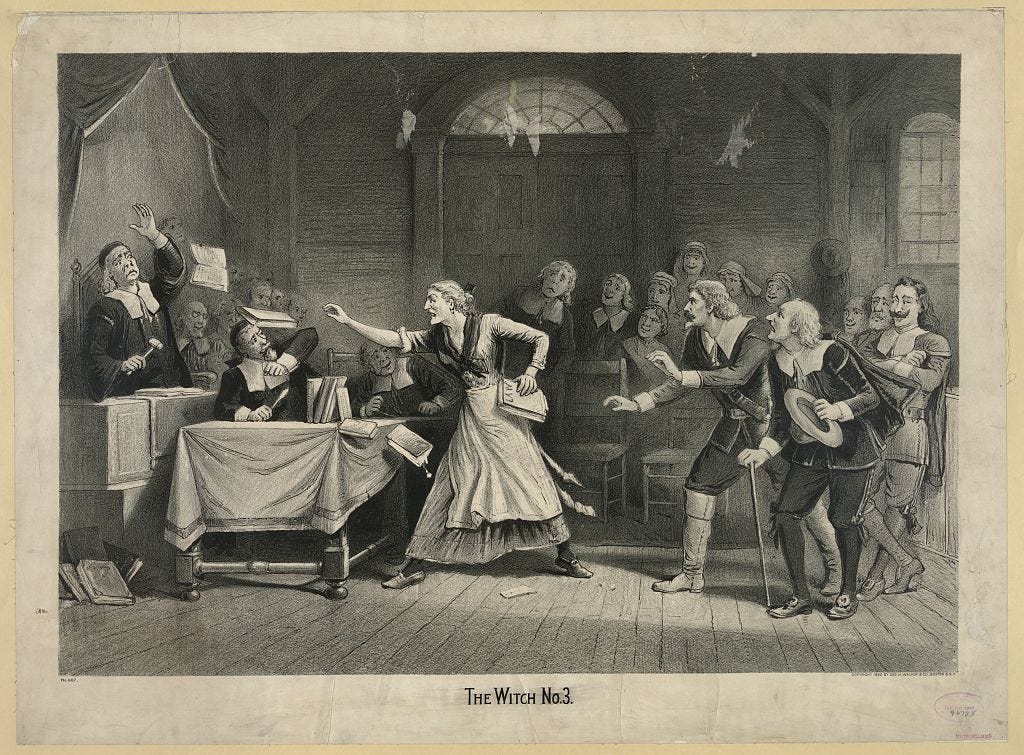
Finally, some of the accusers were engaging in outright fraud, particularly as the trials advanced. The first group of girls, including Betty Parris and Abigail Williams, were very young and likely suffering from conversion disorder. They also disappeared from the trials by the beginning of the summer; Betty was sent away from Salem Village to live with a relative, and seemingly, her symptoms subsided. But the older girls, ages seventeen through twenty, were likely also deliberate in defrauding the court.
Remember Mary Warren, who confessed that they were making it all up? Within seconds, the other girls accused her of witchcraft, and Mary was forced to take back her statement.
It should also be noted that despite the initial accusers being young women and girls, many residents of Salem would come forward to corroborate their stories. Crucially, women could not levy accusations in court on their own—a male relative had to back them up.8 Additionally, many early supporters were allies of Reverend Parris.
As accusations targeted ever-higher members of society, one comes away with the impression that the trials were a mass protest of the colony’s chaotic circumstances. Historian Emerson Baker draws comparisons to a later event fueled by religious fervor: the First Great Awakening in 1725, in which a series of Christian revivals took Britain and the American colonies by storm. This Awakening was a reaction to the Enlightenment, but it occurred during more stable times. Therefore, the strange behavior of adherents was understood to be religious ecstasy, not bewitchment.9
But the Puritans in Salem were living in a world mired by war, economic troubles, and of course, precarious legal status in relation to England and the Crown. A power vacuum had opened in the Massachusetts Bay Colony, just when its people needed strong leadership the most.
Who filled that vacuum?
Next time, we’ll meet those men—the judges—and how members of the public eventually turned against them.
Related from The Crossroads Gazette:


Margo Burns, “People Accused of Witchcraft in 1692,” 17th Century Colonial New England: with Special Emphasis on the Essex County Witch-Hunt of 1692, http://www.17thc.us/primarysources/accused.php.
Emerson W. Baker, A Storm of Witchcraft: The Salem Trials and the American Experience (Oxford University Press, 2015), 109-110.
Azeen Ghorayshi, “How Teens Recovered from the ‘TikTok Tics’,” New York Times, February 13, 2023, https://www.nytimes.com/2023/02/13/health/tiktok-tics-gender-tourettes.html.
Baker, A Storm of Witchcraft, 104.
Baker, A Storm of Witchcraft, 148.
Baker, A Storm of Witchcraft, 130.
Baker, A Storm of Witchcraft, 149.
Paul Boyer and Stephen Nissenbaum, Salem Possessed: The Social Origins of Witchcraft (Harvard University Press, 1974), 27-30.
Baker, A Storm of Witchcraft, 119.