

"No More Than the Specter of Evidence"
In the final entry of our Salem Witch Trials series, we delve into the aftermath of the trials and the broader impact on the future of the United States.

This essay is part of a series on the Salem Witch Trials.

On November 11th, 1696, the Superior Court of the Massachusetts Bay Colony heard the case of Thomas Maule. When the Quaker faced the Court, he did so knowing that several of the judges were participants in the Salem Witch Trials.
But Maule had not been accused of witchcraft. He was there to defend his defiance of Governor Phips’ censorship—under the governor’s leadership, publications that referenced the Salem trials were banned.
Several years had passed since the conclusion of the trials, and they remained a humiliating stain on the legacy of the colony’s leadership. Though Increase Mather had written a manuscript protesting the trials, he had been careful not to have it formally published, thus working around the ban.
Maule was made of tougher stock. Quakers were a religious minority, one that had suffered horrific abuse and discrimination, even death, at the hands of New England’s Puritans. Quakers were a fringe group who held radical beliefs for the time: they were committed pacifists, their views on gender were far more egalitarian, and they were among the earliest campaigners for the abolition of slavery. In 1688, Parliament passed the Toleration Act, which extended freedom of religion to all Protestants. This finally halted legal persecution of Quakers in New England, and it explains why no Quakers were executed for witchcraft in spite their ongoing notoriety—targeting Quakers would have brought the attention of the Crown on the colonists’ heads.
Maule was an outspoken character who courted controversy for defending his fellow Quakers, even as he maintained some respect in the broader community as a successful merchant who had come from humble origins. However, his vocal opposition to the trials proved a step too far. In the fall of 1695, he ignored the censors and published Truth Held Forth and Maintained According to the Testimony of the Holy Prophets Christ and His Apostles Recorded in the Holy Scriptures. In an astonishing show of courage, he published the book under his own name.
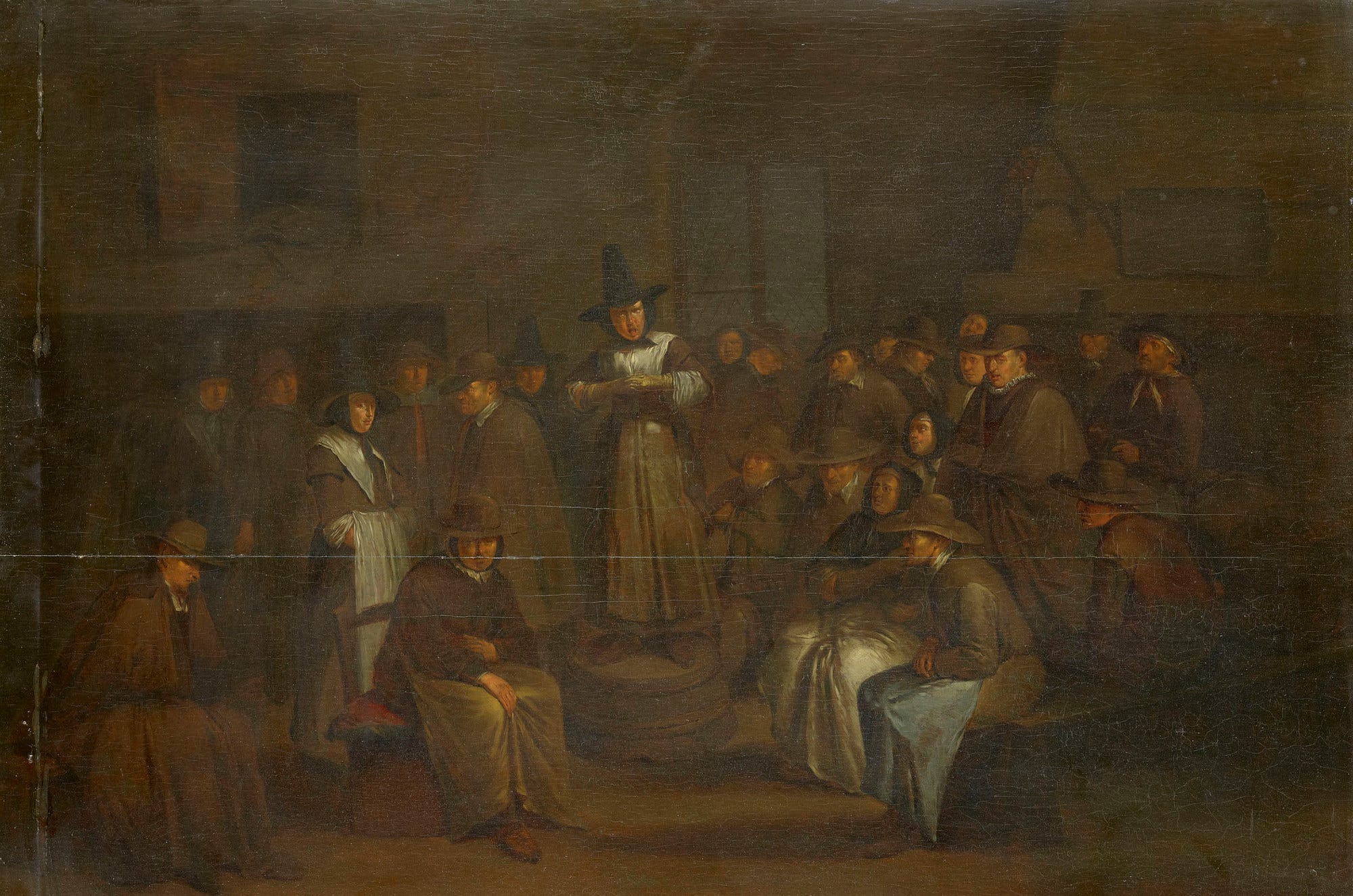
Truth Held Forth was a passionate argument against Puritan government, and the longest chapter (12% of the book) criticized the Salem Witch Trials. Maule believed that the trials were God’s punishment for the colony’s execution of four Quaker missionaries between 1659 and 1661.1
Maule spent a year in prison as he awaited his trial. When the day finally arrived, he didn’t cower before the judges or confess to his “crime.” Maule fought back: he argued that his book was a religious text and therefore should be debated in a religious context, not a secular court. He told the judges that while he respected them otherwise, regarding this particular case, “I do no more value you than I do a jack-straw.” He cleverly added that though his name was on the book, anyone—even the Devil—could have printed it there: his name was “no more than the specter of evidence.”2
This pointed reference to the use of spectral evidence during the Salem Witch Trials must have jolted the judges. But attitudes had changed in the years since the Salem fiasco, and much to the judges’ dismay, the jury acquitted Maule of all charges.
The case of Thomas Maule marked a turning point not just in the public discourse around the Salem trials, but in the broader identity of Colonial America. It was a sweeping victory for freedom of speech, freedom of religion, and freedom of the press—and a sign that the Puritans’ stranglehold on Massachusetts Bay was coming to an end.
In the lead-up to Maule’s trial was a massive shift in public opinion regarding the validity of spectral evidence (though belief in witches and magic continued throughout the Western world). When Phips allowed the Court of Oyer and Terminer to reconvene in January to hear the remaining witchcraft cases, he did so with the order that spectral evidence could not be used in court. Out of dozens of cases, only three people were convicted. However, Phips reprieved them, along with five other victims in line for execution. All were spared from the gallows.3
Deputy governor William Stoughton had already signed the orders for their hangings, and he was livid when he learned that the governor had intervened to save their lives. As the Chief Justice of the Court of Oyer and Terminer, Stoughton would remain a staunch supporter of the Salem Witch Trials until his death in 1701. When Governor Phips died in 1695, Stoughton became the interim governor of the colony while the Crown looked to appoint a new leader. During his tenure, Stoughton impeded efforts among legislators to reverse the attainders on the convicted “witches” who were saved from execution. (A reversal of attainder is when convicted criminals have their civil rights restored.) Several, including John Proctor’s widow Elizabeth, would only gain that meager victory after Stoughton’s death.4
One judge who experienced a major change of heart was Samuel Sewall. In 1696, Sewall wrote a public apology to the victims of the witch trials on behalf of the colony’s House of Representatives. The House also passed a bill to institute a day of fasting and reformation. (These actions led to a major falling-out between Sewall and Stoughton.) On the Fast Day, Sewall took things a step further by issuing a personal apology before his church’s congregation, which was read aloud by his reverend:
Samuel Sewall, sensible of the reiterated strokes of God upon himself and family; and being sensible that as to the guilt contracted, upon the opening of the late Commission of Oyer and Terminer at Salem (to which the order for this day relates) he is, upon many accounts, more concerned than any that he knows of, desires to take the blame and shame of it, asking pardon of men, and especially desiring prayers that God, who has an unlimited authority, would pardon that sin and all other his sins.5
It must have been an astounding sight to see one of the richest and most powerful men in the colony issue a statement of repentance. Sewall’s family had suffered the loss of a daughter in the years since the trials, and he was convinced that God was punishing him for his role in sentencing innocent people to death. Sewall would grow more progressive in his views as he aged, and he became a passionate abolitionist. He would never forgive himself for his actions in Salem.
Both Maule’s trial and Sewall’s apology influenced the merchant Robert Calef to write More Wonders of the Invisible World (1700), a direct attack on Cotton Mather’s Wonders of the Invisible World, which had publicly defended the Court of Oyer and Terminer. Calef was engaged in an ongoing feud with the younger Mather over the handling of witchcraft accusations, and their public writings attacking each others’ perspectives helped to keep memories of the trials alive in popular history.

The victims’ families also sustained the legacy of the Salem Witch Trials. In the aftermath of the horrific events of 1692, Salem Village was torn apart, and any semblance of community trust evaporated. Many of the victims’ families moved to other towns, sometimes even outside of the Massachusetts Bay Colony, and they brought the stories of that harrowing year with them. Some tried to create memorials or seek official apologies for executed victims. The resistance and dithering on the part of local leaders only helped to cement the infamy of the trials in the public conscience.
Meanwhile, Reverend Parris was barely clinging to his job, and he grew so desperate that in 1694, he apologized for his role in the witch trials. The dispute between Parris and the villagers dragged on for several years until he was finally expelled from the community in 1697. He spent the next two decades bouncing from post to post; ultimately, he quit preaching and became a farmer, building a modest estate for his family before his death in 1720.6
And what of the girls who spearheaded the accusations? Massachusetts Bay was a deeply patriarchal society, and thus, records focusing on the lives of women and girls are less plentiful. Betty Parris married a shoemaker in 1710, bore five children, and lived a long life. Abigail Williams and Mary Warren disappear from the records shortly after the trials. Ann Putnam Jr. lost both of her parents in 1699, and at the age of nineteen, she took over the raising of her seven siblings. She died at 38, having never married—interestingly, living the lifestyle of many female victims of witch trials throughout history. She would apologize for her role in the Salem trials when she became a member of the Salem Village church at twenty-nine.7
Salem Village would not achieve separation from Salem Town until 1751, and it was given the new name of Danvers. This change has allowed Danvers to stay out of the Salem limelight ever since. As I noted in the very first entry of this series, many of the tourists who flood Salem each October have no idea that the initial outbreak of witchcraft accusations occurred in the next town over, even if the actual trials and executions occurred in Salem Town.
Massachusetts Bay would never be the same. The legal changes we discussed in earlier entries regarding the new royal charter—namely, religious tolerance for all Protestants, the Crown’s appointing of the colony’s governor, and the requirement of adhering to English law—meant that Puritan leadership was bound to decline. The reactionary nature of the trials only hastened this along as they revealed the flaws of the colony’s leading Puritans. Additionally, the Privy Council in England banned theocratic death penalty laws soon after.8
Calvinist Congregationalism maintained its religious dominance in New England. But theocratic leadership was increasingly regarded with suspicion, and the events of the trials planted a kernel of an idea in the minds and hearts of New Englanders: separation of church and state might not be such a bad idea. Moreover, the censorship instituted by Governor Phips during and after the trials illuminated the importance of freedom of speech and freedom of the press to an otherwise illiberal audience.
Before I researched the events of 1692, I used to wonder how the American colonies could go from hanging witches to establishing a republic just eighty-four years later. After all, many of the revolutionaries had relatives who were involved in the witch trials. Most famously, Benjamin Franklin’s aunt Bathsheba Pope was a Quaker who became one of the many “afflicted” people to levy accusations against Martha Cory, John Proctor, and Bathsheba Pope. One generation later, her nephew would become a leading figure in the Age of Enlightenment. Salem would prove to be not an aberration in the history of Colonial America, but a catalyst that illuminated the need for stronger civil liberties and guardrails against theocracy.
In our age of Internet pile-ons, political purity tests, and rabid ideologues who revel in canceling their foes, I find that the lessons of Salem are desperately needed at both ends of the political spectrum. Salem remains a powerful example of the dangers of mob rule and the need to support dissenting voices—even if they are inconvenient, and especially when our instinct is to turn away from the mirror in their hands.
Related from The Crossroads Gazette:


Emerson W. Baker, A Storm of Witchcraft: The Salem Trials and the American Experience (Oxford University Press, 2015), 213-216.
Baker, A Storm of Witchcraft, 218.
Michael P. Winship, Hot Protestants: A History of Puritanism in England and America (Yale University Press, 2018), 289-290.
Baker, A Storm of Witchcraft, 246.
Baker, A Storm of Witchcraft, 222-223.
Baker, A Storm of Witchcraft, 231-233.
Baker, A Storm of Witchcraft, 234-235.
Winship, Hot Protestants, 292.