

Rejection and Family Secrets: The Early Days of Manet's Career
In the next installment of our series, we learn about Édouard Manet's initial setbacks and the secret at the heart of his personal life.

This essay is part of the series The Life of Édouard Manet.

If the weather was fair, one might see Édouard Manet strolling through the streets of Paris.
Manet was a consummate flaneur in the great Parisian tradition. The city was transforming before his eyes. The Bourbons were finished, Napoleon III was on the throne, and Baron Haussmann was tearing down medieval slums and broadening the streets. His vision was met with ire and disdain from many locals—they didn’t use the word “gentrification” in this context yet, but everyone knew that the poor were getting pushed out.
Despite all of Haussmann’s efforts, not every musician, dancer, prostitute, or drunk could be banished from his modern dream of Paris. Manet was fascinated by the city’s evolution, by its contrasts. As a young man from a wealthy family, his childhood was miles away from the discomforts of ordinary life. Often, we are drawn to the unfamiliar: Pierre-Auguste Renoir came from the working class and loved to paint the gilded beauties of the Parisian bourgeoisie, while Manet came from the landed gentry and often painted working men and women.
It’s easy in our more cynical times to roll our eyes at the class tourism, but it’s important to keep in mind how extraordinary this would have been to a 19th-century audience. In 1859, Impressionism had yet to be born, and the radical movement of the day was Realism. The Realists wished to portray the masses through an unvarnished lens, and their subject matter served as a statement that the lives of everyday people were worthy of artistic investigation. (As we’ll see later in our series, Impressionism took this a step further by breaking with traditional techniques and compositional norms.) Leading French Realists included Gustave Courbet, Rosa Bonheur, and Jean-François Millet.
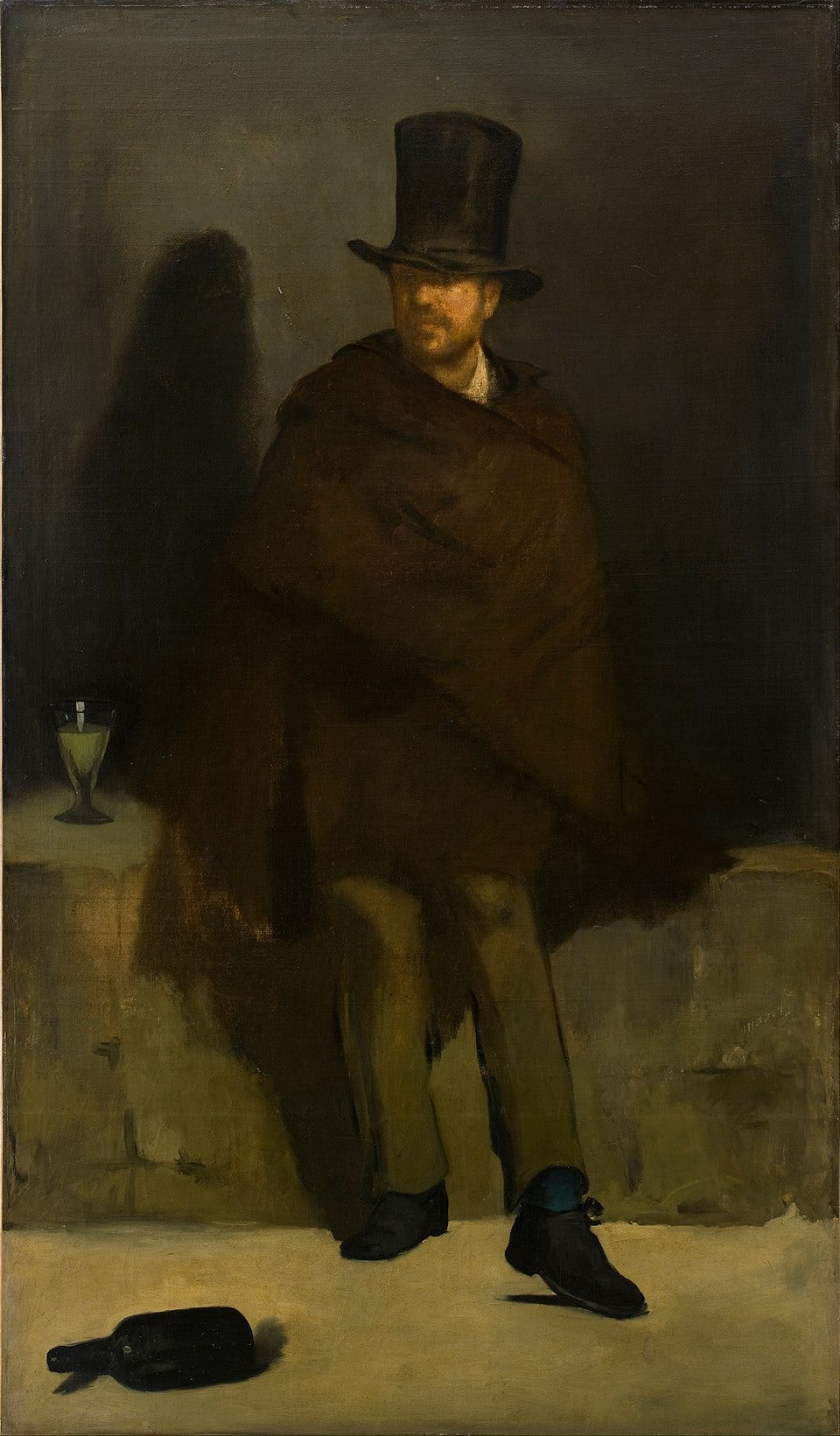
Though Manet did paint a few history paintings in his early career, he swiftly turned to Realism after leaving Thomas Couture’s studio. One of his early forays was The Absinthe Drinker (1859), a somber image of an alcoholic named Collardet.
Collardet was a chiffonier—a rag-picker or rag-and-bone man, someone who collected unwanted items and sold them to merchants in the days before thrifting became “cool.” Collardet could frequently be found near the Louvre, and it’s likely that this is where Manet stumbled upon him. Manet submitted the work to the Salon of 1859, and all jury members, including Couture, rejected the painting—with the notable exception of Eugène Delacroix.
Couture was absolutely appalled by his former student’s creation. Absinthe was a drink for degenerates. It certainly didn’t belong on the walls of the Salon. Though a strong early work, the painting doesn’t exhibit the same technical prowess of pieces that Manet would produce even a year or two later. After all, practice makes perfect.
Manet was home with his friend, the poet Charles Baudelaire, when he heard the news of his rejection. At the time, Manet was twenty-seven years old, and he wanted the Salon’s approval. Never mind his rebelliousness in embracing Realism! Manet was brought up by the establishment, and he craved institutional support. Baudelaire tried to encourage him. “You’ve just got to be true to yourself,” he said.1
The problem was that Manet didn’t fit neatly anywhere. He felt far more comfortable at Tortoni’s on the boulevard des Italiens than he did among true bohemians. Even Baudelaire, once friends with the Realist Gustave Courbet, was eventually turned off by “the mob of vulgar artists and literary men whose short-sighted intelligence takes shelter behind the vague and obscure word realism.”2
But Manet wasn’t a history painter either, and he would have to carve out his own niche.
His personal life was similarly of dual natures: handsome and stylishly-dressed in the latest fashions, he possessed the social charms and confidence of someone brought up in Paris’s elite circles. Yet like his father, he harbored republican sympathies—why should the French be ruled by a king? And his lover was not a great lady of Society, but his younger brothers’ piano teacher, with whom Manet lived in secret. Suzanne Leenhoff was a Dutch musician from a modest background, and she was several years older than Manet (far from being a normal match at the time).
In 1852, when Suzanne was twenty-two and Manet was nineteen, she gave birth to a boy whom she named Léon Édouard. She gave him the last name Koëlla, and several years later, the boy was baptized. Manet acted as his godfather, and Suzanne claimed the child as her younger brother in official records. She only acknowledged that she was Léon’s mother shortly before her death for inheritance purposes.
We don’t know precisely when the affair with Suzanne began. It’s unclear if Léon Koëlla was the son of Édouard Manet; he never claimed paternity of the boy, though he raised Léon with Suzanne and frequently painted him. It’s also possible that Suzanne was initially the mistress of Manet’s father, which would explain why they waited to marry until after his father’s death, even though his mother was still alive. (The couple married in 1863.) As was the case for upper-class families of the era, a secret like that was carefully guarded.
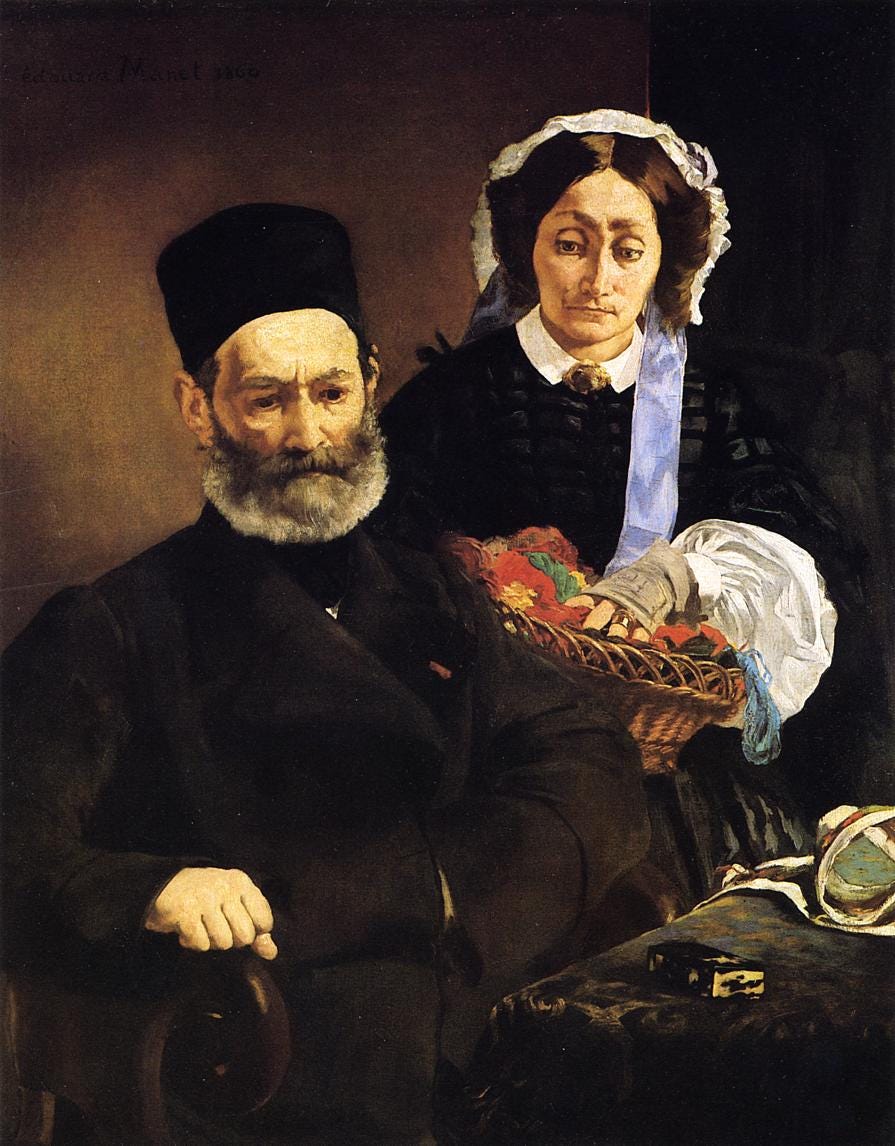
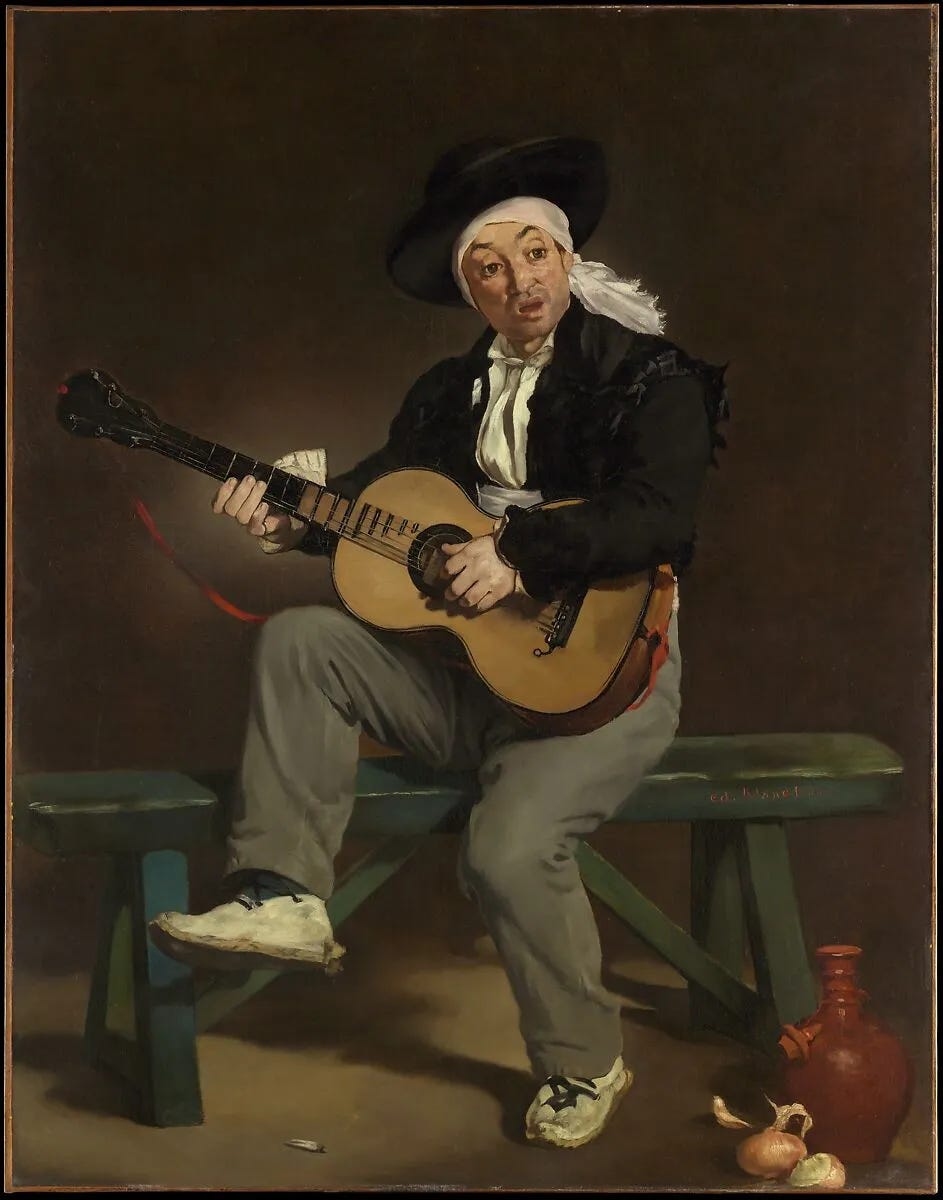
Manet worked past his rejection in 1859, and two years later, he finally succeeded in placing two works at the Salon. One, a portrait of his parents (above), inspired little enthusiasm. But the second painting, Spanish Guitar Player (1860), caught the attention of attendees. As the French writer and literary critic Fernand Desnoyers observed:
This canvas, which made so many painters’ eyes and mouths open wide, was signed by a new name, Manet. This Spanish musician was painted in a certain strange, new fashion, of which the young, astonished painters believed themselves alone to possess the secret, a kind of painting that stands between that called realistic and that called romantic.3
Here was a new talent to follow. (And a reminder that there’s no such thing as overnight success, for this “big break” arrived a decade into Manet’s career.) The painting was awarded an honorable mention at the Salon of 1861, with many comparing it to the works of Diego Velázquez and Francisco Goya. For a Salon debut, it was quite the success.
However, Manet’s artistic vision would soon push boundaries that even other Realists wouldn’t dare cross. The works he painted over the next few years would make him a target of outrage—and cement his fame.
Sue Roe, The Private Lives of the Impressionists (Vintage, 2006), 32.
John Rewald, The History of Impressionism: Fourth, Revised Edition (New York: Museum of Modern Art, 1973), 52.
Rewald, History of Impressionism, 52.