

Rossetti's Women of Myth
Examining the influence of mythology on the works of Dante Gabriel Rossetti, and why he turned away from the Pre-Raphaelite Brotherhood.

This essay is part of the series Art, Myth, and Literature: The Pre-Raphaelites.

The Pre-Raphaelite Brotherhood rushed into the world with boyish enthusiasm in 1848, and by 1853, it was over.
Or rather, the Brotherhood itself had all but dissolved. The style its members pioneered would endure for decades, partially due to the movement’s literary ties.
Within the original Brotherhood, several of its members were writers. William Michael Rossetti was a passionate advocate for the movement, and he grew his career as an art critic while his peers were developing as painters. Even among the painters (such as William’s brother, Dante Gabriel Rossetti), there existed great enthusiasm for writing, especially poetry. Finally, one cannot forget the writers who were not themselves part of the Brotherhood but were associated with its members. Examples include the art critic and historian John Ruskin, as well as Christina Rossetti, the great Victorian poet and sister of Dante and William Rossetti. Not only did works of literature and mythology inspire the Pre-Raphaelites, but their close connections with writers served to amplify their cause and maintain the notoriety surrounding the movement.
The art of Dante Gabriel Rossetti is emblematic of the Pre-Raphaelites’ literary flair. Yet, he was the earliest member to pull back from the group after the disastrous year of 1850.
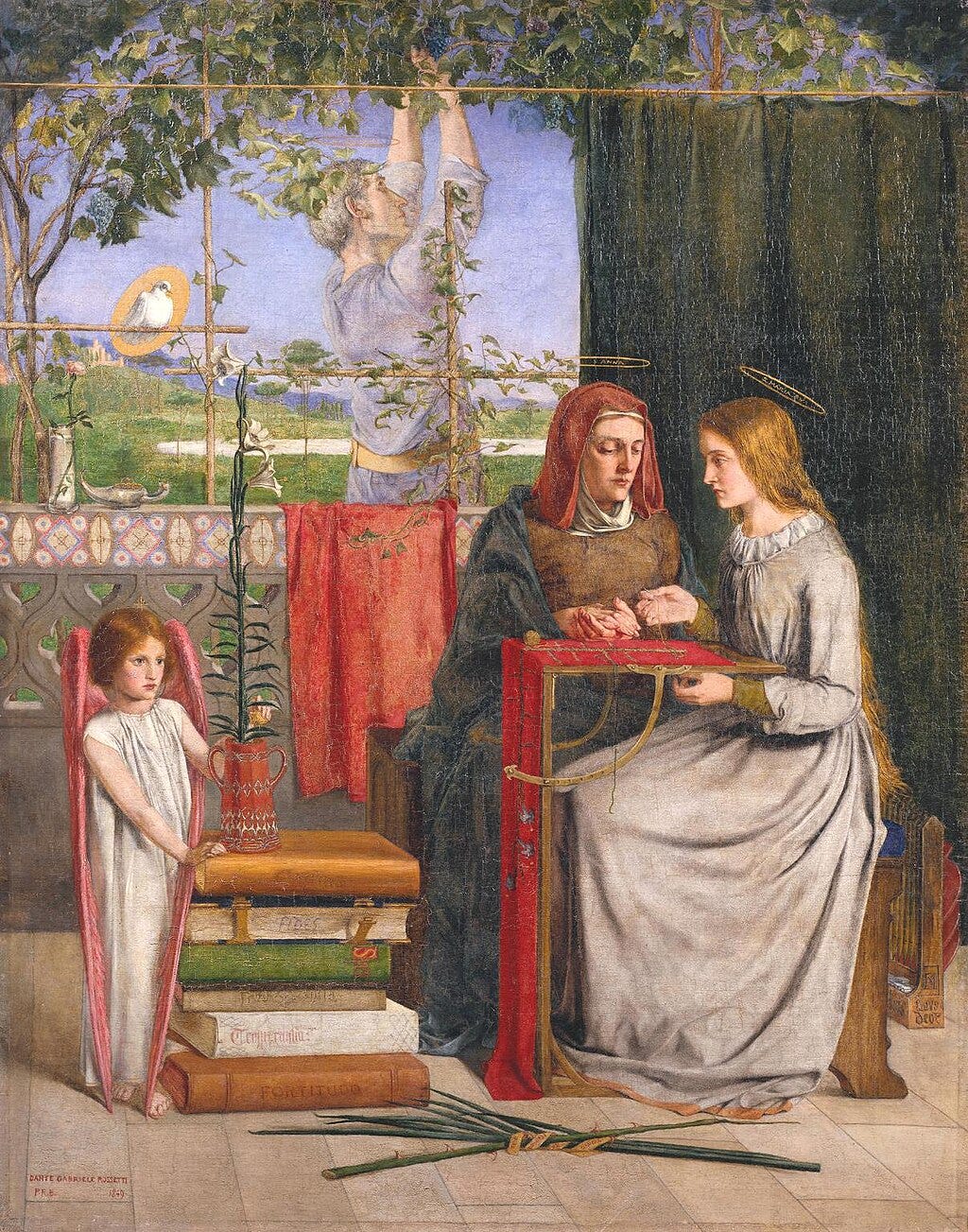

Everything seemed to be going according to plan. In 1849, the Brotherhood exhibited works at the Royal Academy to mixed reviews. While it wasn’t a victory, critics were beginning to understand the goals of the Brotherhood. As one writer observed in the Morning Chronicle, Rossetti’s Girlhood of Mary Virgin (above) was “remarkable… for the feeling with which it adopts the ‘early religious’ style, and reprehensible for the blind idolatry of imitation.” A critic for the Athenaeum praised the piece for showcasing “much of the sacred mysticism inseparable from the works of the early masters.”1
There was something odd about these “revivalist” paintings—works by Rossetti, William Holman Hunt, John Everett Millais, and other members of the Brotherhood featured the initials “P.R.B.” (Members of the Royal Academy would include the initials R.A. for Royal Academician or A.R.A. for Associate of the Royal Academy.) Then, in May of 1850, a gossip column called the Illustrated London News revealed the truth: P.R.B. stood for Pre-Raphaelite Brotherhood, a secret society of young artists who had been operating right under the nose of the Royal Academy.
For context, post-Napoleonic Europe was a time in which secret, liberal societies spread in defiance of the conservative order established by Prince Metternich and the Congress of Vienna. From 1815 onward, the monarchies of Europe strove to put down any revolutionary rumblings, until pro-democracy sentiments boiled over during the Revolutions of 1848.2 Though the Pre-Raphaelite Brotherhood was not explicitly political in nature, I do have to wonder how this backdrop of a rigid, monarchical establishment played a role in reactions toward the 1850 exhibition season.
No longer would the Brotherhood receive balanced reviews. The press became so vicious, so dramatic in its criticism that the satirical magazine Punch made fun of the critics as much as it did the art itself. Critics claimed that the Brotherhood’s subjects appeared deformed, diseased, and unwashed.3 Dante Gabriel Rossetti was so distressed by this reception that he significantly pulled back from public exhibitions, even as Hunt and Millais stubbornly persisted.
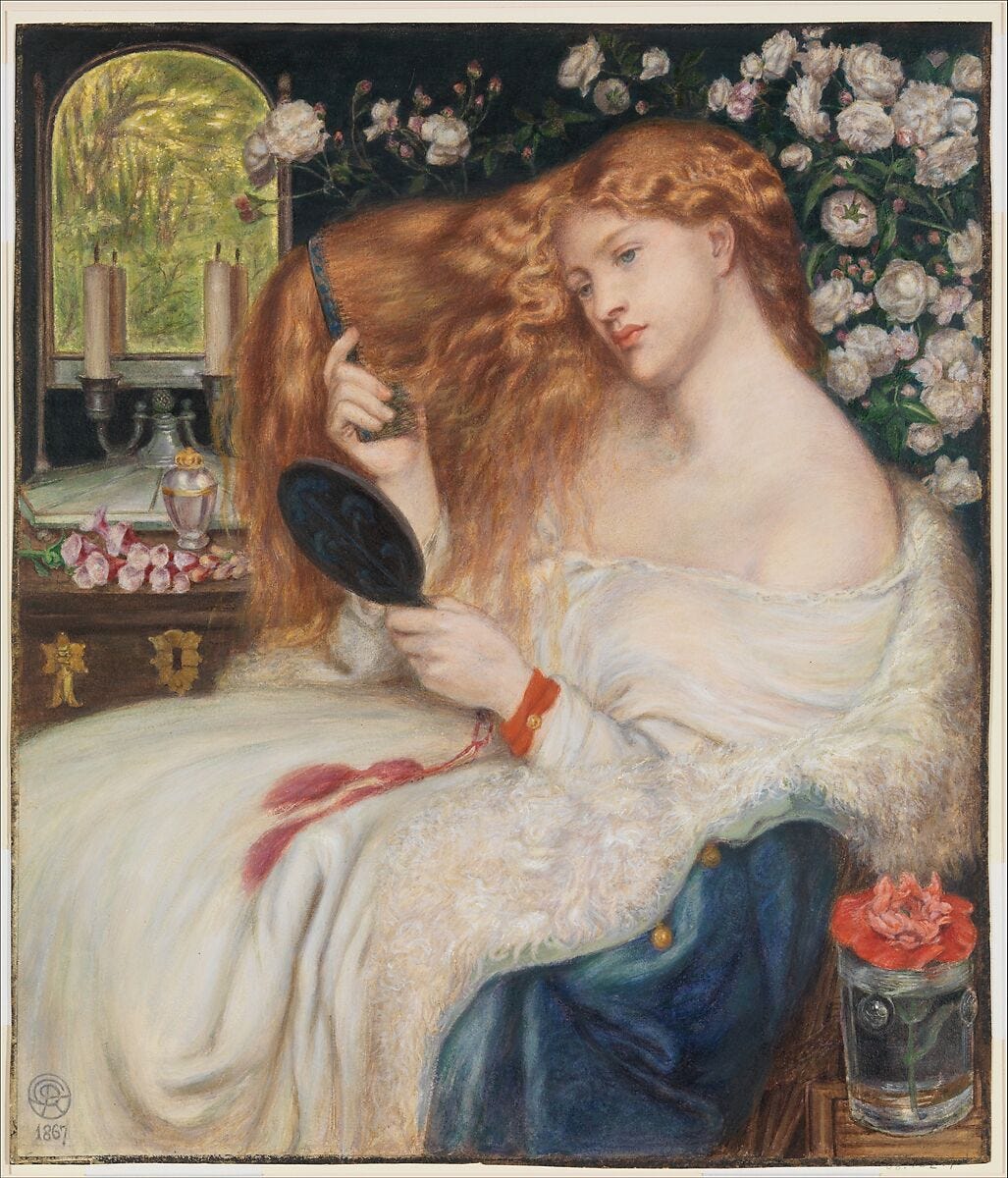
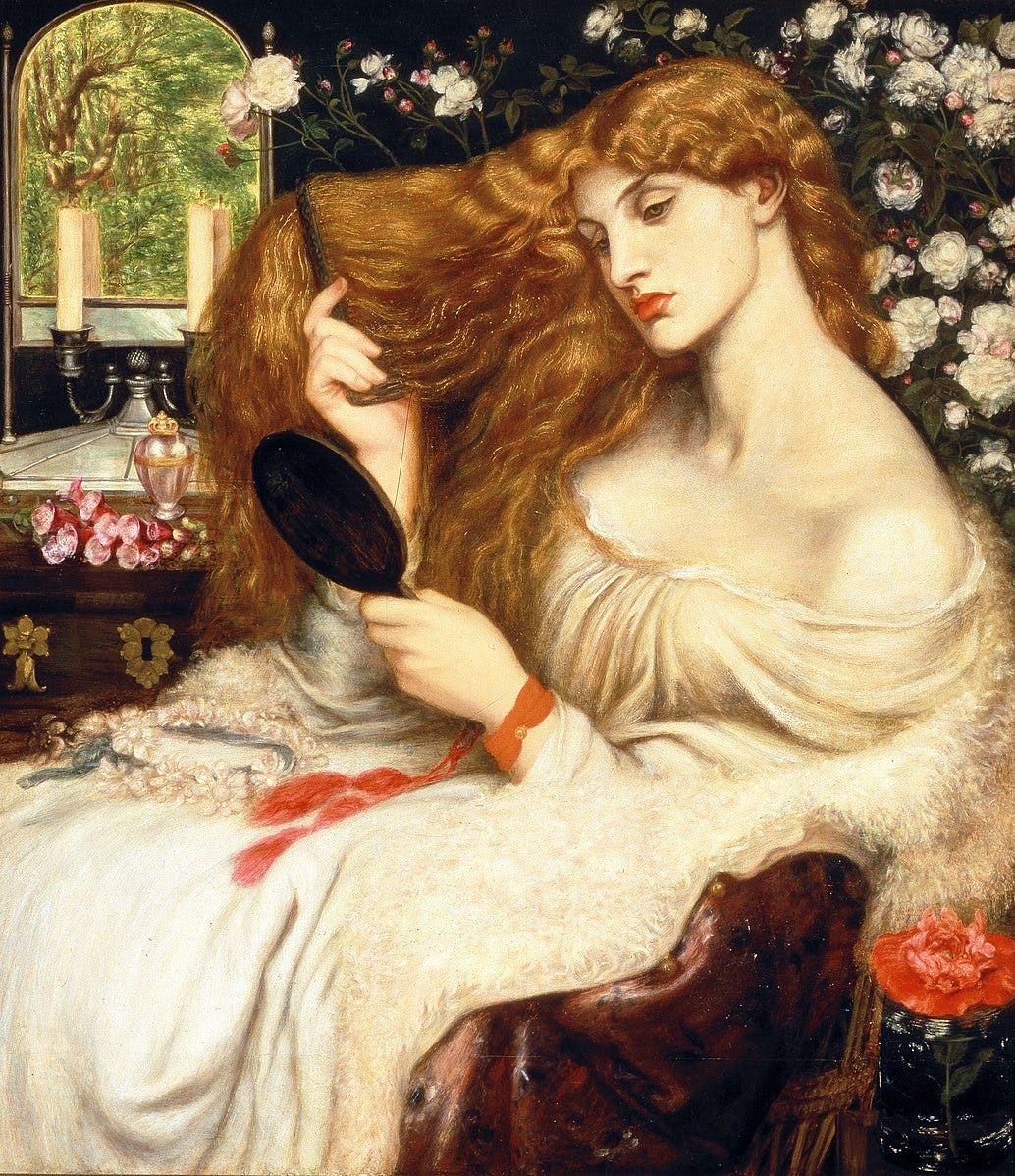
However, Rossetti’s body of work continued to feature traits from the movement that he helped to pioneer. Though he began to move away from medieval and Quattrocento-inspired tableaux in favor of portraits, these images remained vibrantly-colored and highly detailed, and in many cases, included women from ancient myths. His portraits of Lilith (above) both feature striking beauties with red hair, and he was so taken with pale, red-headed models that the look became a cliché of the Pre-Raphaelite muse. (We will examine the muse in greater detail in the next entry, when we turn to the subject of Elizabeth Siddal, Rossetti’s wife and the face of Millais’s Ophelia.)
Rossetti’s portraits of women often possessed a femme-fatale essence, with sharp features and fiery hair. Lady Lilith depicts a character from Jewish mythology—the first wife of Adam, who does not appear in biblical texts but in popular folklore. Her roots stretch back to ancient Mesopotamia, but by the medieval period, her story evolved into that of a seductress who refused to be subservient to her husband, and was thus cast out of the Garden of Eden.
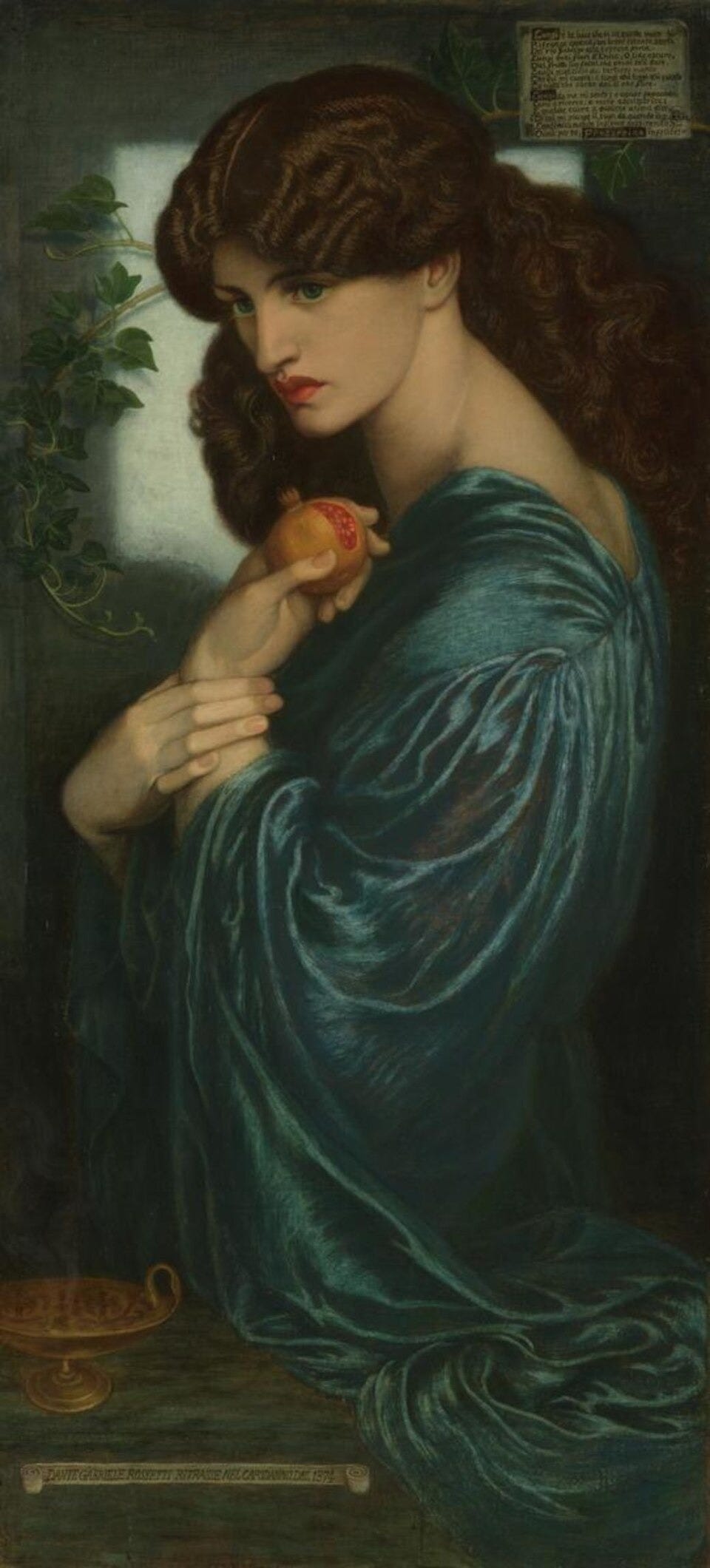
Another portrait by Rossetti that features a woman of myth is his 1874 Proserpine. Proserpine or Proserpina is the Romanized deity of the Greek Persephone, the goddess of spring whom Hades abducts and makes Queen of the Underworld. In Rossetti’s portrait, she holds the enchanted pomegranate; when consumed, its seeds trap Persephone in the Underworld during the winter months.
Rossetti painted this in the final decade of his short life. He struggled enormously with addiction, and later, kidney disease. His mental health had taken quite the beating two years before completing Proserpine, when critics roundly scorned his first published collection of poetry. The goddess in this image is gazing hesitantly toward the light, imagining the prospect of freedom. It is a touching scene when considering the artist’s state during its creation.

While scenes from myths or canonical works of literature were among the loftiest subjects by the standards of French academic art, this was not the case in England when the Pre-Raphaelites burst onto the scene in 1848. Those who followed my Impressionism series will know that the Salon des Beaux-Arts prioritized religious, mythological, or historical subjects above landscapes and domestic scenes. While Impressionism was several decades away, the French avant-garde of the 1840s and 1850s manifested in the Realism Movement. Its artists strove to represent ordinary (often working-class) people and landscapes as they were.
In early-Victorian England, religious and historical works were not as popular. Instead, Royal Academicians gravitated toward pleasant, commercially-viable subjects such as Edwin Landseer’s paintings of animals (who doesn’t love dogs?), Francis Grant’s portraits of the royal family, or Charles Robert Leslie’s genre paintings. When works from history or literature were painted, such as Leslie’s The Principal Characters in ‘The Merry Wives of Windsor’ (1838), they usually featured light-hearted scenes. In the words of art historian Elizabeth Prettejohn, the Pre-Raphaelite Brotherhood represented “an attack from above”: artists like Rossetti sought to elevate the mythic once again.4
By 1853, when the artists reached their mid-twenties, they stopped meeting regularly and the Brotherhood fizzled out. But as Rossetti’s later works featured in this essay will prove, 1853 was far from being the end for the Pre-Raphaelites—and for the remainder of this series, we will see how the movement evolved in the 1860s and beyond.
Elizabeth Prettejohn, The Art of the Pre-Raphaelites (Princeton University Press, 2000), 46.
To learn more about this fascinating subject, I strongly recommend reading Chapter 1 and Chapter 3 of Richard J. Evans’ The Pursuit of Power: Europe 1815-1914 (Penguin Books, 2016).
Prettejohn, The Art of the Pre-Raphaelites, 48.
Prettejohn, The Art of the Pre-Raphaelites, 36-37.