

Seeing Georgia O'Keeffe's Floral Studies in a New Light
For decades, Freudian interpretations of O'Keeffe's floral studies have reigned supreme. There's just one problem: the artist spent her entire career denying them.

This essay is part of the series Flowers in Art.
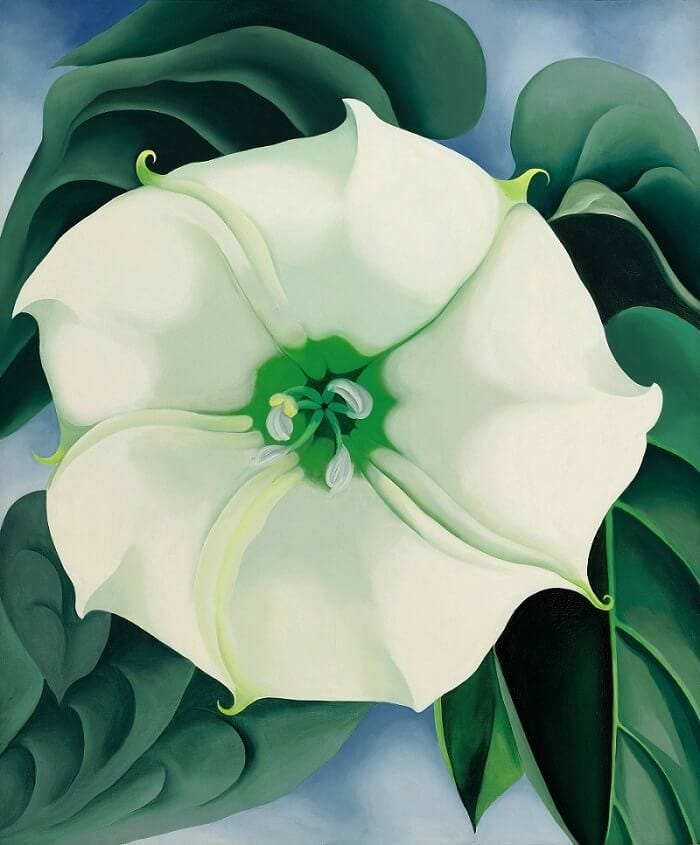
In 2016, the Tate Modern in London hosted a retrospective of Georgia O’Keeffe’s art, in what was the largest exhibition of the artist’s work in the United Kingdom. The 2010s were a big decade for O’Keeffe—in 2014, Jimson Weed (1932), one of her many floral paintings, sold at auction for $44.4 million. It was the most expensive painting by a female artist to be sold.
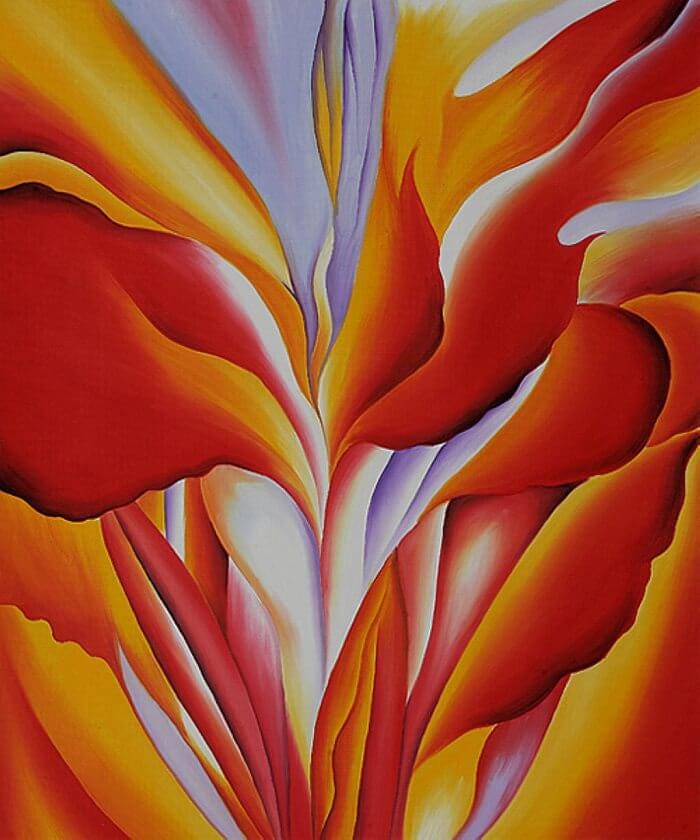
O’Keeffe’s studies of flowers inspire much blushing from viewers. For decades, they have been interpreted as erotic works that resemble female genitalia. Critics in the mid-twentieth century saw them through a Freudian lens; to them, these were works of female anatomy by a female artist.
There’s just one problem: O’Keeffe spent her entire career vigorously denying this interpretation.
Georgia O’Keeffe was born near Sun Prairie, Wisconsin in 1887. She moved to Chicago at eighteen years old to study at the Art Institute of Chicago, then later the Art Students League of New York, the University of Virginia, and again in New York at Columbia University’s Teachers College. By 1916, she had lived all over the country and worked as an art teacher.
The trajectory of her career would change that year. She had produced a series of abstract charcoal drawings, which caught the eye of photographer and gallerist Alfred Stieglitz. “At last, a woman on paper!” he cried out. Her work could soon be found at Stieglitz’s gallery, 291—an institution that introduced New Yorkers to many avant-garde artists of the period.1
O’Keeffe would eventually marry Stieglitz, and their tumultuous relationship lasted until Stieglitz’s death in 1946. Stieglitz was a fierce promoter of O’Keeffe’s work; he hosted dozens of exhibitions on her behalf and connected her with his circle of American modernists. He was also a deeply unfaithful husband—one would feel sorry for O’Keeffe, except for the fact that he was married to another woman when they began their affair. (When someone shows you who they are the first time, believe them!)
O’Keeffe originally began painting her botanical studies in 1924 at the Stieglitz family’s summer house on Lake George, but as her marriage deteriorated, she sought solace further afield. Her first trip to New Mexico was in 1929, and she discovered a fountain of inspiration in its arid, desert landscapes. She spent the next twenty years making annual trips to the state, and made it a permanent move after her husband passed.2
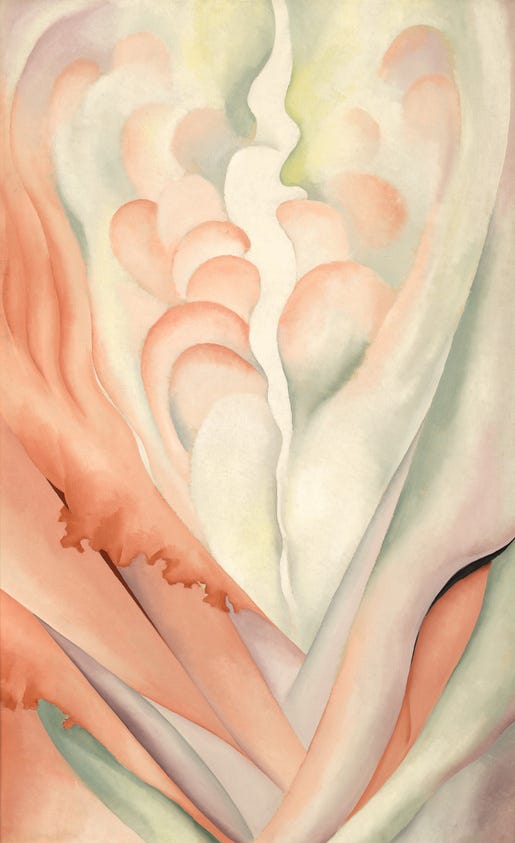
Flower Abstraction (1924) is one of O’Keeffe’s earliest botanical studies. Being surrounded by modernist photographers, O’Keeffe borrowed their technique of closely-cropped images and applied it to her compositions. In an era in which painting was becoming ever more abstract, O’Keeffe’s art straddled the line between abstraction and representation. She wanted viewers to see “ordinary” things, like flowers, in a new light. In her words, “Paint it big and they will be surprised into taking time to look at it—I will make even busy New Yorkers take time to see what I see of flowers.”3
Her work was swiftly interpreted in a Freudian lens by male critics, much to O’Keeffe’s dismay. It was actually her husband who first promoted the idea; Stieglitz was very interested in Freudian theory, though it’s possible that he also saw this as a marketing opportunity. In his gallery, he would sometimes display these paintings alongside nude photographs he had taken of his wife.
O’Keeffe was unable to shake this characterization for decades. By the 1970s, feminist critics now promoted the idea that these flowers represented female genitalia, though unlike the psychoanalysts of the 1920s and 30s, they argued that this was symbolic of female empowerment. Still, O’Keeffe denied that this was ever her intention.
In organizing the 2016 show at the Tate, then-Director of Exhibitions Achim Borchardt-Hume told The Guardian:
O’Keeffe has been very much reduced to one particular body of work, which tends to be read in one particular way. Many of the white male artists across the 20th century have the privilege of being read on multiple levels, while others—be they women or artists from other parts of the world—tend to be reduced to one conservative reading. It’s high time that galleries and museums challenge this.4
Paint it big and they will be surprised into taking time to look at it. Beauty is in the eye of the beholder, and of course, anyone can interpret any work of art however they wish. But if we want to do away with old interpretations of O’Keeffe’s work, as she spent over six decades denying their validity, we must turn to her oeuvre with fresh eyes. What do we see?
One thing that occurs to me is how O’Keeffe’s close-cropping forces viewers to notice the complexity of each flower’s structure. Had she set these scenes further back, they wouldn’t have the same impact. In her renderings, every flower becomes a tiny miracle of nature, something one might not notice when strolling through flower beds and taking in a garden as a whole.
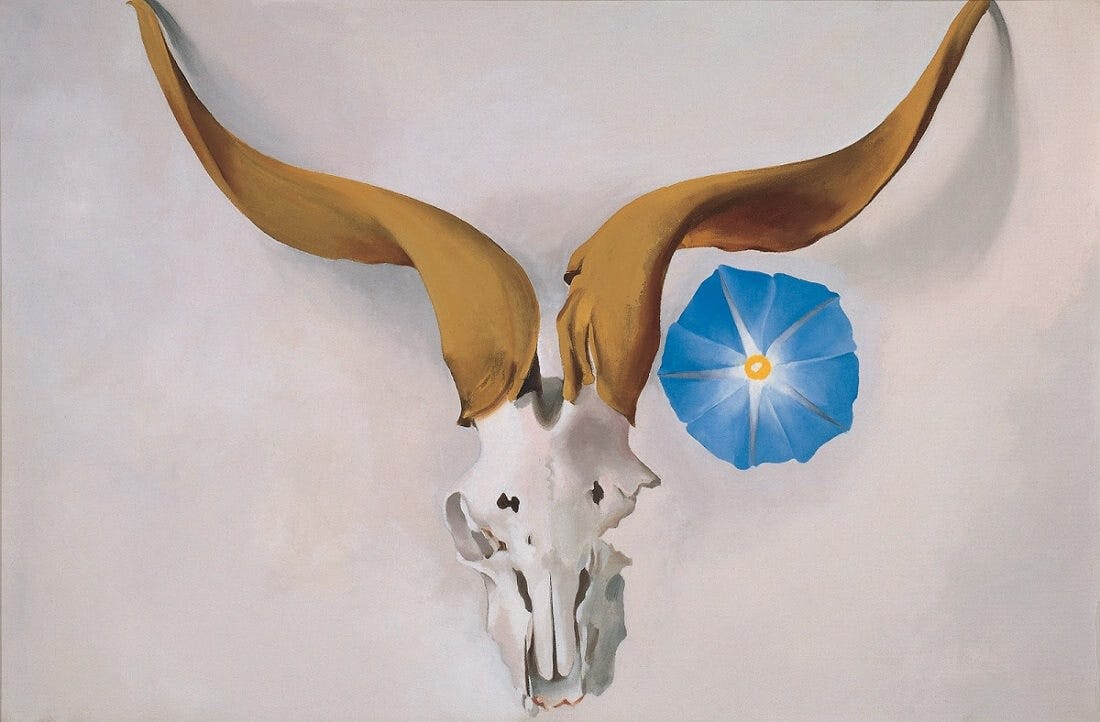
This becomes more poignant when considering her lengthy visits and eventual relocation to New Mexico. Desert landscapes compel one to appreciate plant life and its ability to survive even in the most unforgiving conditions.
O’Keeffe’s paintings demand a certain stillness in viewers, a stillness that anyone who has visited a desert before will understand. O’Keeffe was living in a world that was moving faster, advancing technologically, in a country that would be forever altered by two world wars. Her art invites us to pause and revel in the quiet details of a flower, and see each bloom as a universe unto itself.
Georgia O’Keeffe died in 1986 at the age of 98. In the final decade of her life, her eyesight deteriorated considerably, and she hired assistants to help her continue painting.5 But her fading eyesight never dulled her vision: “I can see what I want to paint. The thing that makes you want to create is still there.”
Lisa Mintz Messinger, “Georgia O’Keeffe (1887–1986),” Heilbrunn Timeline of Art History (The Metropolitan Museum of Art, 2000–), http://www.metmuseum.org/toah/hd/geok/hd_geok.htm (October 2004).
Messinger, “Georgia O’Keeffe.”
“Georgia O’Keeffe, Flower Abstraction, 1924,” Whitney Museum of American Art, https://whitney.org/collection/works/984.
Hannah Ellis-Petersen, “Flowers or vaginas? Georgia O’Keeffe Tate show to challenge sexual cliches,” The Guardian, March 1, 2016, https://www.theguardian.com/artanddesign/2016/mar/01/georgia-okeeffe-show-at-tate-modern-to-challenge-outdated-views-of-artist.
“Biography,” Georgia O’Keeffe Museum, https://www.okeeffemuseum.org/about-georgia-okeeffe/.