

"Some Wretched Frenchman"
Édouard Manet shows "Le Déjeuner sur l’herbe" at the Salon des Refusés, and becomes the most notorious painter in Paris.

This essay is part of the series The Life of Édouard Manet.
.jpg)
In the spring of 1863, Édouard Manet received news from the Salon. All of his works were rejected by the jury.
That year was a blood-bath. Éugene Delacroix did not participate in jury deliberations (in fact, he would pass away that August), so there was no one to fight for young, avant-garde artists. A whopping 2,800 works were rejected, and the 5,600 that were accepted represented the work of only 988 painters. For comparison, in 1861, the year that Manet made his Salon debut, the jury accepted 1,289 painters.1
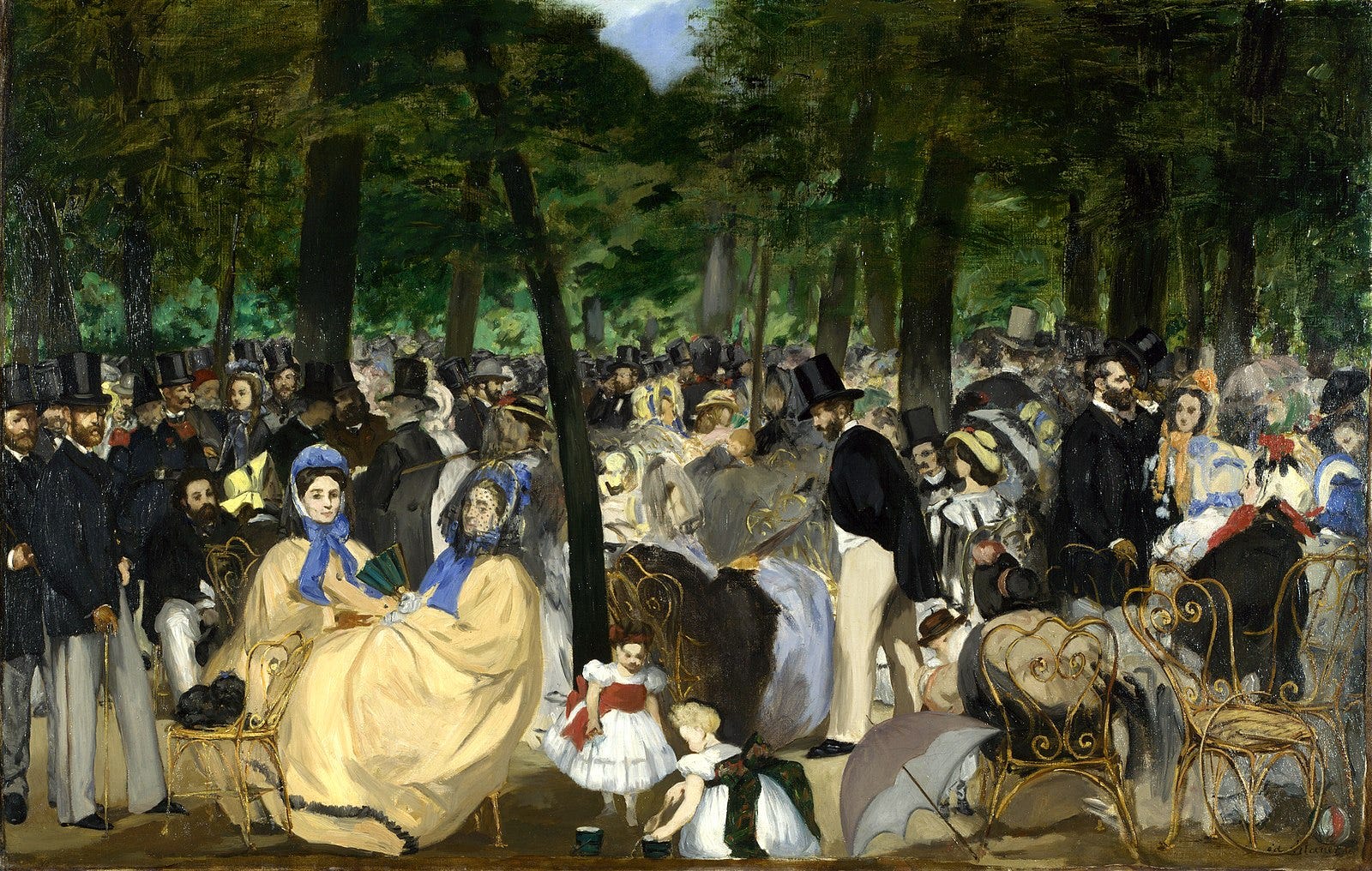
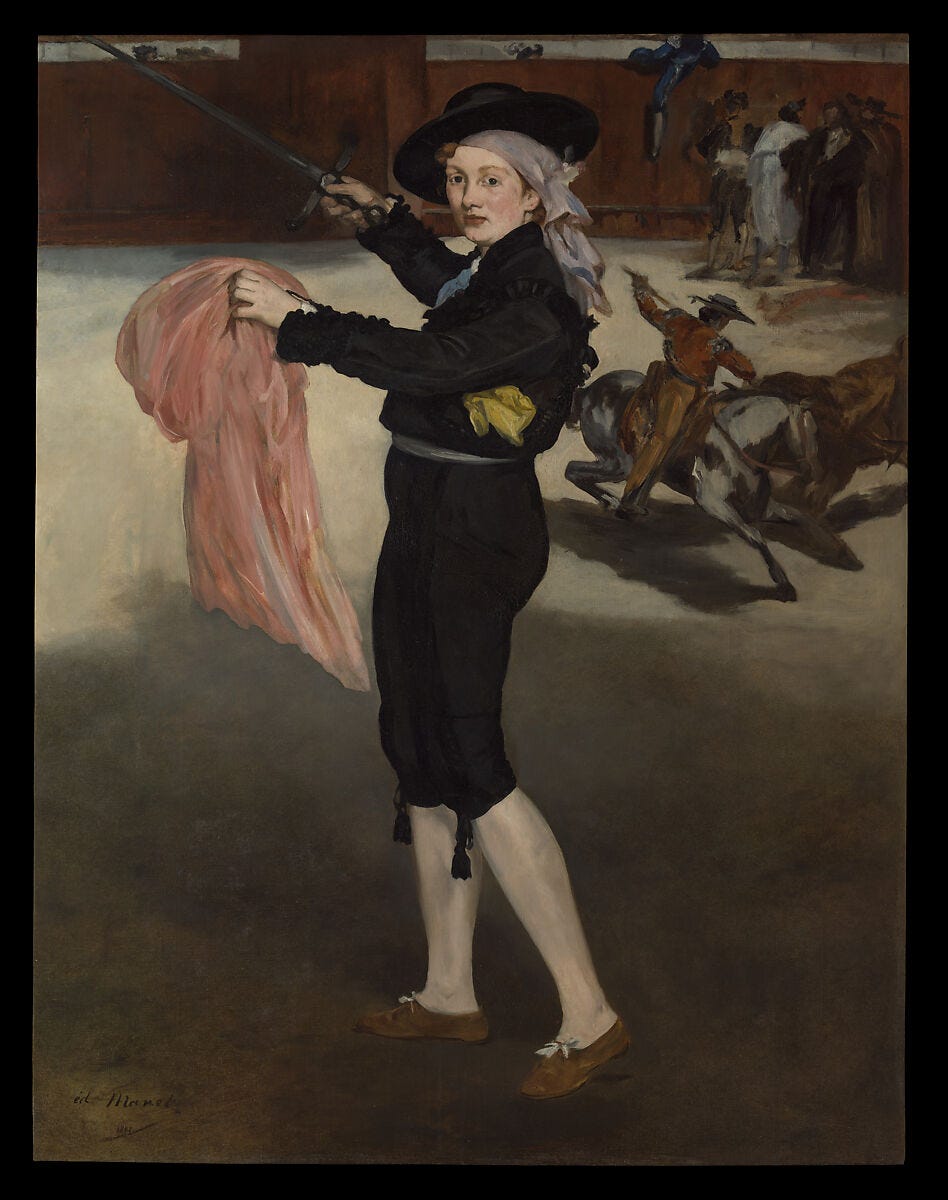
One of Manet’s works that was ultimately rejected was Music in the Tuileries Gardens (1862). Its subject was one that would eventually exemplify the Impressionist ethos—a snapshot of modern life in Paris, rendered in especially vibrant hues thanks to the recent innovation of synthetic pigment. Manet decided to show this painting, as well as Spanish Dancers (1862) and Mademoiselle V… in the Costume of an Espada (1862) at the commercial gallery Martinet’s. Critics lampooned his radical use of color: “a medly of red, blue, yellow, and black which is a caricature of color and not color itself.”2
When Delacroix attended the exhibit at Martinet’s, the aging Romantic was appalled by the jeering visitors who turned their noses up at Manet’s art. As he stormed out, Delacroix loudly proclaimed, “I regret not to have been able to defend this man.”3
By this point, Manet was asserting himself as a youthful leader among a new cohort of painters. Now in his early thirties, Manet had a bit more experience than the newcomers on the scene, including Edgar Degas, whom he befriended around this time. Manet held court at the Café de Bade, where a growing audience of painters and writers spent evenings around his table. They debated everything from politics to art and society. Now, the subject of the day was the Salon’s seismic rejection of artists who deviated even modestly from the establishment’s norms.
For readers who may wonder why painters craved official acceptance, remember that the French art market remained quite centralized at this point in history. Buyers would often refuse to purchase works rejected by the Salon, as its jury was deemed the ultimate arbiter of taste. Rejection therefore wasn’t just a matter of prestige—money was at stake, too. And as is often the case, where money is involved, corruption often follows. Many jury members prioritized voting for their friends.
The jury’s “massacre” posed a pesky problem for Napoleon III.
1863 was an election year, and the emperor feared appearing too regressive. The French had overthrown rulers twice in the past century. Like his uncle Napoleon Bonaparte, Napoleon III began his tenure as leader of a French Republic before proclaiming himself emperor. In a savvy move, he demanded to see all paintings submitted to the Salon that year, whether or not they were accepted. In the end, he came to a decision: in addition to that year’s scheduled Salon, the nation would host a “Salon des Refusés” in another section of the Palais de l’Industrie, where the Salon was held. The public could attend both shows, and viewers could decide for themselves if the jury had made the right decision.
Many of the rejected artists pulled their paintings, fearing punishment by the Salon in the future, or fearing that the Salon would try to sabotage the show by putting the worst paintings in prominent positions. After all, the jury wanted the public to take its side.
As we’ve explored in previous entries of this series, Manet was a complex character. He did not see himself as a revolutionary, despite the radical nature of his art. He didn’t want to burn down the establishment; he wanted the establishment to understand his point of view. Nevertheless, he supported having several of his paintings shown at the Salon des Refusés: Mademoiselle V (previously shown at Martinet’s), Young Man in the Costume of a Majo (1863; another Spanish-inspired work), and of course, the work that would make Manet the most notorious painter in Paris.
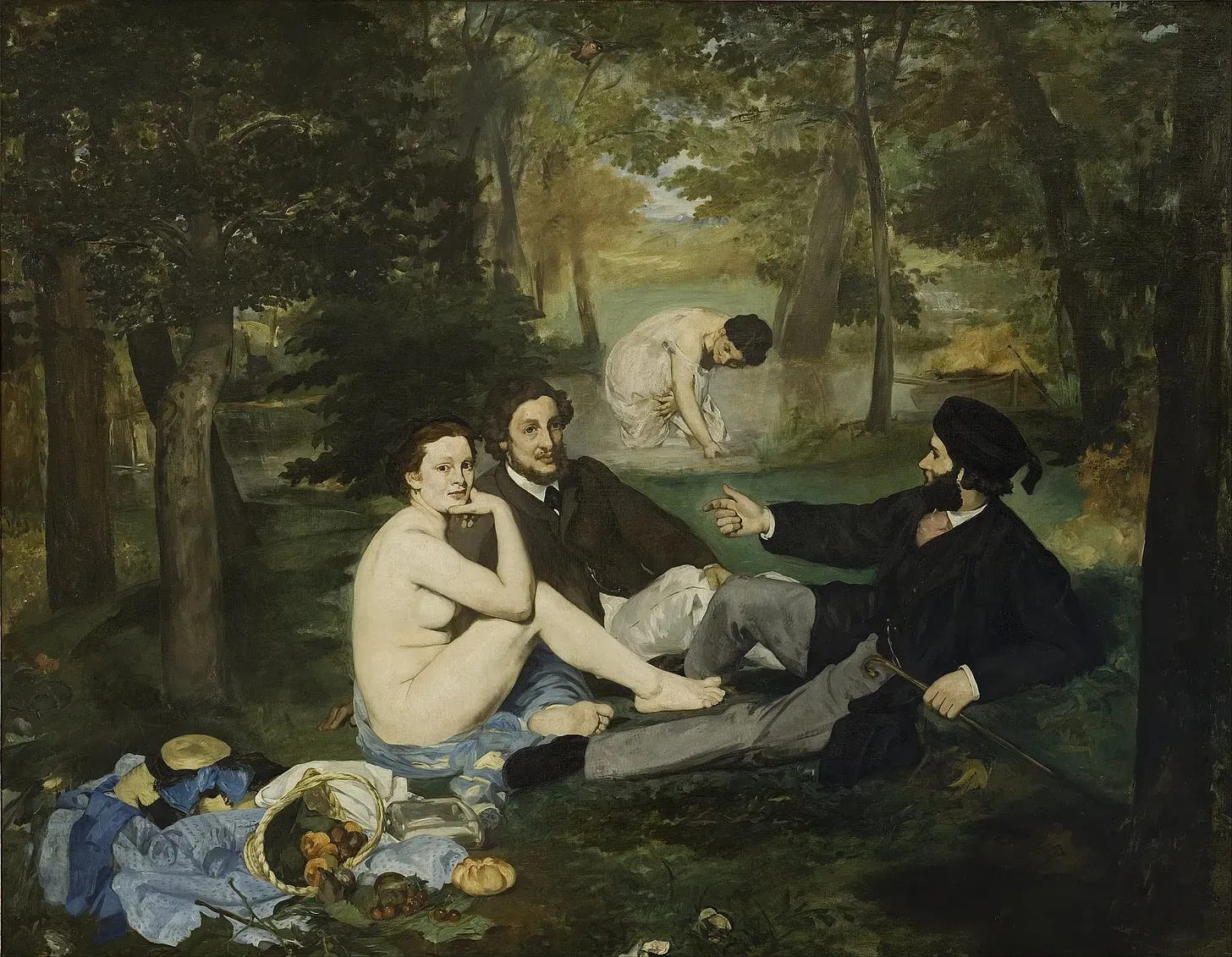

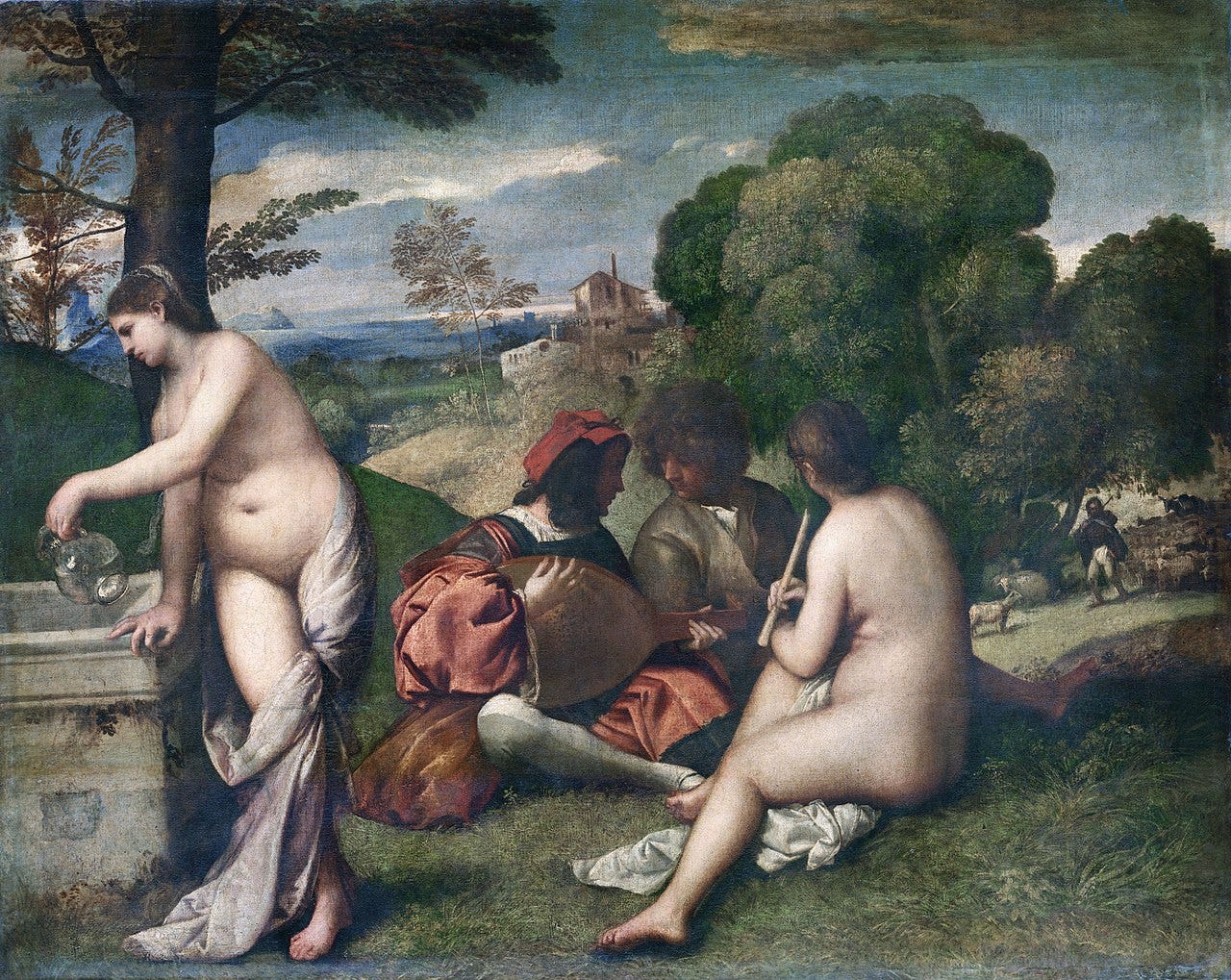
Originally called Le Bain, Le Déjeuner sur l’herbe (1863) would leave viewers aghast. Napoleon III called it “immodest.” P.G. Hamerton, writing for the Fine Arts Quarterly Review, noted the painting’s reference to Titian’s Pastoral Concert (1509), which was previously misattributed to Titian’s contemporary, Giorgione:
I ought not to omit a remarkable picture of the realist school, a translation of a thought of Giorgione into modern French. Giorgione had conceived the happy idea of a fête champêtre in which, although the gentlemen were dressed, the ladies were not, but the doubtful morality of the picture is pardoned for the sake of its fine color… Now some wretched Frenchman has translated this into modern French realism, on a much larger scale, and with the horrible French costume instead of the graceful Venetian one.4
Part of what made the work so scandalous, as we’ve discussed before, is the woman’s nakedness. Nudity was generally only acceptable in history paintings, because the subjects were at a safe distance from contemporary life. (Note how in his criticism, Hamerton states that Le Déjeuner sur l’herbe is a work of “modern” French Realism, and the figures wear “modern” attire.)
That year, the star work at the Salon was Alexandre Cabanel’s The Birth of Venus (1863): in my opinion, a far more lascivious work than Manet’s Le Déjeuner sur l’herbe.
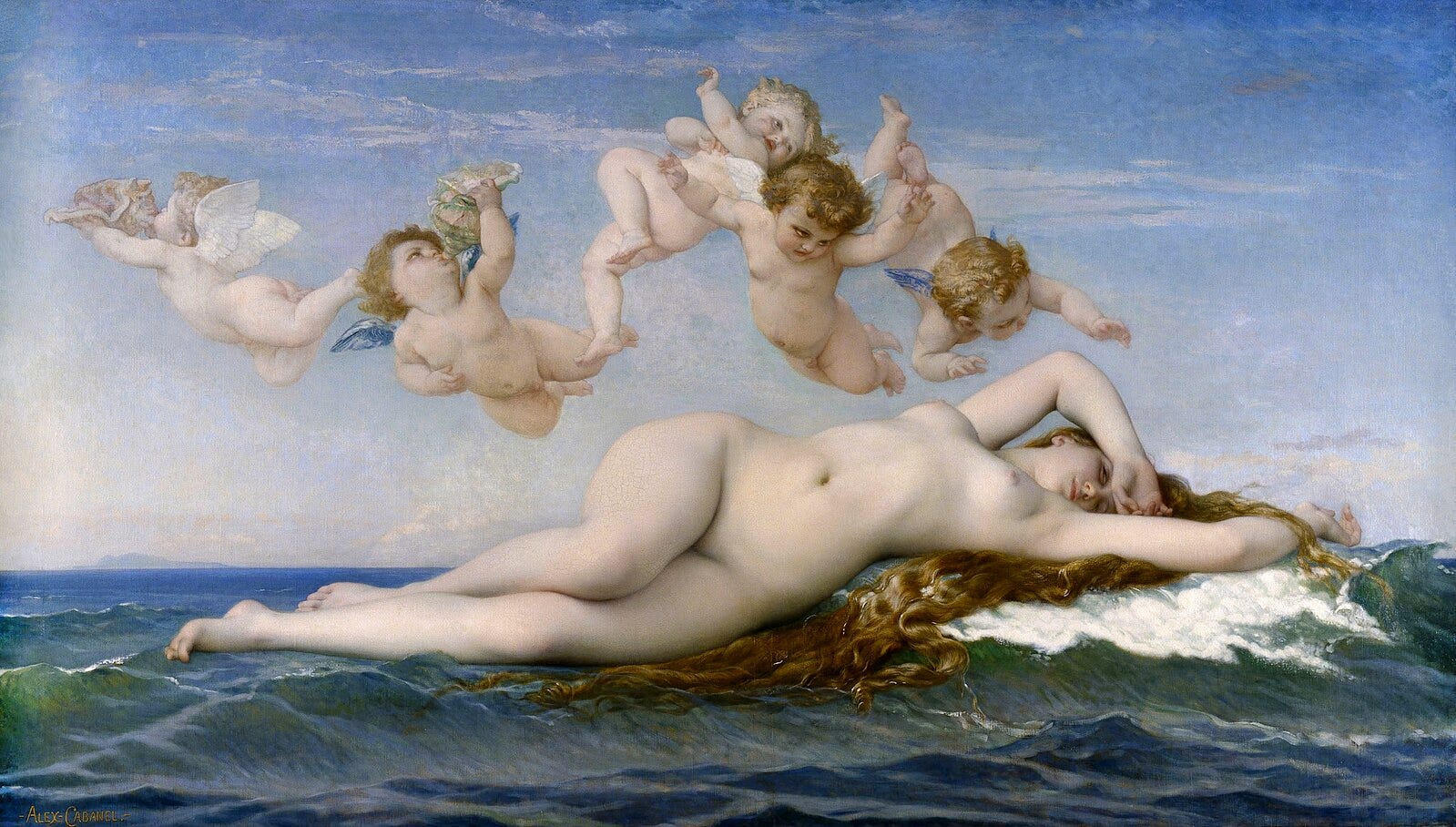

Look at the women in Manet and Cabanel’s paintings, and another difference emerges. In The Birth of Venus, the woman does not look at the viewer. She is a subject to be viewed. But in Manet’s painting, the naked woman looks at us. She breaks the fourth wall, forcing us to acknowledge that we see her nakedness. She knows we are looking at her, and she is looking back.
Manet’s painting broke with conventions of the male gaze that had governed Western nudes for centuries, in which nude women were almost always posed glancing demurely away from the viewer, allowing them to look without the shame of being watched in return. The painting also made use of the vivid pigments that had inspired such criticism towards Music in the Tuileries Gardens. Though largely fitting within the Realist school, Le Déjeuner sur l’herbe hints at Manet’s later move toward Impressionism with its looser brushstrokes, especially in the background of the painting.
Polite society was outraged, and nothing draws a crowd like the stench of scandal. On its very first day, the Salon des Refusés attracted 70,000 people. Thousands more would visit in the coming days, and most came away with the conclusion that the jury was right: radical artists like Édouard Manet did not belong in the Salon des Beaux-Arts.
But some disagreed. A group of young painters from the studio of Charles Gleyre, including Frédéric Bazille, Claude Monet, Pierre-Auguste Renoir, and Alfred Sisley, were captivated by Manet’s work. These artists were growing exasperated with academic art, and they craved a mode of expression that couldn’t be confined to an indoor studio. In Manet, they found someone a bit older who seemed to understand their sensibilities.
In Manet, they saw the future.
Sue Roe, The Private Lives of the Impressionists (London: Vintage, 2006), 26-27.
John Rewald, The History of Impressionism: Fourth, Revised Edition (New York: Museum of Modern Art, 1973), 77.
Rewald, History of Impressionism, 79.
Rewald, History of Impressionism, 85.