

The Affair of the Diamond Necklace
By 1784, Marie Antoinette's reputation was already in decline. But a scandal involving a diamond necklace, a credulous cardinal, and a very cunning thief would launch her down a path of no return.

This essay is part of a series on the life of Marie Antoinette.

As every French nobleman at Versailles knew, there were aristocrats in name, and aristocrats in fortune.
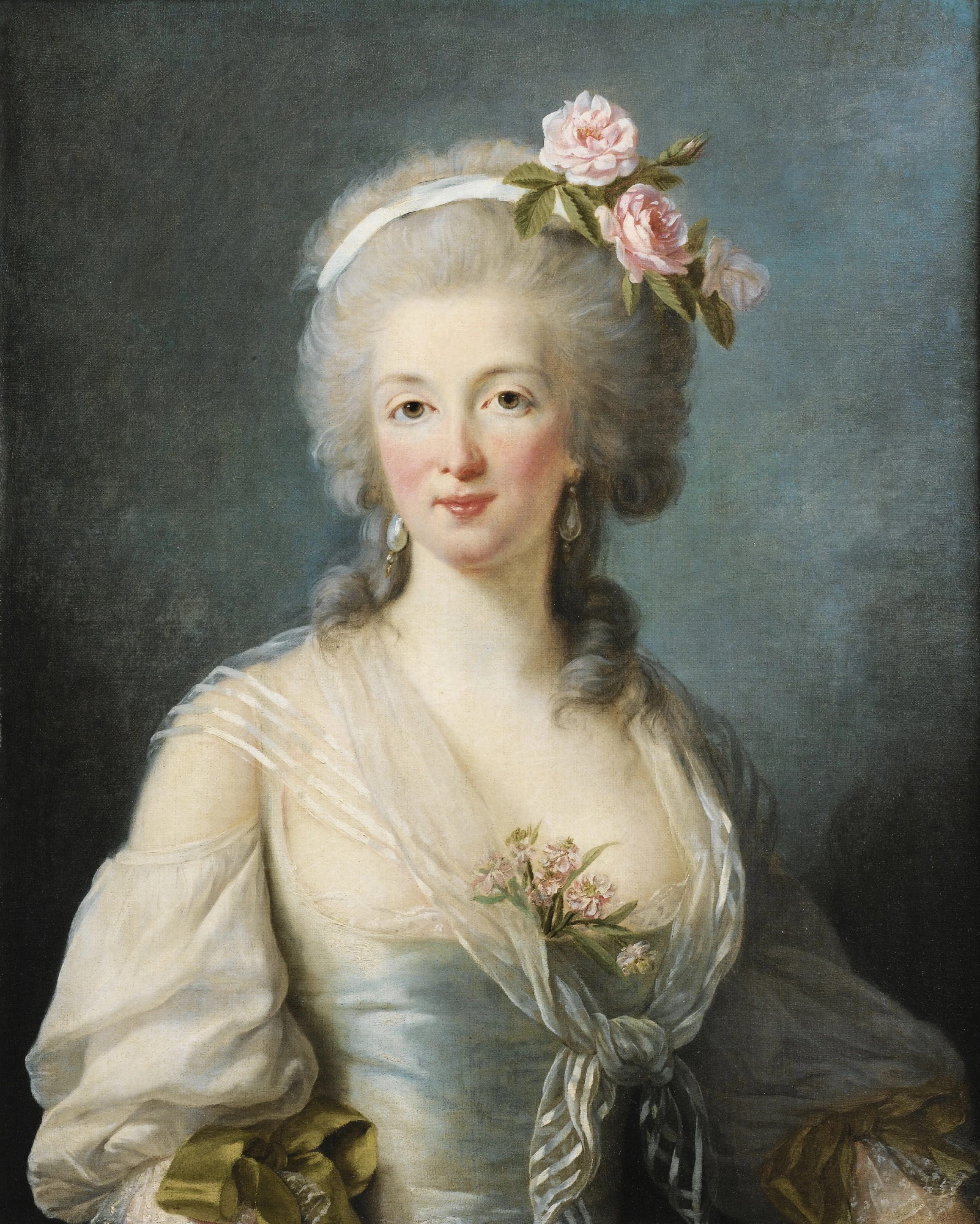
Unfortunately for Jeanne de Valois, all she had to recommend her was her family’s name. A descendent of an illegitimate son of Henri II (d. 1559), Jeanne and her siblings otherwise lived hand-to-mouth. Orphans were not looked upon with great kindness in 18th-century France, and when Jeanne begged for food as a child, she pleaded that one might “take pity on a poor orphan of the blood of Valois.”1
By the time she reached adulthood, she managed to prove her ancestry with the court genealogist, negotiate a small pension, and carve out a meager position at Versailles. In 1780, she married Marc-Antoine-Nicolas de La Motte and began styling herself as the “Comtesse de La Motte,” though the legitimacy of the title was dubious at best. Already, Jeanne’s rags-to-riches, fake-it-‘til-you-make-it story seems primed for Hollywood. (All aristocratic titles begin in fabrication, anyway; let the woman be a countess if she so desires!) But Jeanne wanted more, and her scheming would have a major impact on the life of Marie Antoinette—and indeed, the institution of the monarchy in France.
When we last left Marie Antoinette, we discussed the roots of her demise: her delay in producing an heir, rampant royal spending (much of which wasn’t her fault), the loosening of court etiquette (which made her even more unpopular at court), and her inept political meddling. Regrettably, her early forays into politics were fueled less by strategy and more by personal resentments. By the early 1780s, her popularity had deeply declined.
In other words, she was the perfect target.
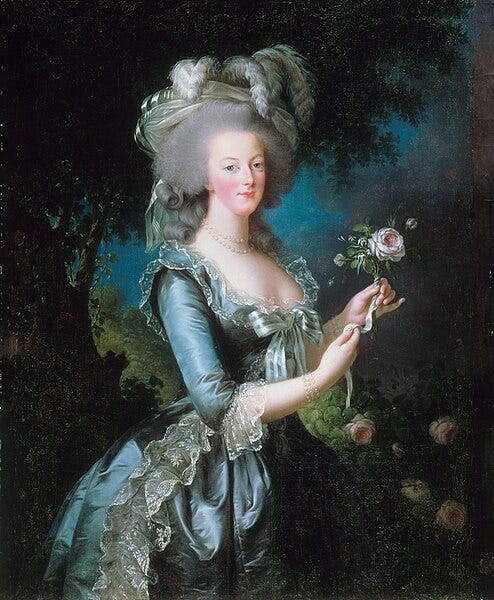

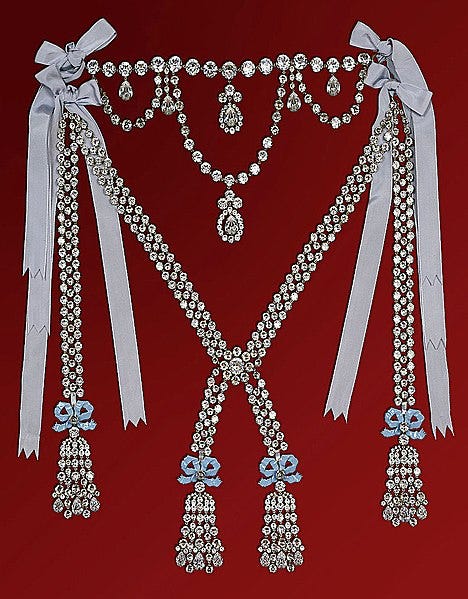
After all, the queen was known for her love of diamonds. (One of the more ridiculous rumors about her was that she had a room at Petit Trianon that was entirely covered in the costly gems.) Between 1774 and 1776, Marie Antoinette spent 1,600,000 livres with Boehmers, the court jeweler.2 By the French Revolution, her jewelry collection was worth about 3 million francs.3 Boehmers did possess one necklace that was too grand even for the queen’s budget: a cascade of overlapping diamonds so expensive that courtiers called it the “slave necklace,” for its price of 2 million francs would financially imprison the person who bought it.
Charles Boehmer made the necklace with Madame du Barry in mind. (Recall that Madame du Barry was Louis XV’s final mistress before he died.) But his jewelry firm made the mistake of creating the piece without a formal commission from the king. After Louis XV died, Boehmer hoped to sell the necklace to the new king’s wife. Marie Antoinette, knowing full well that even she couldn’t get away with such a price, advised him to break up the expensive piece and sell the stones separately.
Luckily for Jeanne de Valois, the Cardinal de Rohan was not aware of this.
Louis René Edouard, prince de Rohan-Guéméné, was a spendthrift from a cash-strapped noble family. (Certain members of the French aristocracy brought the phrase “house-poor” to a whole new level.) Rohan hoped to improve his family’s fortunes by becoming a minister, if not a prime minister. However, as we established in my last entry on Marie Antoinette, the queen was known to hold a grudge. Because Rohan had been an ally of the powerful Madame du Barry, the great thorn in Marie Antoinette’s side during her younger years, Rohan was on the queen’s blacklist and would need to regain her favor in order to advance.
Jeanne de Valois, now the supposed Comtesse de La Motte, befriended Rohan in the early 1780s and may have been his lover at one point. She convinced him that she had become a close friend of the queen, and that she could soften the queen’s disdain toward him. Her current lover, the guardsman Réteaux de Villette, forged the queen’s replies to Rohan’s letters. In a final stunt of theatricality, Jeanne found a shop girl (allegedly, also a sex worker) who resembled the queen and organized a clandestine meeting. Late at night, in the queen’s favorite citrus grove, the faux-Marie Antoinette briefly met Rohan, and in his desperation, he was convinced.4
When Jeanne delivered a forged letter to Rohan, in which “Marie Antoinette” asked that he go to Boehmers and organize the sale of the infamous necklace, Rohan eagerly complied with the request. The firm agreed that the queen could pay in four installments with interest, and Charles Boehmer himself cleared the deal with his banker, Baudard de Saint-James. The moment Jeanne and Rétaux got their hands on the necklace, they bludgeoned it with a kitchen knife and began selling the stones individually, just as Marie Antoinette had originally suggested to Boehmer.5
As you probably guessed, everything unraveled when the queen missed her first payment. Rohan tried to speak with the queen; befuddled, she instructed him to turn the matter over to the Baron de Breteuil. Rohan made a grave error in listening to her—Breteuil was his political rival, and Rohan could have avoided a great deal of public spectacle had he gone directly to King Louis XVI.
What ensued was a public scandal of such magnitude that it didn’t matter if Marie Antoinette had nothing to do with the scheme: the public believed that she had tried to buy the necklace, and was now attempting to weasel her way out of paying for it. Her hatred of Rohan only inflamed the situation; instead of handling the matter privately, she made the fatal mistake of demanding a trial. In their zeal to clear the queen’s name, both Marie Antoinette and her husband Louis rushed into their decision to arrest him on August 15th, 1785.
The couple chose the most public form of humiliation: they arrested the cardinal in the Hall of Mirrors, just before he was to officiate the feast of the Assumption of Mary. Off to the Bastille he went! While his luxurious suite was well attended by servants and friends, the optics remained horrendous—the king and queen appeared downright tyrannical. Rohan did agree to be tried before the Parlement de Paris over a special commission, but his formal response to the king, cosigned by family members, makes it clear that he wished to avoid a public trial altogether. His desire was to confront Jeanne in an audience before the king:
Sire, I had hoped by the confrontation [with Jeanne de Valois] to have proved conclusively to Your Majesty that I was the victim of a fraud and in that case I should have desired no other judges but your justice and beneficence. Since the refusal of this adversarial confrontation deprives me of this hope, I accept [trial by the Parlement].6
Once again, Marie Antoinette’s past rivalries came back to haunt her. Charles Gravier, comte de Vergennes and foriegn secretary to the king, was a close friend of the Rohan family and personally intervened to prove the cardinal’s innocence. He tracked down the guard Rétaux and the shop girl-impersonator, both of whom had to be extradited from abroad. These key witnesses ensured Rohan’s acquittal in 1786.
The king and queen’s ruthlessness in persecuting Rohan would be all the more damaging to the monarchy now that Rohan was found innocent. But the Comte de Vergennes didn’t care; the queen had spent years trying to undermine his foreign policy goals. He never forgot how she tried to convince Louis to fire him over his refusal to support her native Austria in the Kettle War of 1784.7 In the end, the foreign secretary got his revenge.
And what of Jeanne de Valois?
Jeanne was sentenced to public flogging, branding, and lifetime imprisonment. Under murky circumstances, she escaped to London two years later and published a memoir that would further remind the public of the Affair of the Diamond Necklace.8 The queen was so despised that the rumor of her orchestrating the entire scandal persisted. She demanded that Rohan face internal banishment in the farthest corner of the country. Her desire for revenge once again thwarted her, and her reputation would never recover. At least the dashing Axel von Fersen had returned to Versailles, and she could find comfort in his arms.
This story is a perfect example of Marie Antoinette’s shortcomings as a leader. Much of the chaos that enveloped her life was not her fault: she was the innocent party in the Affair of the Diamond Necklace, and the public and press dragged her name through the mud. However, as we examine her life story, the quality that continues to rear its ugly head is her impetuousness. A wiser ruler, knowing that their popularity had taken a backslide, would have proceeded with caution.
Instead, Marie Antoinette pursued vengeance against a longtime enemy without stopping to consider that he, too, might be innocent—and jailing a guiltless man would only confirm the public’s worst beliefs about their queen.
Since this patron essay was delayed, the next entry in the series will be out later this week. Stay tuned!
John Hardman, Marie Antoinette: The Making of a French Queen (Yale University Press, 2019), 100.
Hardman, Marie Antoinette, 97.
I couldn’t find reliable data on the value of francs in the 1780s, especially since French currency changed from livres to francs during the Revolution, but to give you some idea: 3 million USD in 1789 is the equivalent to roughly 107,000,000 USD today. While we can’t make a one-to-one conversion with francs or livres, this should hopefully help to illustrate the colossal value of Marie Antoinette’s jewelry collection.
Hardman, Marie Antoinette, 100.
Hardman, Marie Antoinette, 101.
Bibliothèque de la ville de Paris, ms de la réserve, cited in Hardman’s Marie Antoinette, 108.
Munro Price, “The Dutch Affair and the Fall of the Ancien Régime, 1784-1787,” The Historical Journal 38, no. 4 (1995): 875-905, https://www.jstor.org/stable/2640093.
Jeanne de Valois, comtesse de La Motte, Memoirs of the Countess de Valois de La Motte: Containing a Compleat Justification of Her Conduct, and an Explanation of the Intrigues and Artifices Used Against Her by Her Enemies, Relative to the Diamond Necklace. Available on the Internet Archive.