

The Battle of the Victorian Fairies
In the well-to-do households of Victorian cities, fairies were being scrubbed and starched to suit a new, child-friendly image. But in the countryside, the "Good Folk" maintained a frightening aura.

This essay is part of a series called On the Origin of Fairies.

In the twilight of the Edwardian era, the village of Grange in County Sligo, Ireland received a strange visitor. He was an Oxford scholar by the name of Walter Evans-Wentz, and he came to talk about the fairies.
The academic had embarked on a multi-year quest to record the testimony of fairy believers. Time was of the essence: as the older Victorian generations aged, the stories of peasants across Ireland, the United Kingdom, and Brittany—many of whom were only partially literate—would be lost to time.
Evans-Wentz would become a major scholar of Tibetan Buddhism and an early translator of key texts into English, including the Bardo Thodol, otherwise known as The Tibetan Book of the Dead. However, his first love was fairy folklore. He published his dissertation in 1911, and The Fairy-Faith in Celtic Countries has remained a staple in folklore studies ever since.
To the villagers of Grange, being asked to divulge one’s beliefs about fairies, to an Oxford man no less, would usually be a non-starter. But this man wasn’t from the British upper classes; he was an American, and his mother’s family was Irish. Most of all, he approached his conversations with curiosity and respect. Due to these attributes, Evans-Wentz gained the trust of old folks throughout Ireland, Scotland, Cornwall, Wales, the Isle of Man, and Brittany.
Upon his arrival in Grange, Evans-Wentz sought the advice of a local priest named Father Hines, who helped him to meet elders with vivid stories of the fairies. Hugh Currid, the oldest man in Grange at the time, was willing to open up after learning that the scholar’s mother was Irish. With his sister translating (Currid mainly spoke Irish), he shared tales of fairy abductions:
An old woman near Lough More, where Father Patrick was drowned, who used to make her living by selling flax at the market, was taken by the gentry, and often came back afterwards to her three children to comb their hair. One time she told a neighbour that the money she saved from her dealings in flax would be found near a big rock on the lake-shore, which she indicated, and that she wanted the three children to have.1
Patrick Waters, a tailor who lived two miles from Hugh Currid, had his own stories of fairy kidnappers:
A girl in this region died on her wedding-night while dancing. Soon after her death she appeared to her husband, and said to him, “I’m not dead at all, but I am put from you now for a time. It may be a long time, or a short time, I cannot tell. I am not badly off. If you want to get me back you must stand at the gap near the house and catch me as I go by, for I live near there, and see you, and you do not see me.” He was anxious enough to get her back, and didn’t waste any time in getting to the gap. When he came to the place, a party of strangers were just coming out, and his wife soon appeared as plain as could be, but he couldn’t stir a hand or foot to save her. Then there was a scream and she was gone. The man firmly believed this, and would not marry again.2
In other villages, Evans-Wentz encountered people who either claimed to have seen the fairies, or knew someone who had. In Rosses Point, a Mrs. Conway said:
John Conway, my husband, who was a pilot by profession, in watching for in-coming ships used to go up on the high hill among the Fairy Hills; and there he often saw the gentry going down the hill to the strand. One night in particular he recognized them as men and women of the gentry and they were as big as any living people. It was late at night about forty years ago.3
And Neil Cotton, a seventy-three-year-old from Tamlaght in what is now Northern Ireland, claimed that he witnessed his cousin being saved from Faerie (or Fairyland) when he was a boy:
One day, just before sunset in midsummer, and I a boy then, my brother and cousin and myself were gathering bilberries (whortleberries) up by the rocks at the back of here, when all at once we heard music. We hurried round the rocks, and there we were within a few hundred feet of six or eight of the gentle folk, and they dancing. When they saw us, a little woman dressed all in red came running out from them towards us, and she struck my cousin across the face with what seemed to be a green rush. We ran for home as hard as we could, and when my cousin reached the house she fell dead. Father saddled a horse and went for Father Ryan.
When Father Ryan arrived, he put a stole about his neck and began praying over my cousin and reading psalms and striking her with the stole; and in that way brought her back. He said if she had not caught hold of my brother, she would have been taken forever.4
These examples barely scratch the surface of Walter Evans-Wentz’s research, and I would encourage anyone interested to read The Fairy-Faith in Celtic Countries for themselves.
What I would like to point out is that although Evans-Wentz collected these accounts from roughly 1907 to 1909, these older storytellers would have lived most of their lives during the Victorian period, and their accounts give us a window into the folklore of a fading world. Furthermore, we are miles away from Tinker Bell and the Cottingley fairies, which we discussed in last week’s entry in this series.

The fairies that we are meeting today are not the flower fairies at the bottom of the garden. They steal people. They enchant. They delight as much as they destroy.
And yet, for the Victorian middle and upper classes, a different reality was emerging, one that would lead to the child-friendly fairy of the 20th century. The 19th century saw the rise of the middle classes, rapid urbanization, and improvements in medical care. Greater literacy gave a wider share of the population the tools to read and study the world around them. For these upwardly-mobile individuals, fairies were increasingly regarded as superstition.
Even before the Victorian period, we can find a rare equating of fairies with childhood innocence in Samuel Taylor Coleridge’s poem Christabel, published in 1816:
A little child, a limber elf,
Singing, dancing to itself,
A fairy thing with red round cheeks,
That always finds, and never seeks…
This trend continued on the London stage. In 1856, the eight-year-old Ellen Terry played Puck in Shakespeare’s A Midsummer Night’s Dream, and the following year, her sister Kate played Ariel. “Fairy pantomimes” became a popular form of entertainment in Victorian cities, in which overworked-and-underpaid child actors played fairies for young audiences.5
Believing in nature spirits becomes more difficult when the sound of trains and streetcars and eventually automobiles are one’s daily symphony. But the fairies could still be a part of city-dwellers’ lives, just as long as they acknowledged that fairies were fantasy. It is during the Victorian era when George Macdonald published Phantastes (1858), a book that is generally considered the first fantasy novel for adults. Phantastes follows the twenty-one-year-old Anodos, who is whisked away to Faerie by a fairy woman. What separates fantasy from folklore is that Macdonald’s readers knew they were not to believe the tale.

Different beliefs could be found in rural communities, and many in the 1800s still possessed moderate fear of the “Good Folk” (a term of appeasement if there ever was one). We can really see this in stories of changelings. A changeling is a fairy child who has been swapped for a human. Sadly, in real life, “changelings” were often disabled children who fell far enough outside the norm that they became victims of suspicion, and in some cases, abuse. In 1952, classical scholar Gilbert Murray (1866-1957) recalled that during his childhood in 19th-century Ireland:
…a child, who was for some reason reputed to be a changeling, was beaten and burned with irons, the mother being locked out of the room while the invading fairy was exorcised, though unfortunately the child died in the process.6
This murder was not present in the legal record, and it’s possible that many other fairy “exorcists” never faced prosecution, despite stories of such abuse from eyewitnesses and neighbors. One case that did result in criminal prosecution was the killing of the nine-year-old son of Patrick Kearns in Kilkenny. His son was beaten to death by a “fairy doctor” in 1856 in an effort to “free” the sick child, who was believed to be suffering from a “fairy blast.” The child did not survive. An autopsy confirmed that the boy had a massive brain tumor and would have died within weeks; his parents, finding no luck with actual doctors, were so desperate that they recruited a fairy doctor instead.7
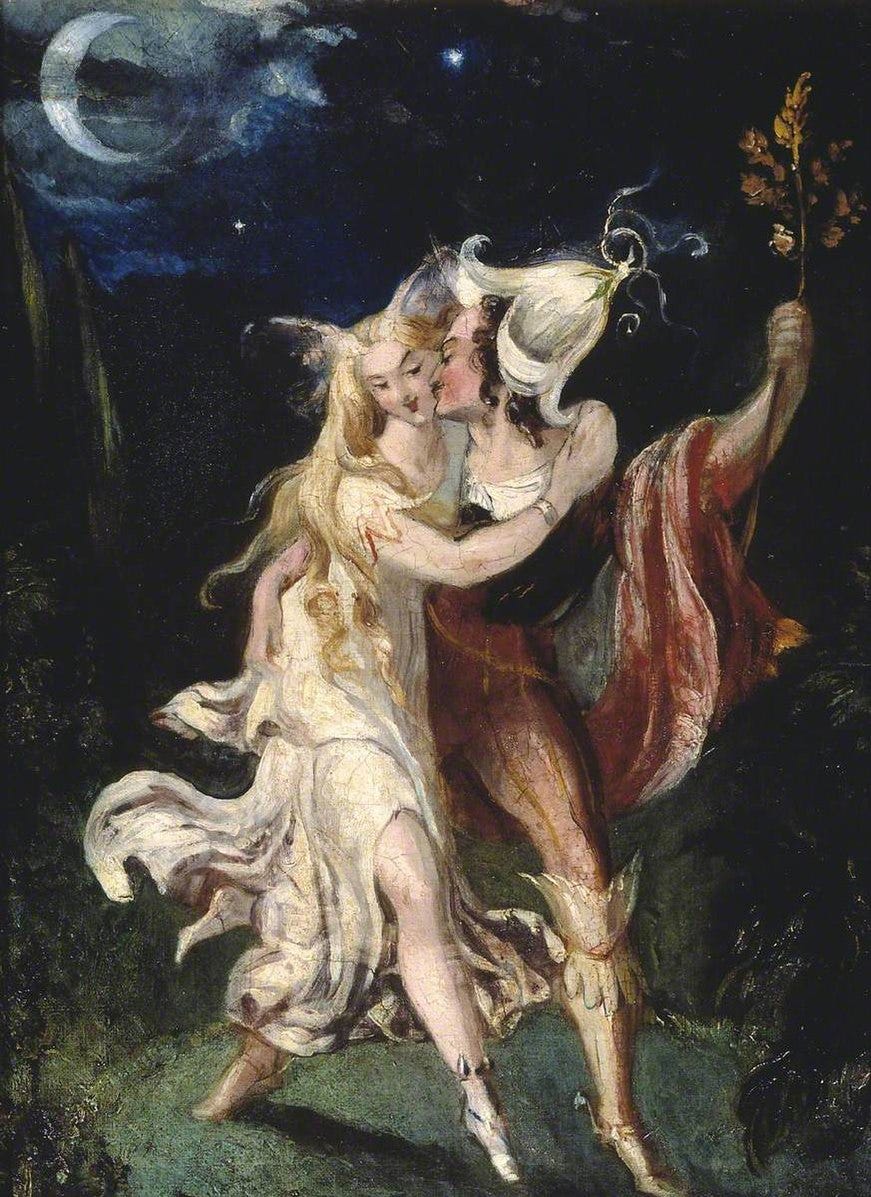

The Victorian period saw the evolution of the fairy in affluent and urban circles, even as fairy dangers lingered in the countryside. There is one place where these distinct interpretations of the fairy collided, and that was in Victorian fairy painting and Pre-Raphaelite art—genres that sometimes overlapped.
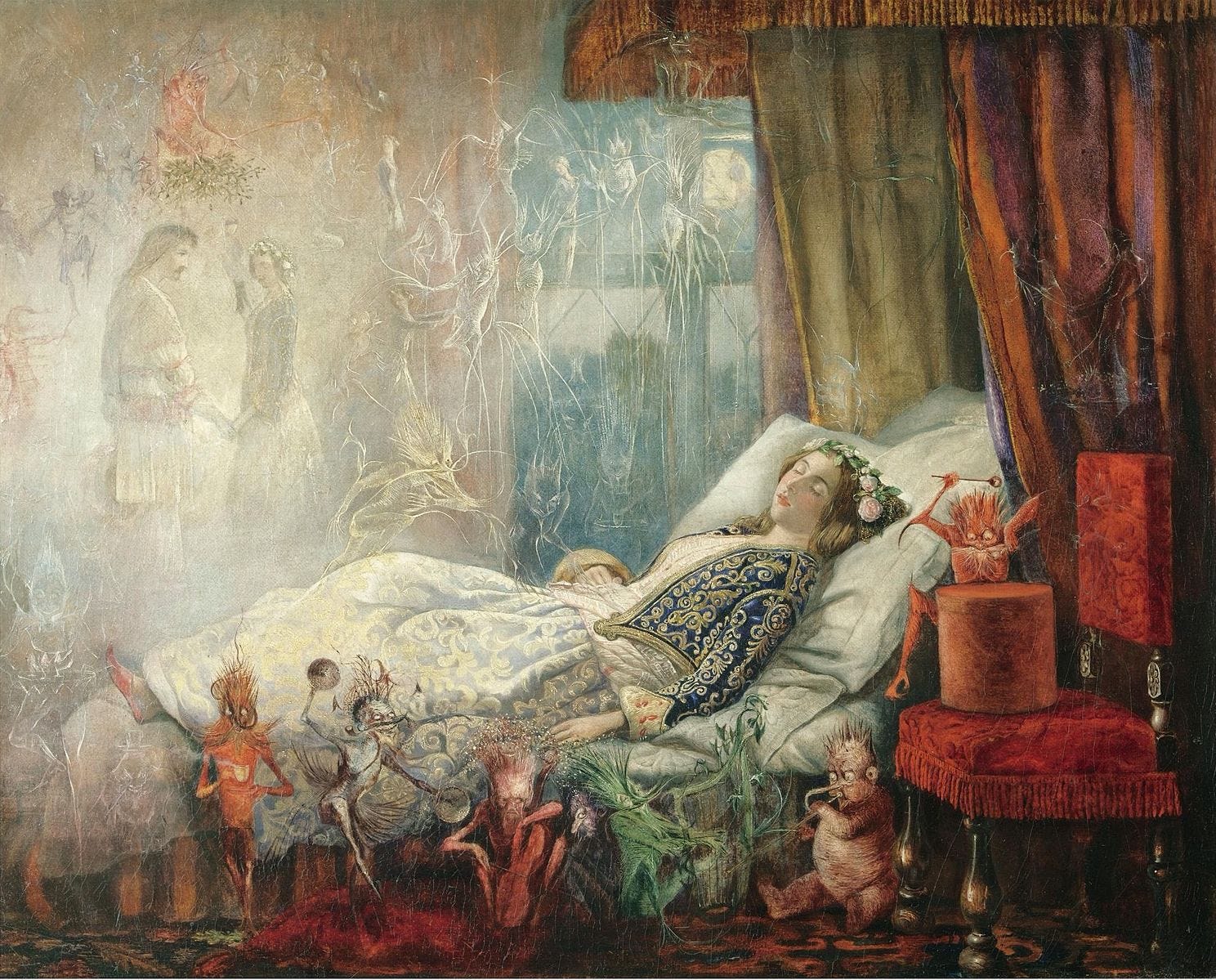
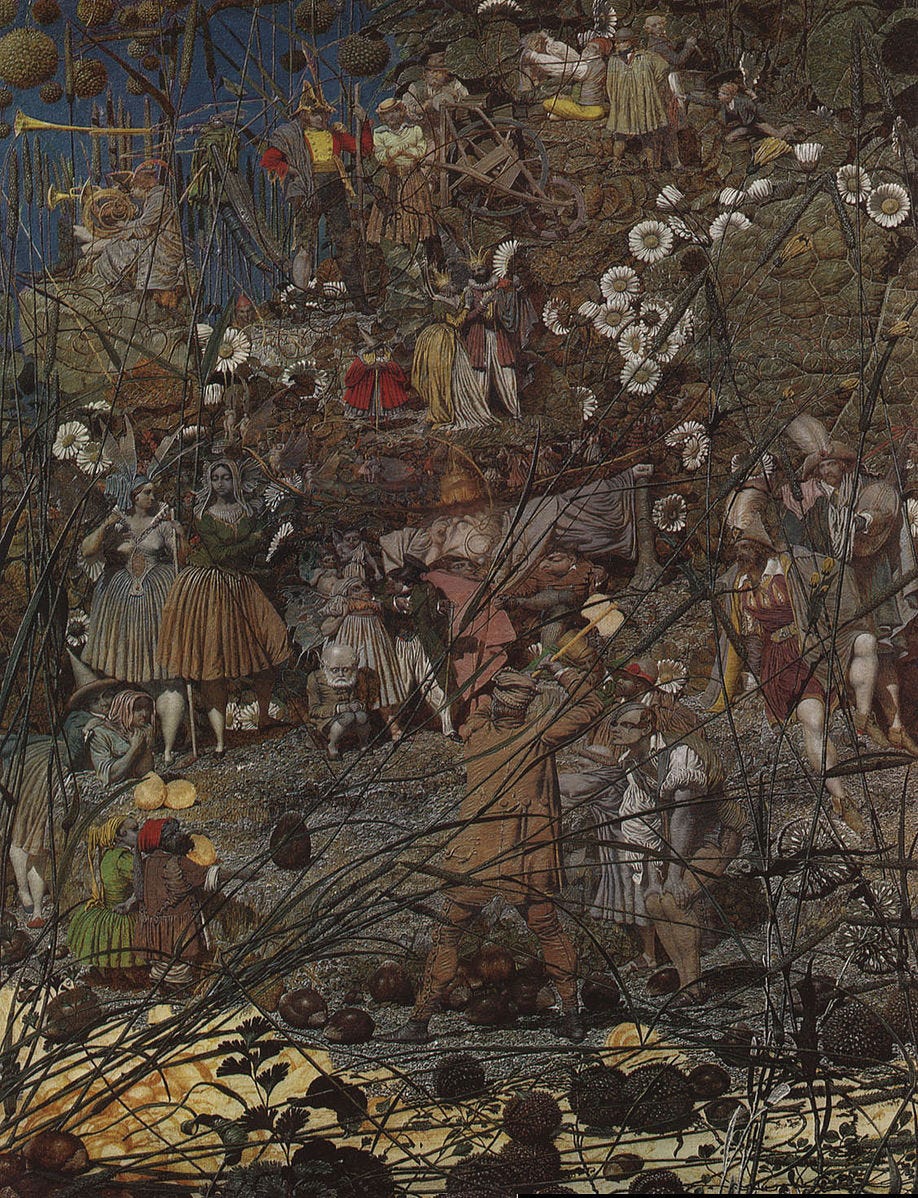
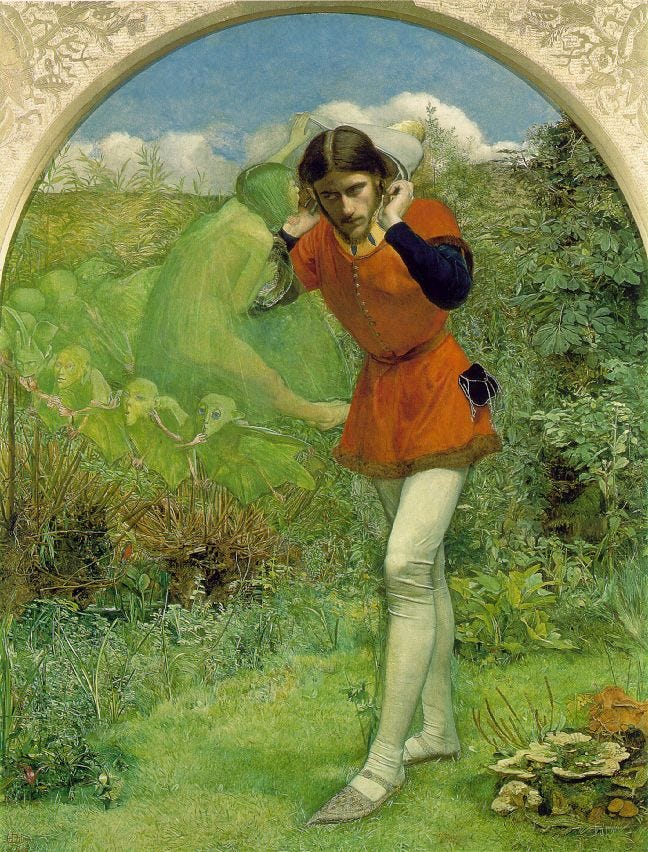
Throughout this essay, I’ve shared some images of such paintings, and you’ll notice that these fairies are nowhere near as sweet as Cicely Mary Barker’s 20th-century illustrations. However, they possess some attributes of the flower fairies. Compared to the stories we heard from Evans-Wentz’s interviewees, these fairies are smaller—in some cases, as small as flowers. The iconic fairy paintings of John Anster Fitzgerald also possess a psychedelic quality. His depictions of fairies were influenced by his visits to the opium dens, that most urban of Victorian vices.
The peasant seers in The Fairy-Faith didn’t need to use opium to see fairies. The fairy world was all around them.
Next week, we will travel even further back in time, and examine how the fairy survived the Age of Enlightenment and found new fans among the Romantics. We’re moving into a period when almost everyone lived in the countryside, and we will see how Mother Nature’s ruthlessness impacted cultural understandings of the fairies. We will also dip our toes into the question that will grow in importance the deeper we travel in time: where exactly do the fairies come from?
Walter Yeeling Evans-Wentz, The Fairy-Faith in Celtic Countries (Anodos Books, 2019), 37. This book was originally published as a dissertation in 1911.
Evans-Wentz, The Fairy-Faith, 38.
Evans-Wentz, The Fairy-Faith, 47.
Evans-Wentz, The Fairy-Faith, 50-51.
Richard Sugg, Fairies: A Dangerous History (Reaktion Books, 2018), 217-218.
Sugg, Fairies, 101.
Sugg, Fairies, 101-102.