

The Legend of Tea
Reflections on the legend and history of tea, the world’s most consumed beverage after water—and the joy of working with plants.

.jpg)
Summer in Tennessee is a lesson in beauty and discomfort. Hotter than the hinges on the gates of Hell, stickier than molasses, yet the land is the richest shade of green and the earth bursts with life. Venture to any Nashville farmer’s market in July, and the seasonal bounty includes the juiciest tomatoes you’ve ever eaten in your life.
I learned the rhythm of Middle Tennessee’s seasonal shifts intimately when I was twenty-two. Dressed in a big straw hat and a white, linen shirt to protect my arms, I drove out of the city every Saturday to a little farm in the hills. This week, we would be harvesting lavender and rose petals.
The previous year, I had been avidly listening to Tending Seeds, a podcast on homesteading and herbalism. I resonated with the host’s practicality and her science-based approach. There are many wonderful, knowledgeable herbalists out there—and there are also those who think raw milk is perfectly safe (“Tuberculosis of the bones? Never heard of it!”) and that the polio vaccine is not. Beware the quacks, my friends.
But Sara was grounded and experienced. I was delighted to discover that her farm was only a twenty-minute drive from Nashville; on a whim, I asked her if she was taking on apprentices. My day job keeps me indoors, and I was looking for a chance to get outside and learn about a subject that had always intrigued me.
In the weeks that followed, I grew to appreciate why organic produce is more expensive—frankly, producing crops without pesticides and weed killers is a lot more labor-intensive. I got to sit in on client consultations, make tinctures, harvest herbs, and of course, make tea blends. I learned a tremendous amount from Sara, and we soon became friends.
Sara and her partner Mike have since bought a larger property in Colorado, where they can continue to expand Nordic Fox Farm (you can find their offerings here), in addition to their tattoo shop. How they do it all is truly mind-boggling; I am so proud of everything Sara has accomplished, though I do greatly miss those summer days on the farm.
One thing that grows apparent after spending time working with plants is how they attain a mythic quality, especially for those that have a more pronounced impact on how we feel. There’s the alertness we gain from a cup of green tea, the surge of energy from coffee, the calm of chamomile, and the sleepiness of passionflower. The time I spent with Sara made me a more avid tea-drinker, both of Camellia sinensis and botanical “teas.”
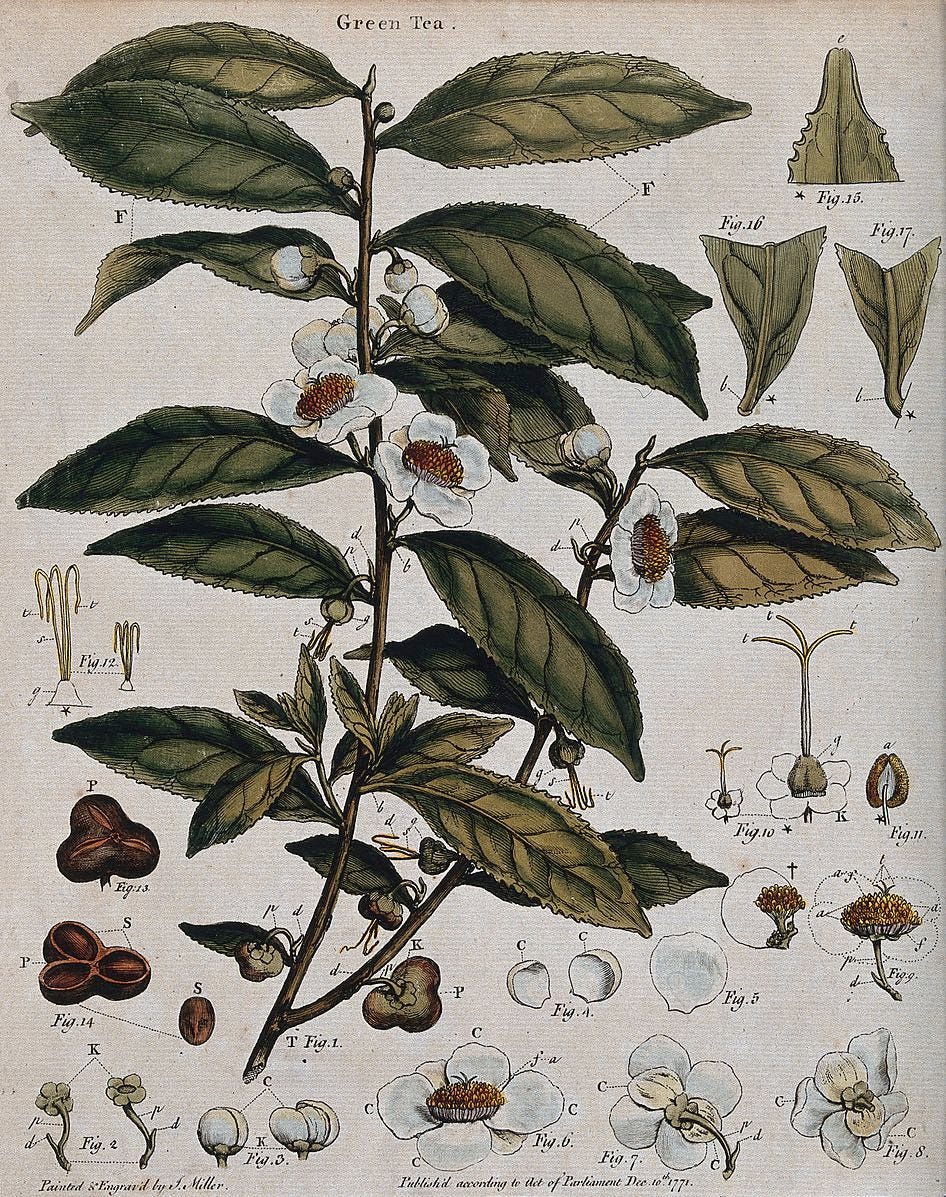
When English-speakers say the word “tea,” it’s usually an all-encompassing term for brewed herbal beverages. Colloquially, you’ll hear people tell you to “make some ginger tea” if your stomach is upset, or “drink chamomile tea” before bed to help you relax. But in its purest form, the word “tea” refers to the plant Camellia sinensis, from which all varieties of tea spring—black tea, green tea, white tea, oolong, matcha, etc. This plant gained worldwide popularity both for its richness in flavor and for the presence of caffeine.
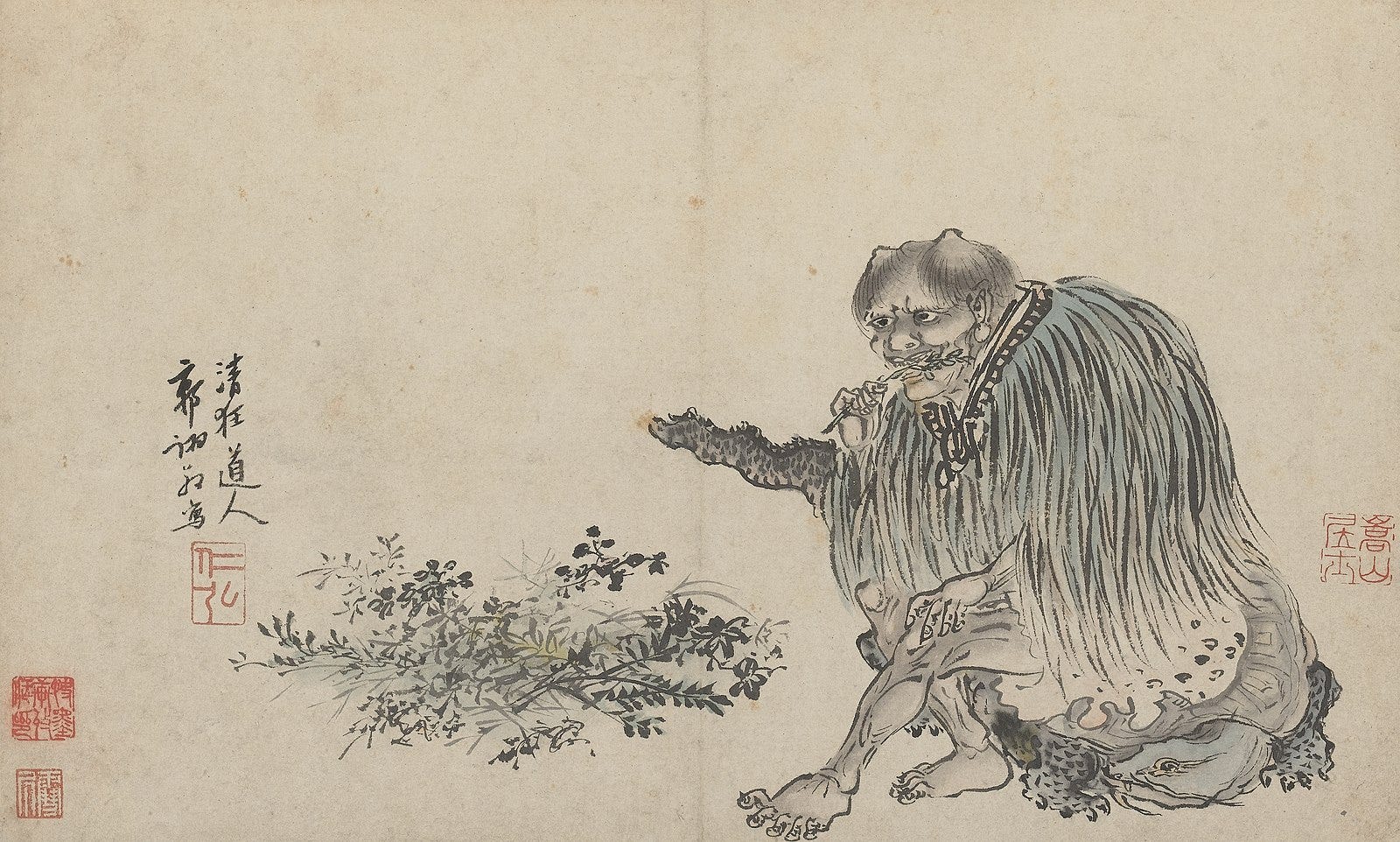
There are two legends on how the tea plant was discovered, both stories involving Shennog (“Divine Farmer”), a mythical emperor of China who allegedly ruled from 2737 to 2698 B.C.* Shennog occupies a central role in many Chinese cultural myths, similar to the role King Arthur plays in British myths (though it should be noted that some communities worship Shennog as a deified ruler). While there is no archaeological evidence that confirms Shennog’s existence, he is held in legend to be the discoverer of tea and a godfather of herbalism who brought agriculture to the people of China.
One version of the tea legend is that Shennog was seated beneath a tea bush with a cup of boiled water when a few dried leaves fell into the cup. He drank the very first cup of tea, observing the impact the beverage had on his mental state.
Another version is that in his quest to master the art of herbalism, Shennog conducted a study of 100 plants. 72 of the specimens made him ill, but only one cured him—the tea plant.
It’s unclear when people actually began drinking tea, though scholars believe tea consumption in China predated the time of the mythical Shennog. However, the first likely written reference to tea would come much later, during the Eastern Jin dynasty (317-420 A.D.). The Huayang Guozhi, a gazette written by Chang Qu, includes a description of the Ba state in southwestern China. The Ba became a vassal state to the Zhou after assisting their northern neighbor in the Battle of Mu Ye, which resulted in the overthrow of the Shang dynasty (1700-1045 B.C.). In his writing, Chang Qu includes a lengthy description of the gifts that the Ba gave to the Zhou in tribute—silk worms, hemp, salt, amongst other luxuries—and, a character that some Chinese etymologists believe to be an older word for tea. (It is a matter of debate.)
As tea consumption spread across China from the 1st to 6th centuries A.D., Buddhism was also finding its way to communities throughout the country. Like the rise of Catholic monasteries in medieval Europe, Buddhist monks and nuns played a crucial role in the lives of peasants, as Buddhist temples and monasteries were safe places to seek aid, food, and medical care. By the year 535, roughly 40,000 Buddhist monasteries and 2 million monks and nuns were in the empire of the Northern Wei dynasty. South of the Yangtze, in the domain of the Liang dynasty, there were over 2,800 monasteries and over 82,000 monks and nuns.
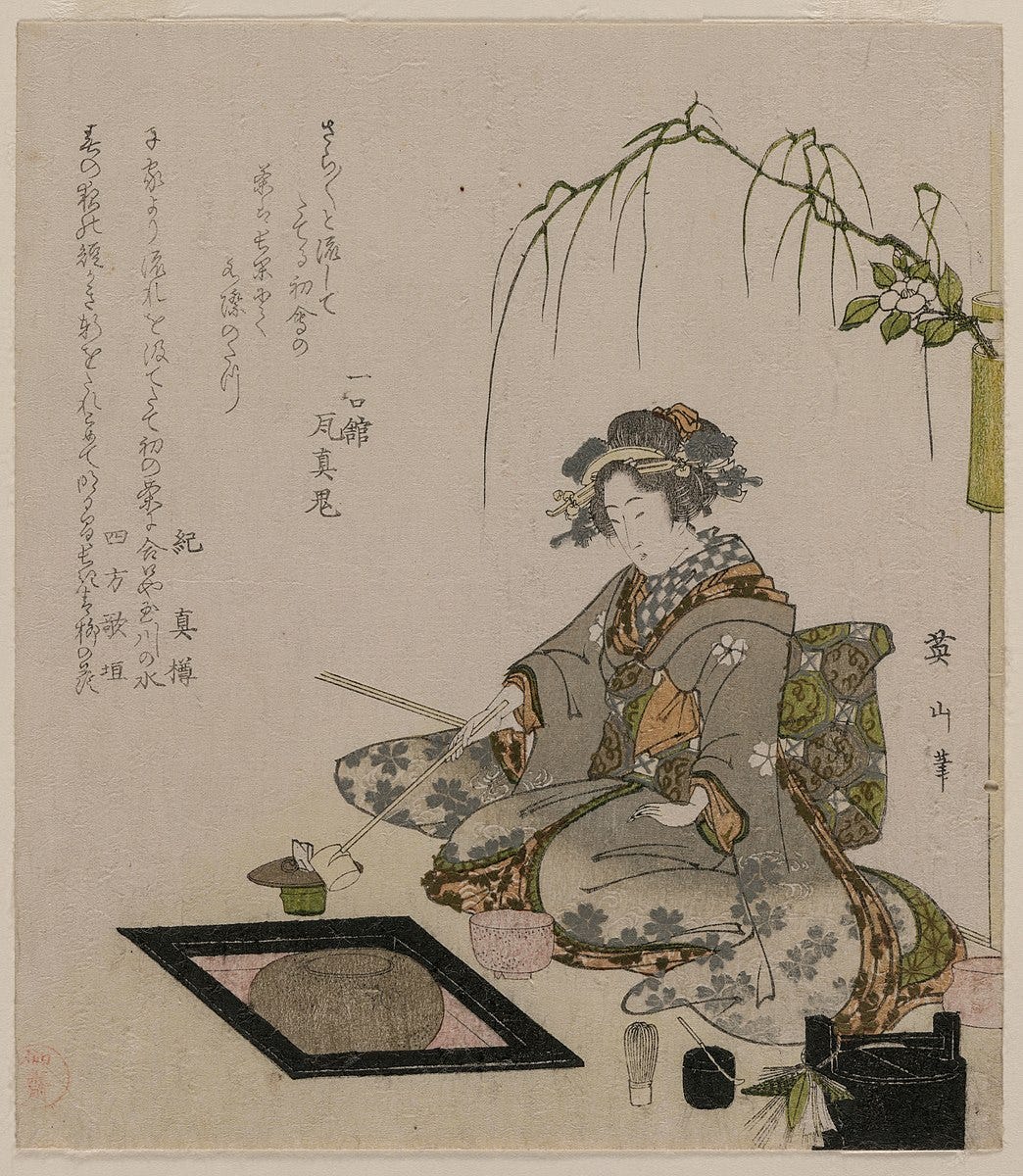
Tea became a staple of monastic life; it produced a steady alertness ideal for meditation, without harmful side effects. This is also how tea would later arrive in Japan, after Buddhist monks Kūkai and Saichō journeyed to China in 804 and returned with tea. Tea would not grow popular in Japan for some time, though—not until the late 11th and early 12th centuries. This is also largely thanks to another monk: Myōan Eisai, who spread Zen Buddhism in Japan after his studies in China and promoted the drinking of tea upon his return. And of course, tea would be elevated to even greater ceremony by Sen Rikyū (1522-1591), the Japanese tea master who pioneered the traditional tea ceremony that is practiced in variations to this day.*
Today, tea is the most popular beverage consumed around the world (after water). In my lifetime, I have also seen tea grow in popularity in the U.S., with the highest concentration of tea drinkers being in the Northeast and the South. As any Southerner will tell you, sweet tea is a staple.
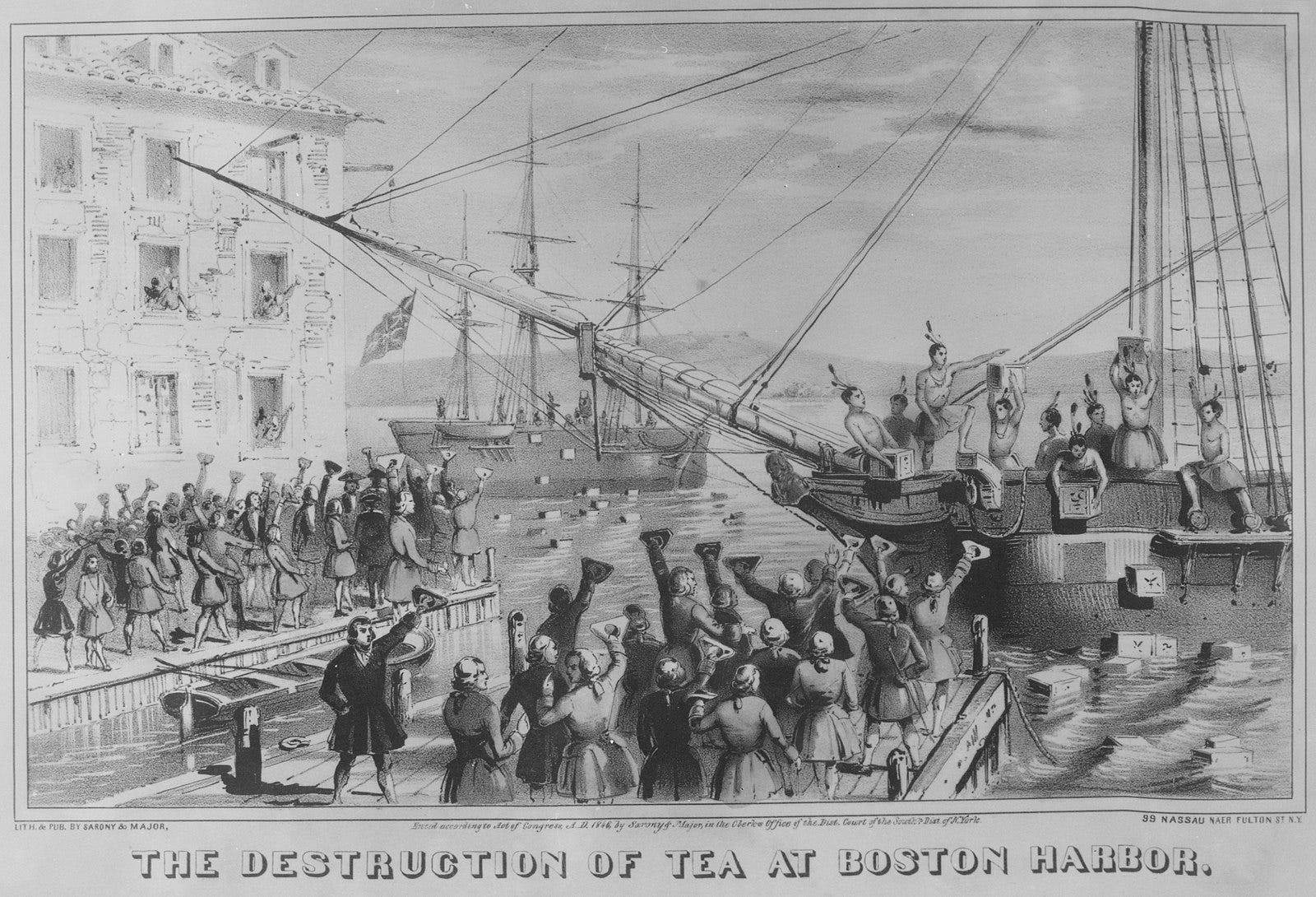
A common historical misconception that gets paraded around the internet is that Americans stopped drinking tea after the American Revolution in an act of patriotism, but this is actually false. While official boycotts led to increased consumption of coffee, people still drank tea. In the lead-up to the revolution, tea smuggling became an incredibly profitable enterprise as a means to evade British taxation, and black-market tea went legitimate after the U.S. gained its independence and could establish its own trade partnerships. (Americans are nothing if not entrepreneurial.) It wasn’t until the World Wars that tea consumption would majorly decline in the U.S., thanks to trade disruptions with both Japan and China. As a result, consumption of green tea in particular took a big hit, as green tea is largely produced in those respective countries. To this day, Americans drink far more black tea than green tea.
Tea also played a major role in the British and Dutch colonization of Central and East Asia; this story (particularly regarding the Opium Wars) requires its own article—one that will come out in the next few weeks here on The Crossroads Gazette. But one note that I’d like to include is that like coffee, we can be responsible consumers of tea by being mindful of purchasing Fair Trade Certified products. (Fair Trade Certification won’t apply to Japanese tea due to the country’s robust labor and standard-of-living protections.)
And what am I brewing? My favorite tea businesses—both of actual tea and botanicals—include Firepot Tea, Tea Huntress, High Garden Tea, and of course, Sara’s herbal offerings. As I write this, it’s a gloomy, rainy day here in Nashville, a far cry from the hot summer afternoons that are only a few months away. When skies are overcast and branches remain bare, the best remedy is a steaming cup of Earl Grey with a dash of milk—no sugar, please.
*If you’re interested in learning more about the history of tea, I highly recommend The True History of Tea by Victor H. Mair & Erling Hoh (Thames & Hudson).
Fair! 😂 Thanks for reading!
I loved this article. On my way to get a cup of tea!