

The Making of a Muse
The life and art of Elizabeth Siddal, the woman behind countless Pre-Raphaelite masterpieces.

This essay is part of the series Art, Myth, and Literature: The Pre-Raphaelites.

If I asked you to close your eyes and imagine a Pre-Raphaelite woman, what would you envision?
Most likely, she is a person with glorious red hair, pale skin, and a melancholy demeanor. Florence Welch for the Victorian age.
Later Pre-Raphaelites (those who painted in the style of the movement but were not original members of the Brotherhood) continued to show a predilection for beautiful women with red hair; the last two artists whom we will examine in this series, John William Waterhouse and Evelyn De Morgan, both favored red-haired models.
But decades earlier, in the days when the Brotherhood remained intact, one model emerged as the original Pre-Raphaelite muse. Her beauty would come to define the look of the movement, and her own work as an artist underscored the very real limitations that female artists faced during the Victorian period, particularly if they came from the working class.
Her name was Elizabeth Siddal.
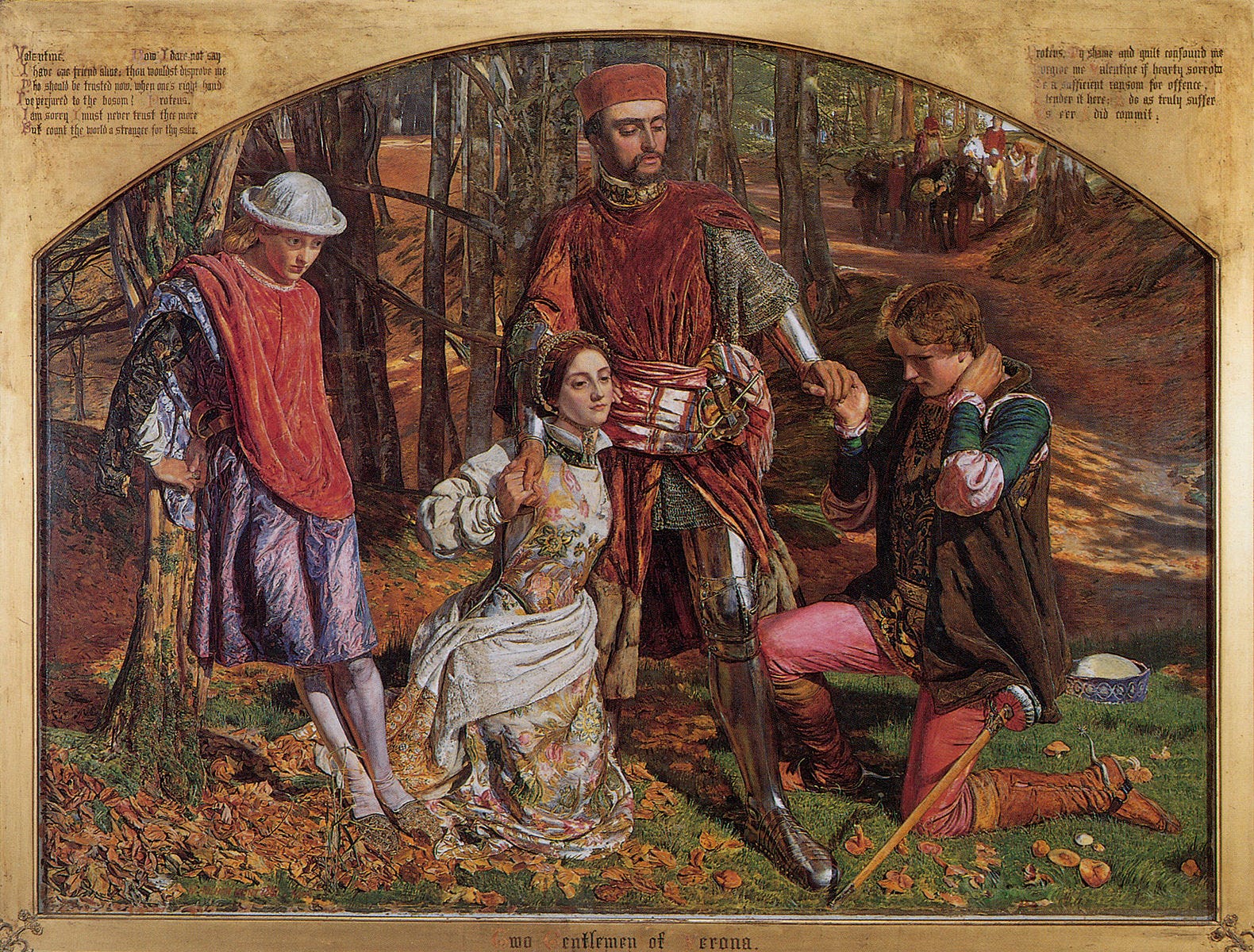
Siddal was born in 1829 in London to a family who worked in the trades; her father made cutlery. There are several competing stories about how she became an artist’s model. In 1849, she was working for a milliner when she was spotted either by the artist Walter Deverell or by his father, or alternatively by a friend. In any case, Deverell did meet Siddal and hired her to model in his Twelfth Night, Act II, Scene IV (1850). Very quickly, Siddal was embraced by the Pre-Raphaelite circle. Her red hair added to her appeal, as these painters strove to capture brilliant colors on canvas. Soon, William Holman Hunt asked her to model in his works, including A Converted British Family Sheltering a Christian Missionary from the Persecution of the Druids (1850) and Valentine Rescuing Sylvia From Proteus (1850-51). To this day, she remains the face of the Pre-Raphaelite movement as John Everett Millais’s Ophelia (1851-52).
.jpg)
However, it was her relationship with Dante Gabriel Rossetti that would consume the remainder of her very short life.
Rossetti and Siddal likely met when they both modeled for Deverell’s Twelfth Night, with Siddal posing as Viola and Rossetti as Feste. Their romance escalated quickly. By 1852, they were engaged, and Siddal was exclusively modeling for Rossetti. Additionally, Rossetti was teaching Siddal how to draw.1
Both Siddal and Rossetti were in their early twenties. They were incredibly young, and perhaps neither had the maturity nor the experience to navigate the obstacles in their relationship. Rossetti came from an upper-class household. (Rossetti’s father, Gabriele Rossetti, was an Italian nobleman exiled from the Kingdom of Naples due to his support for Italian national unification and constitutional government.) Needless to say, his family strongly disapproved of their engagement. To add to the turmoil, both he and Siddal struggled with addiction. I noted in my recent essay on Christina Rossetti’s “Goblin Market” that her brother Dante was addicted to chloral, and Siddal to laudanum (an opium-based tincture).
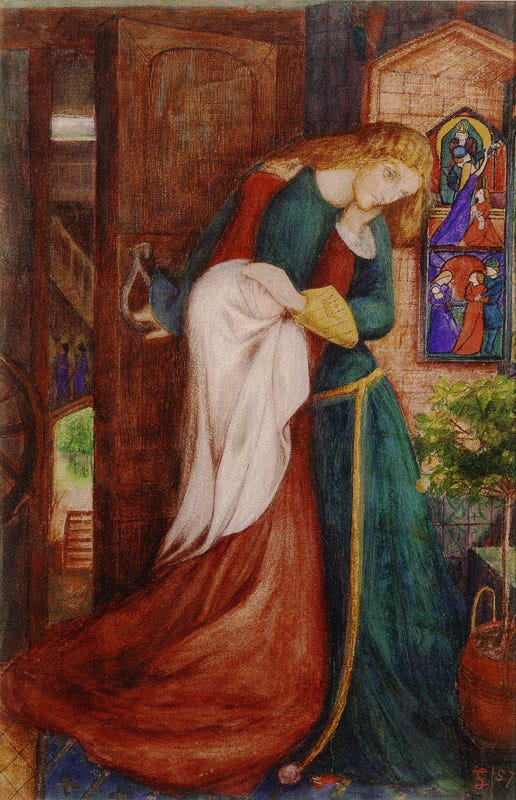
In keeping with the Pre-Raphaelite spirit, Siddal often found inspiration in literature when approaching her own work. The above watercolor, Lady Clare (1854-57), is based on Alfred Lord Tennyson’s poem of the same name, in which Lady Clare discovers that she is not actually of noble birth, complicating her engagement with Lord Ronald.2 The connection to Siddal’s own life and her delayed marriage to Rossetti is clear.
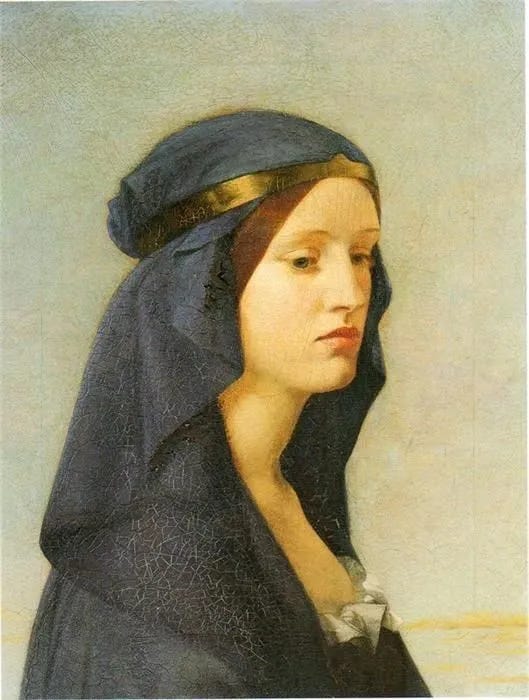
Her lack of formal training is also apparent, especially in comparison to works by other female Pre-Raphaelites whose families could afford private tutors—one can see the contrast between Siddal’s Lady Clare and, for example, Joanna Mary Boyce’s Elgiva (1855) above. This is unfortunately a common theme in 19th-century art; talented boys of even lower economic backgrounds had a shot at attending art school, but girls were usually not allowed to enroll. Therefore, female artists were forced to rely on private instruction, which Siddal’s family could not afford. (Think of the Impressionists—the leading male Impressionists came from a variety of backgrounds across the economic spectrum, but the leading women all came from affluent families.)
Lady Clare was unique in that its “naïveté” wasn’t necessarily a downside to the Pre-Raphaelites. The pure medievalism of this painting and its unique composition would influence other works, including Rossetti’s Before the Battle (1858) and Saint George and the Princess Sabra (1862), as well as Edward Burne-Jones’s The Knight’s Farewell (1858).3
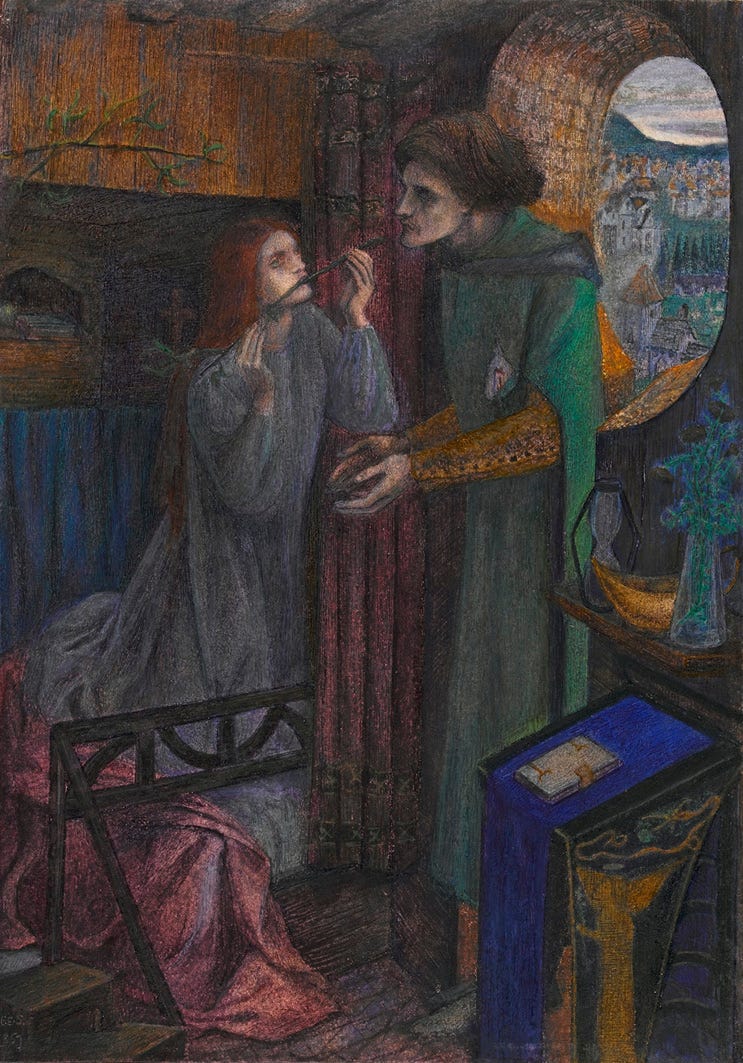

Siddal also asserted some control over her public persona: she adjusted the spelling of her name from Siddall to Siddal when signing her art. Her watercolors and drawings typically derived their subject matter from works of literature and folklore, including The Lady of Shalott (1853) and The Quest of the Holy Grail (1855). There is something truly dark and Gothic about Siddal’s work—the medieval, sometimes gloomy backdrops, the exaggerated facial features, the dark expressions in her subjects’ eyes. Despite her lack of experience, she truly embodied the aesthetic principles that the Pre-Raphaelites hoped to champion.
After 1857, her productivity declined due to her ill health. She and Rossetti finally married in 1860, though Siddal’s opium addiction, coupled with the stillbirth of her daughter in 1861, left her in a deep depression. She died in 1862 of an overdose, and like the character she portrayed in Millais’s Ophelia, it is unclear whether or not her death was an accident. She was thirty-two.
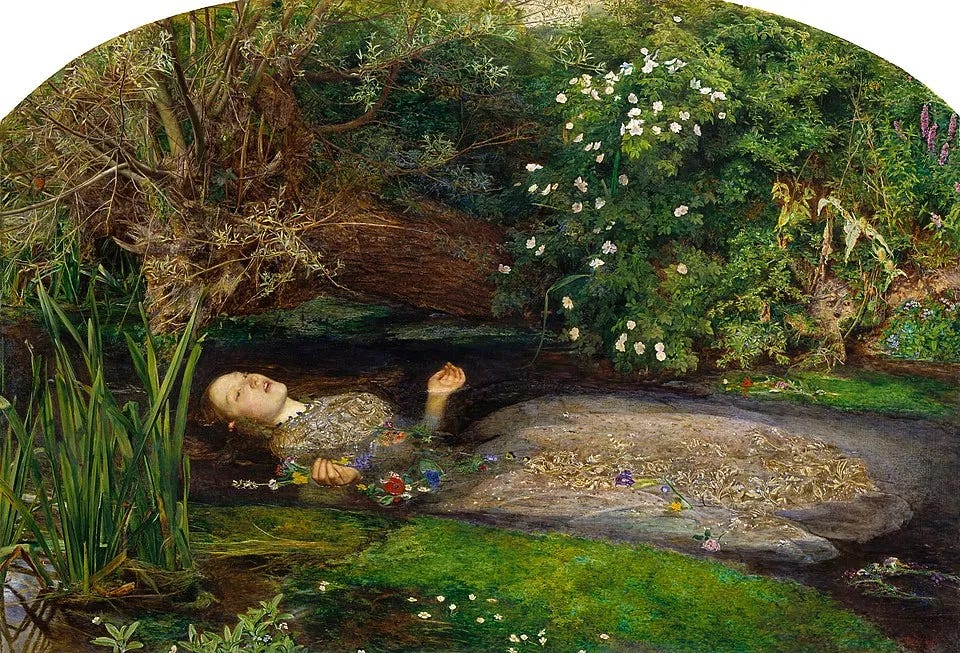
They say that when an artist falls in love with you, you can never die. Rossetti continued to seek out models who resembled Siddal, as did many artists connected with the Pre-Raphaelites. Siddal haunted the movement long after her passing, her likeness finding its way onto dozens of canvases.
This is the danger of becoming a muse—over time, your personhood disappears into the paint, as the artists resurrect your image again and again.
Siddal transformed into a symbol: the damsel in distress, the melancholic beauty, floating in a pool of her own misery. But Siddal was an artist in her own right, and had she lived longer and had more time to develop her craft, one can only imagine what else she might have created.
Elizabeth Prettejohn, The Art of the Pre-Raphaelites (Princeton University Press, 2000), 74.
Prettejohn, The Art of the Pre-Raphaelites, 76.