

The Many Faces of "The Lady of Shalott"
Alfred, Lord Tennyson's enigmatic poem inspired many Pre-Raphaelite adaptations.

This essay is part of the series Art, Myth, and Literature: The Pre-Raphaelites.

On either side the river lie
Long fields of barley and of rye,
That clothe the wold and meet the sky;
And thro’ the field the road runs by
To many-tower’d Camelot;
And up and down the people go,
Gazing where the lilies blow
Round an island there below,
The island of Shalott.
Willows whiten, aspens quiver,
Little breezes dusk and shiver
Thro’ the wave that runs for ever
By the island in the river
Flowing down to Camelot.
Four gray walls, and four gray towers,
Overlook a space of flowers,
And the silent isle imbowers
The Lady of Shalott.1
In 1842, the writer Alfred Tennyson published a revised version of “The Lady of Shalott,” a poem set in Arthurian England about a lady trapped in a tower. The Lady of Shalott is doomed to weave continuously, and her only view of the outside world is a mirror reflecting the tower’s window. Knights, abbots, and lovers go by—but if she turns to the window, a terrible curse will take effect. Who enacted the curse? And why exactly is the Lady trapped?
The reader never finds out.
Tennyson’s first poetry collection, published in 1832, featured an earlier version of the poem. It received such a lashing from critics that Tennyson didn’t publish again for ten years. He would go on to enjoy a successful career, becoming the United Kingdom’s Poet Laureate for most of the Victorian period, and in 1884, he accepted a baronetcy from Queen Victoria. Henceforth, he was known as Alfred Tennyson, 1st Baron Tennyson—or, more commonly, Alfred, Lord Tennyson.
But it is Alfred, Lord Tennyson’s earlier works, which often found inspiration in an imagined Middle Ages, that would leave a profound impact on the Pre-Raphaelites. His “Lady of Shalott” takes inspiration from Arthurian legends of Elaine of Astolat, who dies of a broken heart due to her unrequited love for Sir Lancelot. In Sir Thomas Malory’s Le Morte d’Arthur (1485), Elaine asks that her body be placed on a boat to Camelot with a letter, in which she explains to Lancelot why she died. In many ways, Tennyson’s Lady of Shalott was the perfect character on which the Pre-Raphaelites could project their aesthetic ideals.

So much of the Lady’s story is clouded in mystery. We never learn why she is trapped, or why she must weave. Echoing Plato’s Allegory of the Cave, she cannot see the outside world, and she declares that she is “half sick of shadows.” Ultimately, it is the sight of Sir Lancelot in her mirror that causes her to turn to the window and behold the dashing, raven-haired knight riding past the tower. Her fate inexplicably sealed, the Lady of Shalott leaves the tower, writes her name on the side of a boat, and sails down the river to Camelot. Ensconced within an autumnal landscape, she sings a haunting tune until freezing to death, and in the 1842 version, Lancelot joins the onlookers on the banks, mystified by the sight of the Lady’s corpse:
Who is this? and what is here?
And in the lighted palace near
Died the sound of royal cheer;
And they cross’d themselves for fear,
All the knights at Camelot:
But Lancelot mused a little space;
He said, “She has a lovely face;
God in his mercy lend her grace,
The Lady of Shalott.”2
You may be scratching your head. Admittedly, there is much left answered: how does she leave the tower? Why must she die? How does she know that she is going to die?
Earlier in the poem, the speaker shared that the residents of Shalott believe that a fairy is residing in the tower, for they sometimes hear her beautiful singing. Indeed, there is something of the old fairy stories in this poem—the otherworldly strangeness, the lack of “human” logic that so often accompanies tales of the Good Folk.
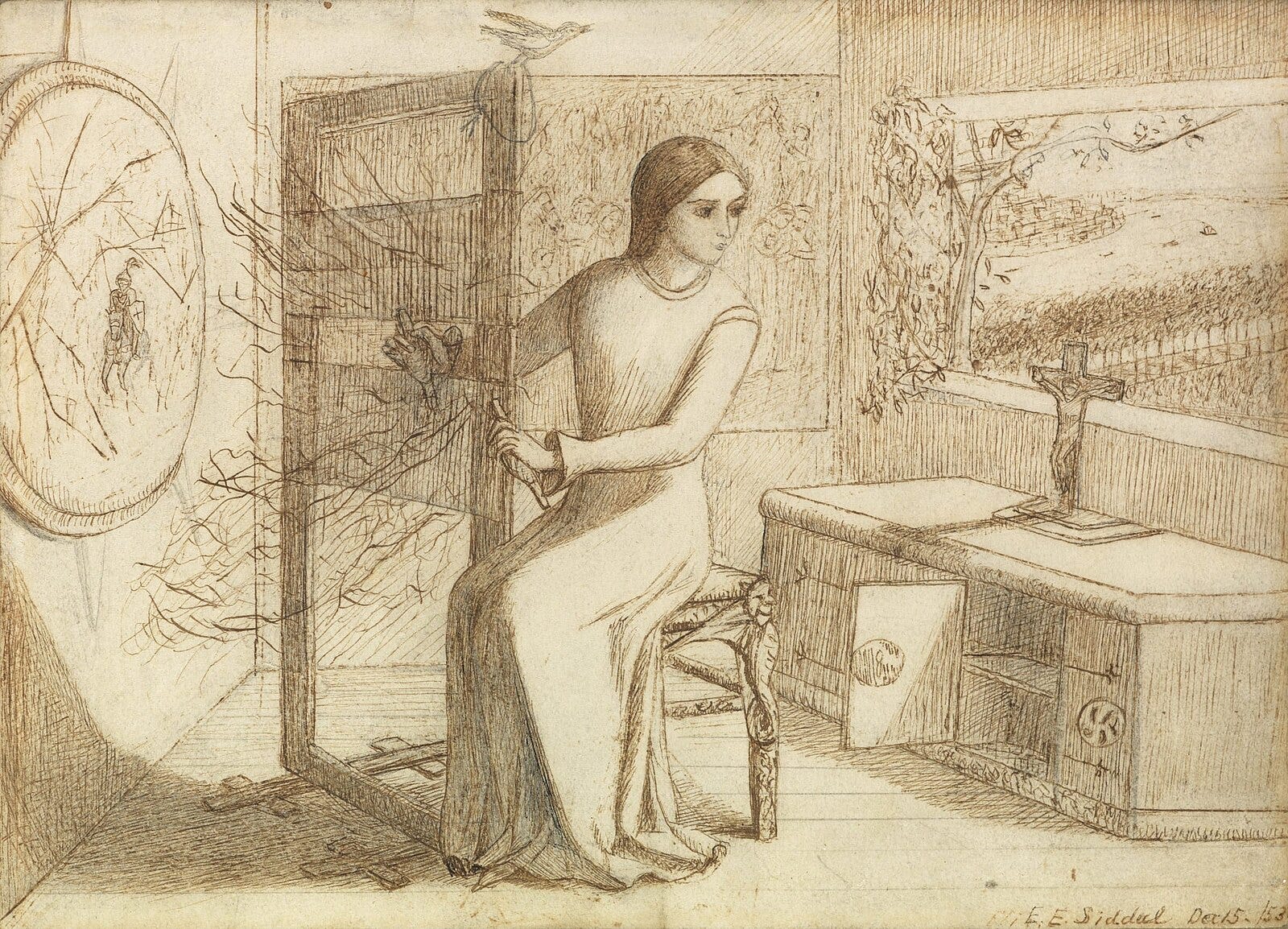
Some scholars interpret the poem as a commentary on the sequestered lives of affluent Victorian women, whose movements and desires were carefully controlled. When the Lady gives into her temptation to look at Sir Lancelot, she is punished for acting upon her desires. Elizabeth Siddal’s drawing, The Lady of Shalott (1853), leans into this interpretation by capturing the moment the Lady turns to the window, and the mirror shatters. The art historian Deborah Cherry comments that in Siddal’s rendition, the Lady “is not offered as a spectacle for the masculine gaze. Seeing, not only seen, she is represented at the moment of her look.”3
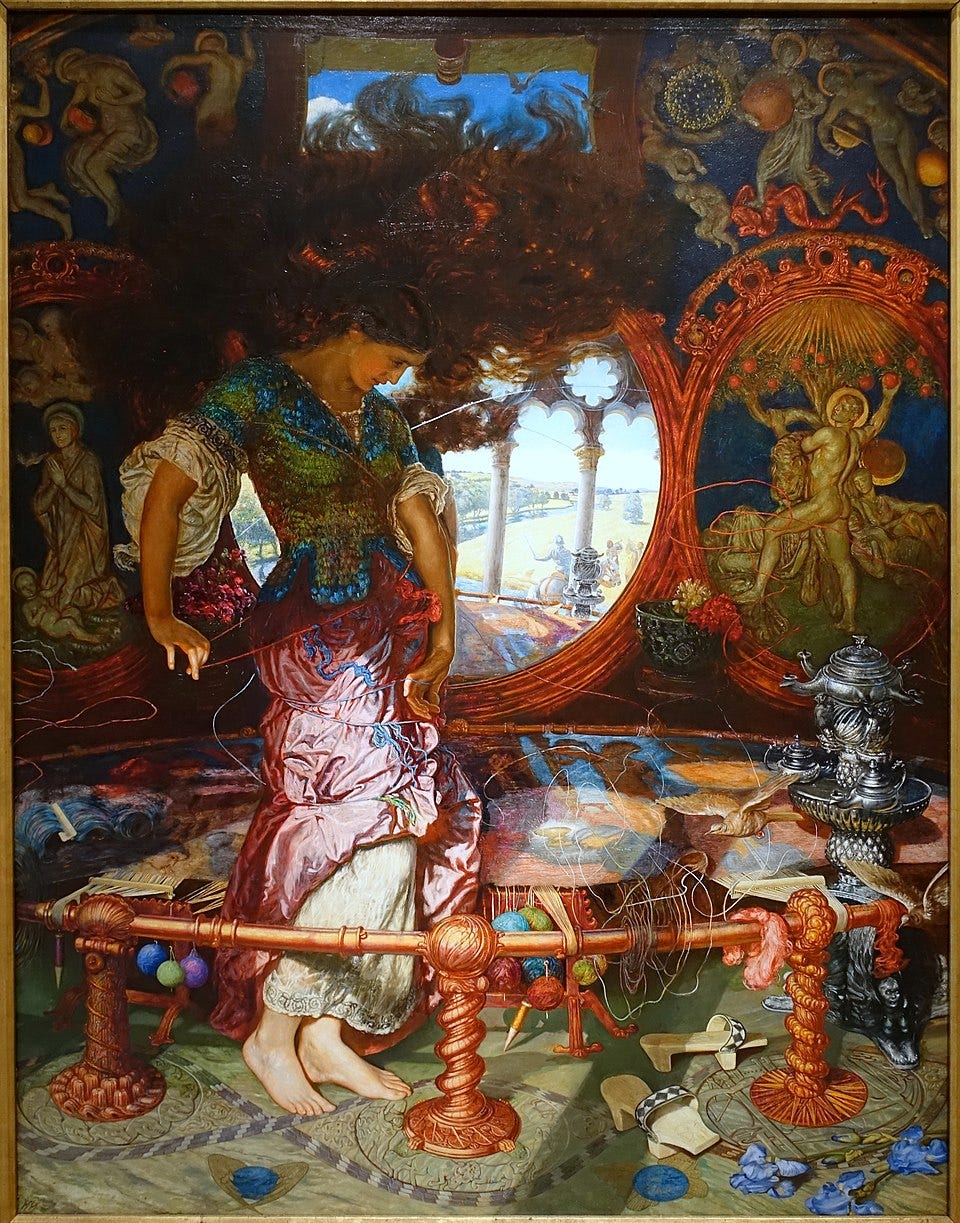

Others see this poem as a reflection of the artistic condition—the Lady herself is an artist, and though she weaves and weaves day and night, her work will never fully capture the beauty of her new muse, Sir Lancelot. William Holman Hunt’s later rendition (above), showcases the eruption of the Lady’s creative process when the loom breaks. The threads of her work (possibly, years of labor) unravel in a single instance, her hair flying in all directions.
In keeping with the Pre-Raphaelite style that he pioneered in his youth, Hunt’s backdrop is just as interesting as the main subject; the walls of the tower are decorated with gilded biblical scenes. To the Lady’s right is Adam picking a fruit from the Tree of Knowledge of Good and Evil, referencing the woman’s decision to know the outside world. To her left is the Virgin Mary with the infant Jesus, representing a pure act of creation much in the way artists create from nothing.
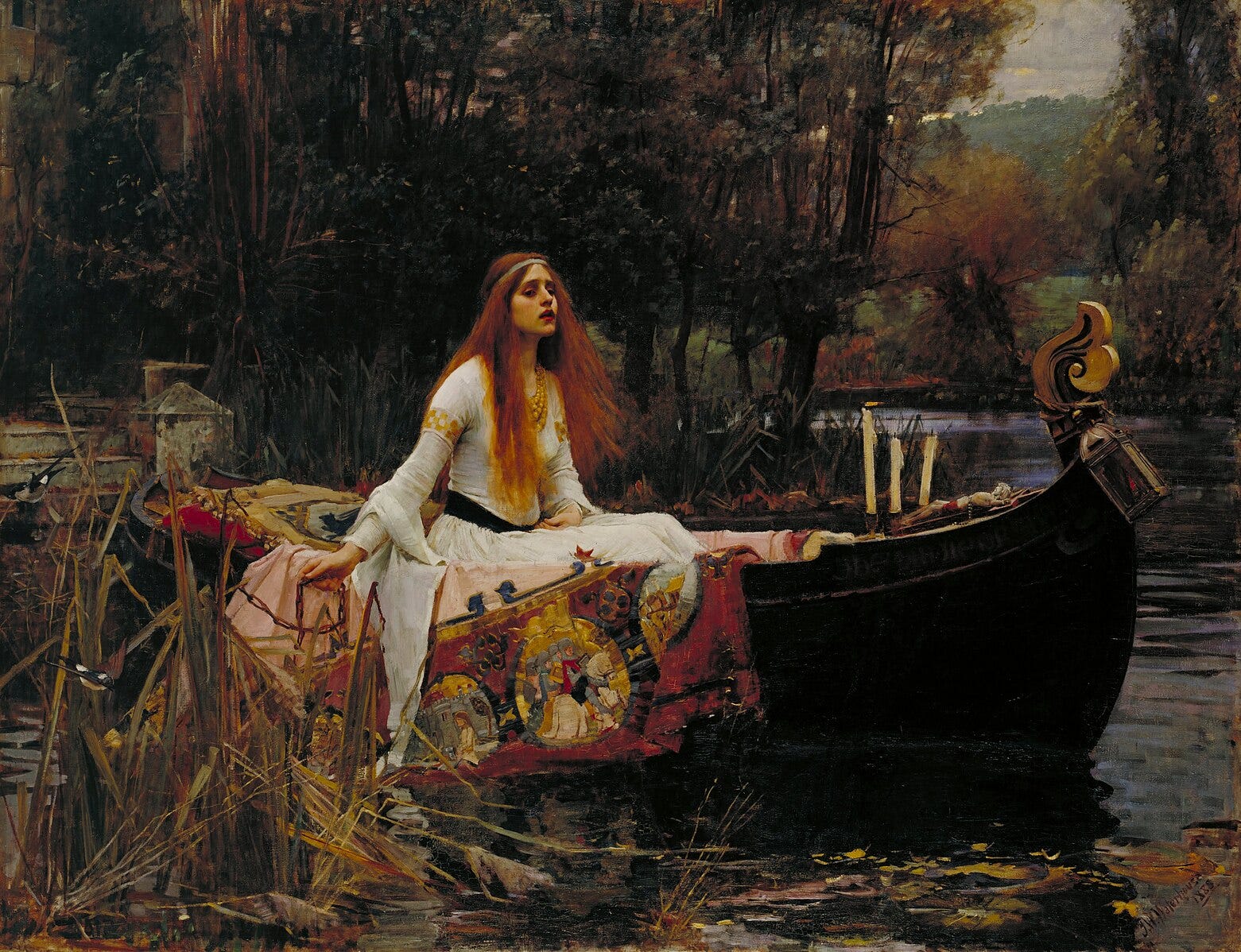
But the most famous Pre-Raphaelite image from Tennyson’s poem is John William Waterhouse’s 1888 painting featured at the beginning of this essay. Waterhouse was born during the short years when the Pre-Raphaelite Brotherhood was still in existence, and he is among the cohort of later Victorian painters who adopted the Pre-Raphaelite style.
Waterhouse, as I mentioned in last week’s essay on Siddal, shared the Pre-Raphaelite fascination with red-haired women. His work often takes inspiration from Greek myths or works of literature—Circe, Ophelia, Ariadne, and Miranda have all found their way onto his canvases, usually portrayed by models with long, red hair. His 1888 Lady of Shalott makes use of this color to compliment the autumnal scene in which the Lady sails to her death. The reeds in the foreground reference John Everett Millais’s Ophelia (1852), and her half-parted lips suggest that she may be about to sing her last song. With her original artwork lying beside her (in Waterhouse’s version, her tapestry is complete), the song represents a new art form—in Elizabeth Prettejohn’s words, “to express the pathos of [the Lady’s] last minutes.”4
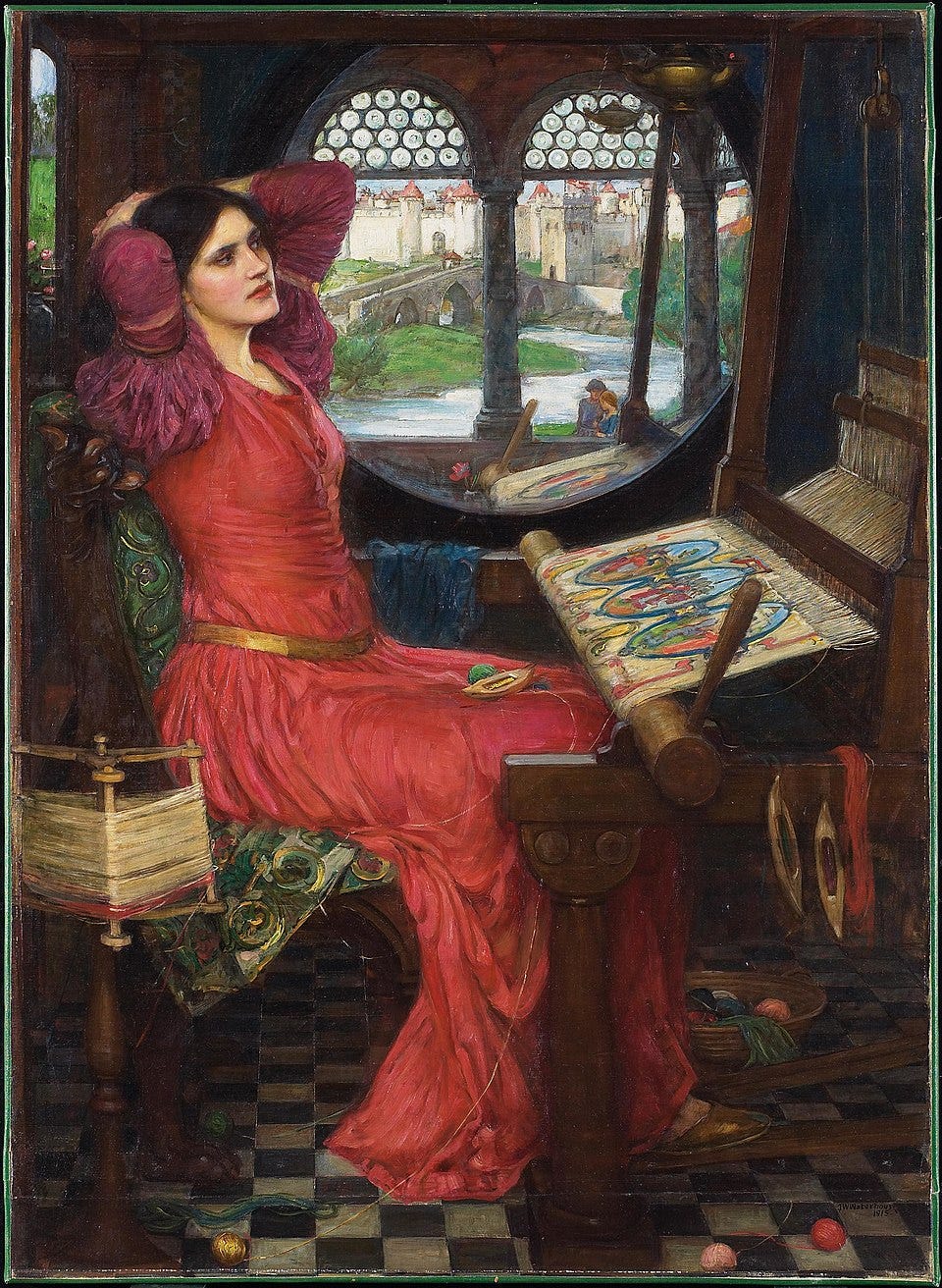

Waterhouse would paint other scenes from “The Lady of Shalott” (see above), but it is his 1888 painting for which he is best known. The landscape is more impressionistic than the original Brotherhood would have allowed, but its overt medievalism, its reference to martyrdom in the boat’s crucifix, and the despondent expression on the woman’s face all reflect the moody Pre-Raphaelite aesthetic.
I would argue that it is the mysticism of Tennyson’s poem that ultimately made “The Lady of Shalott” irresistible subject matter for the Pre-Raphaelites. The poem succeeds in transporting the reader to an unknowable, mist-laden past, in which obscure spells are cast, and the magic is beyond our understanding. Tennyson’s ode to Arthurian romance offered the Pre-Raphaelites a wealth of evocative, fantastical imagery:
Lying, robed in snowy white
That loosely flew to left and right—
The leaves upon her falling light—
Thro’ the noises of the night
She floated down to Camelot…5
They, better than anyone, knew how to bring a long time ago, in a land far away to life.
Alfred Lord Tennyson, “The Lady of Shalott” (1842), Poetry Foundation, https://www.poetryfoundation.org/poems/45360/the-lady-of-shalott-1842.
Tennyson, “The Lady of Shalott.”
Elizabeth Prettejohn, The Art of the Pre-Raphaelites (Princeton University Press, 2000), 227.
Prettejohn, The Art of the Pre-Raphaelites, 230.
Tennyson, “The Lady of Shalott.”
I love this, the Waterhouse painting has always been a favorite. I think the idea that the Lady represents a constrained Victorian femininity is apt. The story is so rich for feminist theorizing: the restriction of her gaze, her being forced to weave (a historically female task), her imprisonment in a phallic tower, her inability to resist temptation.
It's also so interesting to see what parts of the narrative artists chose to depict. The chaos of Hunt's painting is so different from the serenity and mournfulness of Waterhouse's, while the Waterhouse painting of the Lady weaving seems to vibrate with frustration.
But there's something about Siddal's drawing that hits deepest. The almost resigned look on the Lady's face as she turns. The way the light falls through the window and onto her dress. The reflection of Lancelot in the shattered window. It appears to be such a simple drawing at first, but there is so much to fall in love with!