

The Transformation of the Snow Queen
From Hans Christian Andersen's beloved fairytale to the White Witch of Narnia and Disney's Elsa, the Queen of Winter prevails.


I was eighteen years old when I first witnessed the magic of snowfall.
It was my freshman year at my university, and after growing up in a seasonless paradise, I would get to experience my first real winter. I had been trapped indoors all evening in a dark theater, rehearsing for a play, and had little indication of the transformation taking place on the other side of the thick, concrete walls. By the time I was finally free to walk back to my dorm, the campus was shrouded in a blanket of snow.
I vividly recall opening the front door of the theater and feeling my breath leave my body; like Lucy pushing past the fur coats and stepping gingerly into Narnia, I had found myself in a foreign land. The snow descended silently, and on my black coat, I could make out every groove and crystal formation of each individual flake. I just couldn’t believe that such delicate beauty existed in the world, and that I would have the privilege of witnessing it.
But living in blustery Chicago, I soon discovered that winter’s beauty and allure possessed a brutal edge. From trudging to class in knee-deep snow at seven-thirty in the morning to experiencing my first polar vortex, winter swiftly revealed its teeth. As I huddled in my L.L.Bean parka and darted quickly into cozy coffee shops and libraries, I wondered how in the world our ancestors survived this season without central heating.
(Well, not my ancestors. Mine were scattered around the Mediterranean, eating hummus and drinking wine, as one should. No wonder I moved South after school—my people are simply not built for the cold!)
Nevertheless, my four years of experiencing long, punishing winters (and wondering how it could possibly snow in May) gave me enormous appreciation for those who lived in times when a warm fire was one’s best option.
With winter’s arrival, I knew that I wanted to write about The Snow Queen for The Crossroads Gazette. After all, it’s the perfect wintry fairytale, and I do love Hans Christian Andersen. But as I was researching the stories that his iconic Queen of Winter inspired, I was struck by how different Queen Elsa of Disney’s Frozen is from the original story, or even from the White Witch of The Chronicles of Narnia. Part of this is due to the transformation of the witch in popular culture from a symbol of evil wrapped up in anxieties regarding female power, to a positive symbol of women’s liberation and self-determination.
Elsa herself underwent this evolution: in the film’s original script, she was the stereotypical evil queen so prevalent in fairytales. It wasn’t until after writing the song “Let It Go” that the film’s creators realized they should take the character in a different direction. “Let It Go” is a hero’s song, and the writers axed their original story to make room for a new tale of sisterhood and family. But I also wonder if part of this transformation has to do with our shifting relationship to winter itself.
Andersen published The Snow Queen, quite fittingly, on the winter solstice of 1844. The story follows a brave young girl named Gerda, who embarks on a long journey to rescue her friend Kai. Kai has fallen under an evil spell cast by the Devil that distorts a victim’s view of people, such that the enchanted person cannot recognize the good in others and fixates on the bad. The only beauty Kai sees is the perfection of snowflakes.
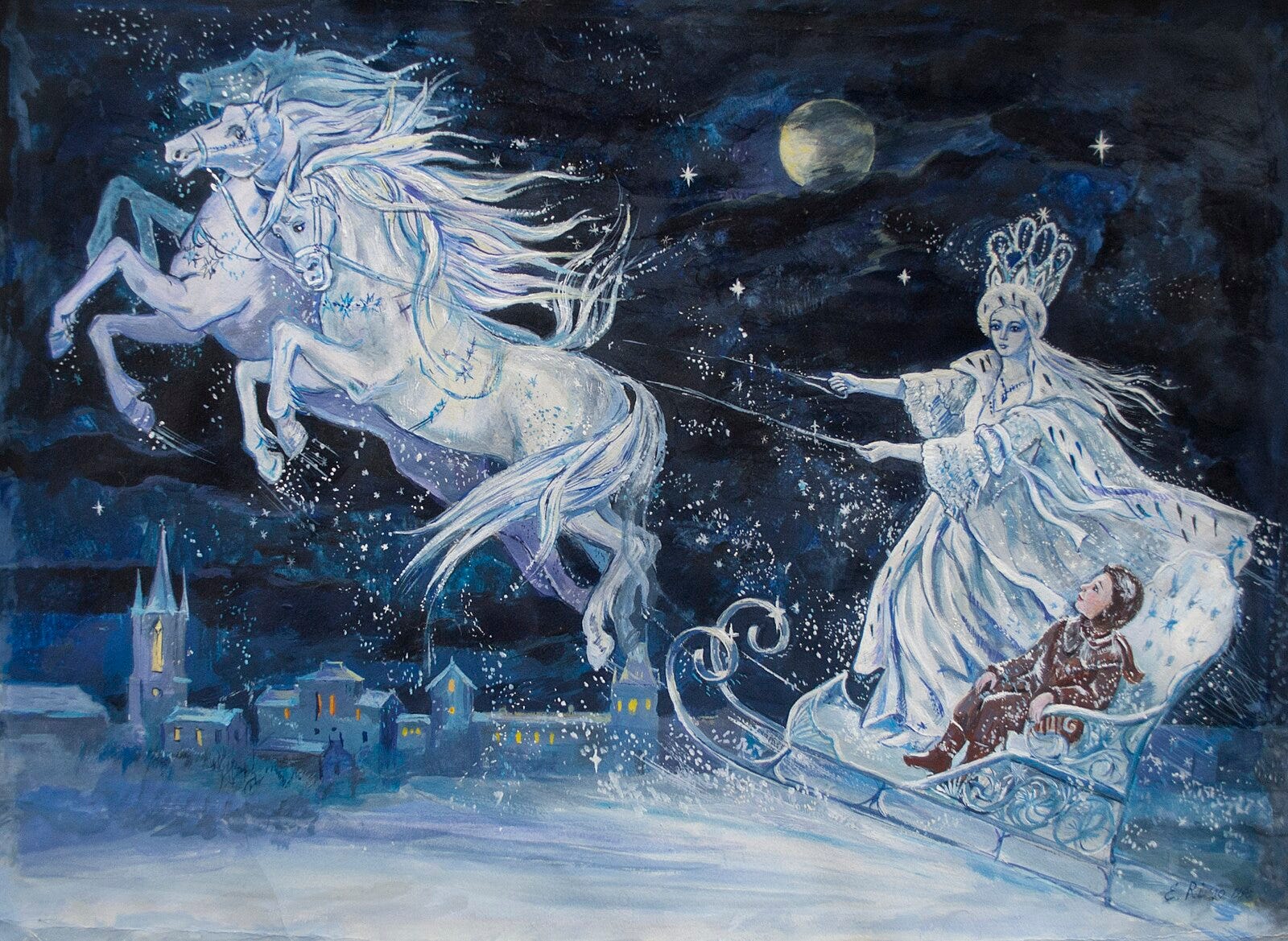
That winter, Kai encounters the Snow Queen while sledding through town, and with a magic kiss, she makes him forget Gerda and his entire family. Hypnotized, Kai joins the Snow Queen on her sleigh and leaves for her palace of ice.
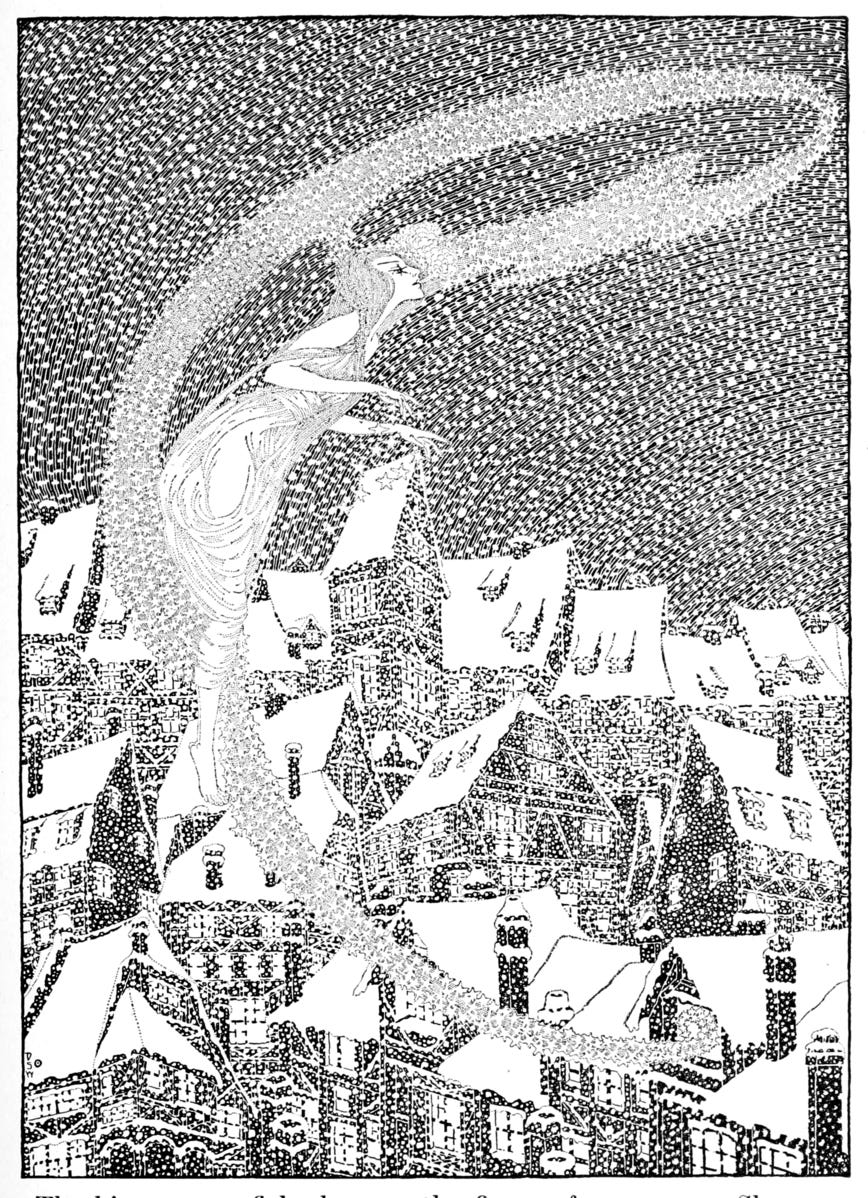
Jadis, better known as the White Witch from The Chronicles of Narnia series, closely mirrors the Snow Queen. In looking at old illustrations of the original fairytale, I couldn’t help but notice how the moment of Kai joining the Snow Queen so exactly mirrors the scene from The Lion, the Witch and the Wardrobe, in which Edmund Pevensie is lured onto the White Witch’s carriage.
Both of these queens, like Disney’s Elsa, rule from a palace of ice. But even as Anna and Sven journey through the mountainous outskirts of Arendelle, the wintry landscape of Frozen lacks the ominous undercurrents of its predecessors. The mingled beauty and terror of The Snow Queen is alive and well in C.S. Lewis’s Narnia—the moment Lucy exits the wardrobe and into the forest is both captivating and humming with danger.
.png)
Of course, the earlier fairytales served a different purpose from their Disney-fied counterparts, as they instructed children about the dangers of the world. When Hans Christian Andersen wrote The Snow Queen, the average person heated their home using wood-burning stoves or fireplaces, and homes in colder climates were designed to retain heat. Radiators and steam-powered furnaces, while available in the Victorian period, were only accessible to wealthy homeowners. (It wasn’t until 1919 that African American inventor Alice H. Parker would patent the first central heating system using natural gas, the basis for the central heating systems on which we rely today.)
In our age of globalization and factory farming, it’s difficult to imagine a world in which bananas and blueberries aren’t available year-round in grocery stores for one’s morning oatmeal. Getting through winter meant careful planning, canning, salting, and storage throughout the year to ensure the harvest’s bounty stretched into the colder months. Extreme climate events, such as the infamous Year Without Summer of 1816, resulted in famines throughout the world—with summer and fall harvests ruined by incessant rain and cold following the eruption of Mount Tambora in Indonesia. Surviving winter in a time of extreme famine is no small feat.
Winter, though beautiful, was a time of death: the death of the natural world, and for the unfortunate or ill-prepared, the death of people, too. Gerda’s long journey to the Snow Queen’s palace holds new significance when evaluated in that context, as does the Snow Queen’s casual cruelty. Mother Nature doesn’t care if we survive the winter, and neither does the White Witch as she curses the land of Narnia to eternal snow.
The Snow Queen, like many classic fairytales, is also a story of good-versus-evil, with winter squarely on the side of evil. The Narnia books, whose narratives employ a Christian allegorical lens, follow a similar good-versus-evil narrative arc. Less commented on is the particular brutality of winter during World War II. The Lion, the Witch and the Wardrobe was published in 1950, and the preceding years of war and turmoil left a considerable impact on C.S. Lewis (as did his own years of military service in World War I). The winter of 1939-1940 was the coldest Europe had experienced in 45 years. As AJ Drummond of Britain’s Royal Meteorological Society commented at the time, “The present century has been marked by such a widespread tendency towards mild winters that the ‘old-fashioned winters,’ of which one had heard so much, seemed to have gone forever.”
The winter of 1941-1942 was even worse, and while it did have the positive impact of impeding Germany’s invasion of the Soviet Union, it also meant that during the most violent conflict in human history, winter sunk its claws into the European continent and didn’t let go. Did this backdrop of intense, cruel winter amidst a terrible war influence C.S. Lewis as he wrote of a war-torn Narnia cursed with endless cold?
As I ponder these questions, I’m reminded of Thanksgiving 2019. Frozen II had just come out, and with my sister and I both home for the holidays, we decided it would be fun to see the movie together. After all, it’s a film centered around the bond between sisters—and any woman who has a sister knows what a precious thing that is. While we were driving back to our parents’ house, the fog suddenly rolled in, blocking our view. In Southern California’s mild winters, the ice and cold of the Snow Queen is a distant dream. But along the coast, the dense, heavy fog of winter nights—what locals call the “marine layer”—is very real, and at times, very dangerous.
In that moment, my sister did what anyone does when the visibility is so poor that you can’t see the car in front of you—slow your vehicle to a crawl, cling to the steering wheel, and pray. Inch by inch, we made it home safely.
Nature has a way of revealing to us how small we are. Even with heating and air conditioning, electricity and paved roads, winter reminds us that we are firmly in her grasp. Perhaps that explains the ending of The Snow Queen: while Gerda succeeds in rescuing Kai from the palace of ice, the Snow Queen herself is not vanquished. Her captive may be free, but as sure as the snow will melt in spring, the Queen of Winter will live to see another year.
I never picked up on the connection between the White Witch picking up Edmund and the Snow Queen! Great insight
Wow,
Great visual effect.
It is like being there