

What's Your Roman Empire?
All over social media, videos abound of women asking their male partners how often they think about the Roman Empire. What's your "Roman Empire"—and why are we drawn to certain periods of history?

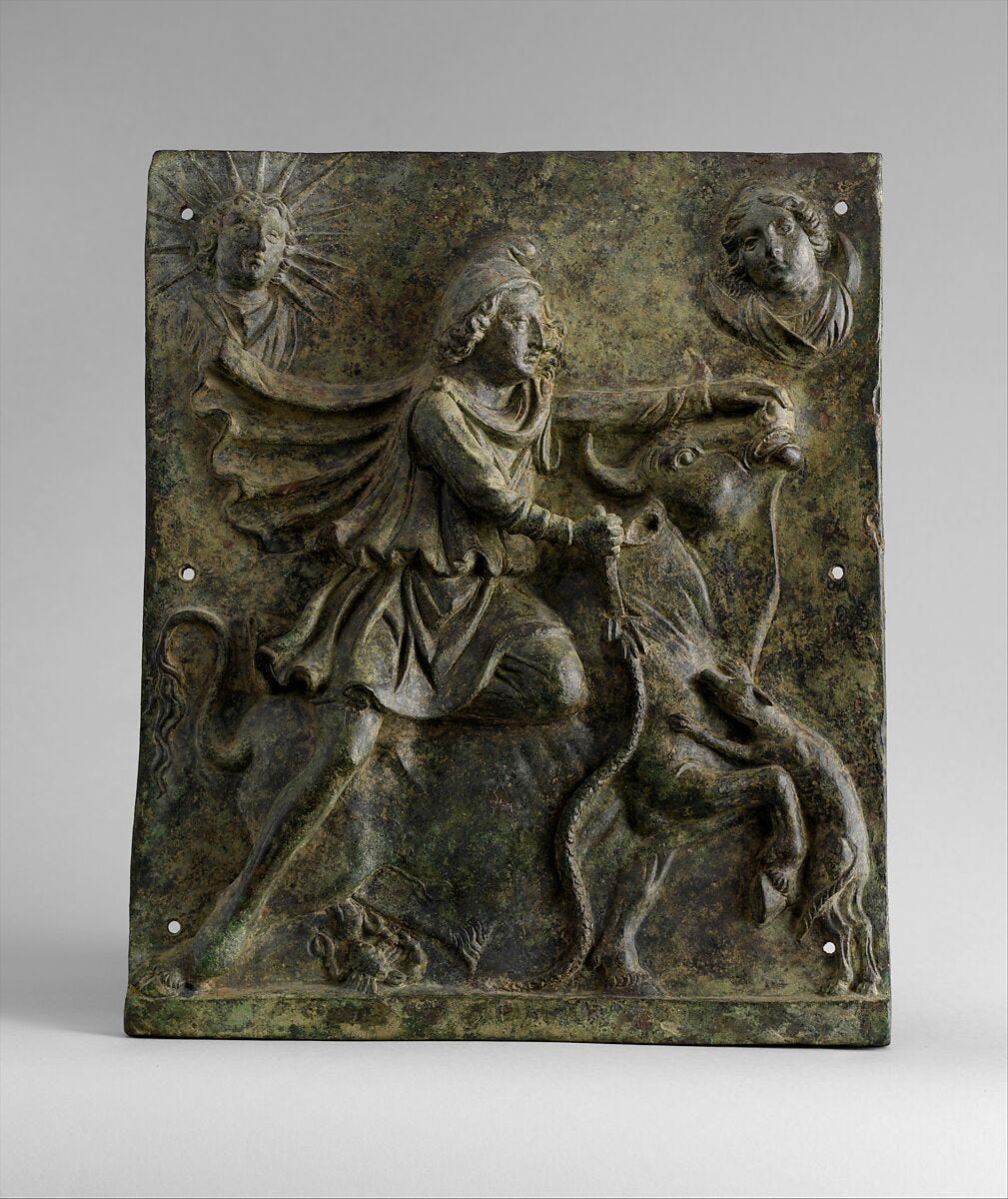
It began as a silly social media trend. Women would point the camera at their boyfriends and husbands and ask, “How often do you think about the Roman Empire?”
The results were initially astonishing—men all over the United States (most of the videos I came across involved Americans) claimed that they thought about Rome at least once a day. However, we all know that social media is often artificial and manufactured. It’s this reason that in my videos on folklore, history, and literature, I employ a presentational style; frankly, I detest the faux-relatability of these supposedly “raw” and “real life” moments captured on screen. How do I know that this wasn’t staged? How do I know that you didn’t spoon-feed that line to your partner in hopes of garnering views?
I do have to assume that some of these are real, which prompts the question—why Rome? Some commenters have pointed out that these individuals are likely not obsessed with the actual Roman Empire, with its complicated bureaucracy, legal code, civil projects, military campaigns, and incredibly diverse peoples and cultures over which it ruled—but rather, the romanticized portrait of Rome featured in films like Gladiator. And before we wag a pointed finger at these men, we should keep in mind that romanticizing the Roman Empire has a long and entrenched legacy. As historian David Mattingly brilliantly explores in his book, An Imperial Possession: Britain in the Roman Empire, the Victorians played a major role in the glorification of Rome in English-speaking countries. Looking at Roman history within their context—as the British Empire was at its peak of power and influence—it’s not surprising that the Victorians saw the colonization of their own island by a foreign power as a positive thing for the indigenous Britons. Now that the United States has taken the UK’s place as the global superpower, even with that supremacy being increasingly challenged, it’s not terribly shocking that Americans might be prone to the same starry-eyed view of Rome.
While I do find Rome fascinating (the good, the bad, and the ugly), I am even more interested in how the Western Roman Empire fell apart, even as the East prevailed for another thousand years. But this online trend got me thinking: what is my Roman Empire? And why do certain subjects keep me coming back over and over again?
First, like many Americans, my education focused almost exclusively on European and American history, a gap which I am trying to remedy now as an adult. When we did study non-Western cultures in school, it was always from the perspective of Western imperialism, which explains why Western students are prone to both radically undervaluing the contributions of non-Western societies, while also underestimating the capacity for subjugation that leaders of such societies can inflict on their own populace, and yes, those of other territories. In both instances, there is condescension at play.
What this means for me is that despite having a Cuban mom and a Greek dad, and despite growing up surrounded by Latinos, I’ve had to acquire the lion’s share of my knowledge on Latin American history as an adult. This also means that my “Roman Empires” come exclusively from the European history I learned in school.
My first Roman Empire was my obsession with fairy folklore. Growing up in the early 2000s, I had a plethora of options to indulge this love. I was introduced to Cicely Mary Barker’s illustrations of flower fairies at a young age, and I would beg my mom to buy flower fairy figurines any time we went to a garden center. As I grew older, and discovered that the original fairy legends were much darker than the Disney fairies who populated my childhood, I wasn’t repelled. I was hooked! From fiction like Susanna Clarke’s Jonathan Strange & Mr. Norrell to historian Richard Sugg’s research (Fairies: A Dangerous History), I couldn’t, and still can’t, get enough.
Witches closely followed the fairies. The Wizard of Oz was my favorite movie as a little girl, and I was fascinated by Glinda and the concept of “the good witch.” If Glinda could be magical and powerful and feminine and good, then I, with my pink tutu, sparkly blue eyeshadow, and big dreams, could too. An interest in the history of European and American witch trials, along with the evolving archetype of the witch (so intimately tied to our evolving ideas about women), quickly followed.
As more people have posed the question, “What is your Roman Empire?” on social media, I’ve come across many women who quip that for a lot of us, it’s Marie Antoinette. This made me laugh, because as a teenager, I was obsessed with the ill-fated French queen and her glittering royal court at Versailles. I would guess that Sofia Coppola’s Marie Antoinette has something to do with this overall trend, as her film is precisely where my interest began. The boys have their romanticized portrayal of Rome in Gladiator, and us girls have Coppola’s Marie Antoinette. Despite its historical inaccuracies, it’s the only movie I can watch on mute and still be entertained. Coppola’s film is a visual feast resplendent with pastel cakes, opulent silk gowns, lush flower gardens, and the wistful melancholy of a young woman in the wrong place at the wrong time.
Of course, the actual Marie Antoinette was a complicated figure. The film portrays her as completely powerless politically, but she did have some influence, and her role grew while planning the royal family’s comeback after they were forced to leave Versailles for Paris. (This increased role was largely to do with her husband’s inept leadership.) Perhaps if she had the savviness of her mother, Empress Maria Theresa of Austria, Marie Antoinette would have accepted the new constitutional monarchy instead of conspiring with foreign powers. While the real queen is far more complex and interesting, I do love to rewatch Coppola’s interpretation when I’m in the mood for striking visual beauty.
And finally, I acquired two additional “Roman Empires” as an adult: the Middle Ages, and the Victorian period. Both were the result of my degree in English literature, and this passion for both periods is obvious to anyone who watches my videos on social media. I wrote my senior thesis on Gothic literature, an art form that was often preoccupied with a fantasy version of the Middle Ages. In the strict and orderly climate of Victorian Britain and the U.S., many writers from Bram Stoker to Edgar Allan Poe were captivated by the turbulence and mysticism of the medieval world. Much like today’s “cottagecore” trend (a fantasy of rural living ironically spread through social media), the Victorians also had to make sense of a rapidly changing and industrializing world, fueling a wistful view of “simpler” times cloaked in Arthurian mythology and chivalric romance. Thus, many Victorian thinkers, from writers to painters to politicians, were prone to the same glorification of Britain’s medieval past that the husbands of TikTok supposedly employ today towards imperial Rome.
Which brings me to you, dear reader. What is your Roman Empire? What period of history do you enjoy learning about most, and why?
Have any topics you’d like to see covered by The Crossroads Gazette? Let us know in the comments!