

When AI Raises the Dead
A few weeks ago, the Musée d'Orsay closed a record-breaking exhibit on Vincent van Gogh's final months, including an AI van Gogh. Should we allow artificial intelligence to speak for the deceased?

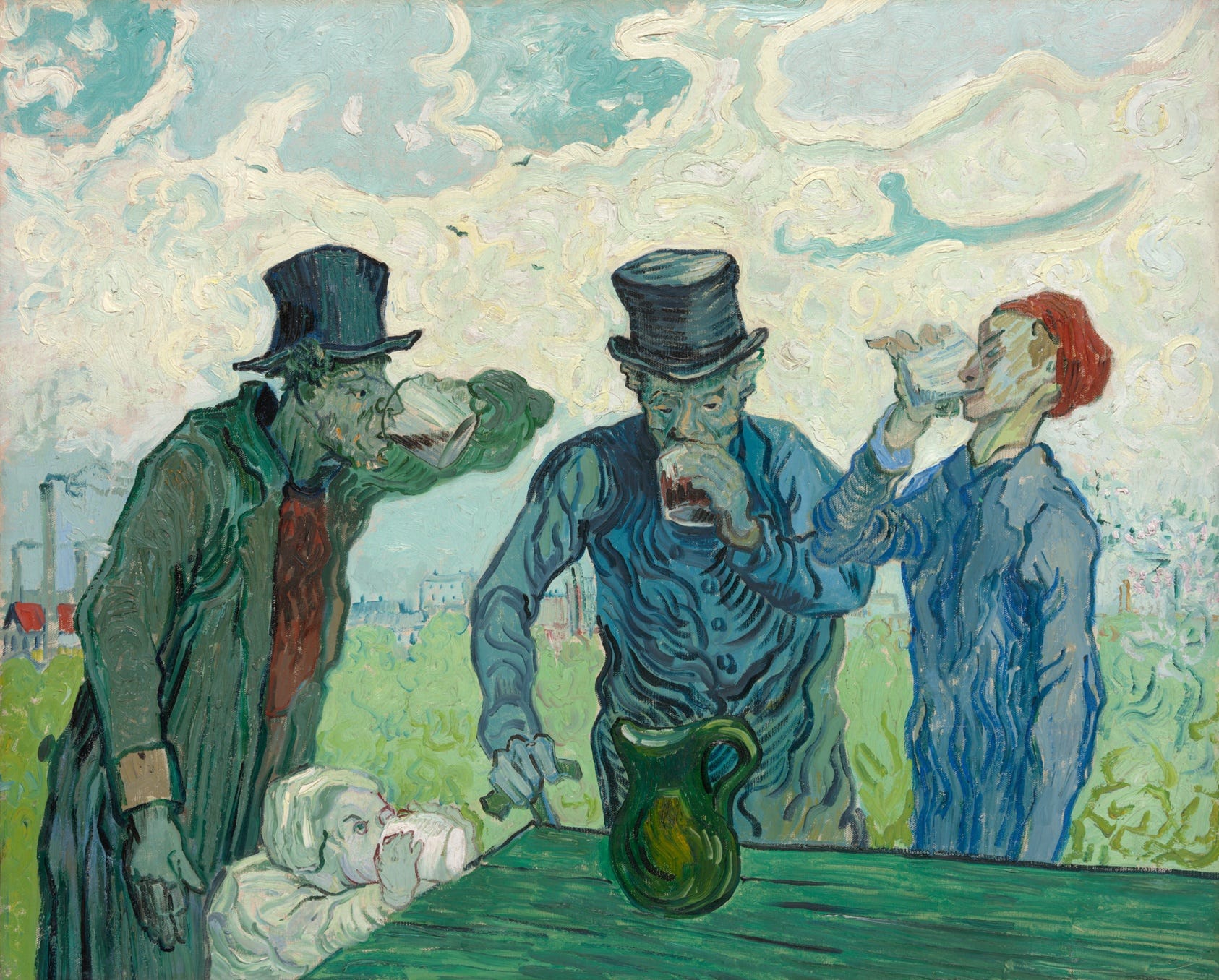
If you could come face to face with Vincent van Gogh, what would you ask him?
Over the past few months, the Musée d’Orsay addressed this very question in their record-breaking exhibit, “Van Gogh in Auvers-sur-Oise, the Final Months.” After the exhibit officially closed a few weeks ago, the museum released attendance numbers, and the results are staggering: 793,556 people visited the exhibit, with a daily average of 7,181 visitors.
A major part of the draw, no doubt, is how beloved van Gogh’s work remains. The largely self-taught artist’s expressive style and bold, vivid colors are instantly recognizable. (It should be noted that the vibrant style for which he is best known would develop after his arrival in Paris in 1886; works painted prior to this period often possessed more somber hues.) In just ten years of working as an artist, he created nearly 900 paintings and over 1,100 works on paper. Tragically, he died just as he was beginning to gain critical attention, with his work on show at the Salon des Independants in Paris between 1888 and 1890 and Les XX in Brussels in 1890. In other words, van Gogh succumbed to his mental illness just as he reached the precipice of his “big break.”
It is that mental illness, along with his eventual suicide, that haunts his legacy in the public imagination. This undercurrent was alive and well at the Musée d’Orsay’s exhibit, and not just because the show focused on the final months of the artist’s life. The exhibit included an interactive component in the form of an AI van Gogh. Guests could “talk” to van Gogh—whose speech was trained on letters he wrote throughout his life.
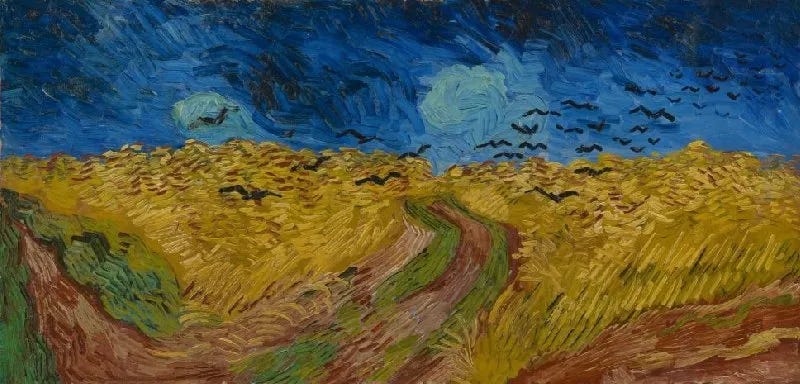
According to Zachary Small for the New York Times, many visitors were eager to ask van Gogh about—you guessed it—why he would take his own life. In an eerie display, AI van Gogh is seated beside one of his final paintings, Wheatfield with Crows (1890)—a foreboding landscape that lacks the vividness of van Gogh’s usual color palette. On July 27, 1890, van Gogh would attempt suicide in a wheat field and pass away from his injuries two days later. Here, “he” sits before us to address our morbid curiosities.
As Small reports, museum officials stated that the algorithm “is constantly refining its answers” to reply delicately to sensitive questions about the artist’s mental illness. In the exhibit, this included benign responses, such as AI van Gogh imploring a visitor to “cling to life, for even in the bleakest of moments, there is always beauty and hope.”
The Musée d’Orsay’s head of digital development added that in the year-long development process, “One of the questions we asked ourselves was at what point this van Gogh was the real van Gogh. It was important to show how this technology will not only be a commercial project, but a cultural one that can improve the display of knowledge.”
But does AI van Gogh do that?
I included this story in the February 18th Crossroads Roundup for patrons, in which I noted how unsettling it is to see AI speaking for the dead in this manner. First, there’s the question of “knowledge”: humans ultimately exercise control of the algorithm. As we’ve seen with Google’s recent Gemini scandal (in which the AI refused to produce images of white people, including bizarre inaccuracies like generating images of black Nazis or the U.S. Founding Fathers as women), these AI programs can often represent the political and social beliefs of its creators.
AI van Gogh, as the museum itself has admitted, involved careful adjustments to ensure that it spoke of van Gogh’s suicide in a sensitive manner. That’s all well and good for a documentary film speaking in the third person, but for an AI creation speaking from van Gogh’s perspective? Are the vague platitudes that the AI offers meant to represent a sort of heavenly van Gogh—as if his spirit has passed on, and this is his message to us in the afterlife? Or is this really supposed to “educate” the public on his final months?
Given the violent nature of his death, I have to ask—who does this refined, palatable van Gogh really serve? Would it not be better to just let the man rest?
We live in a time when artists can’t just be artists—they are often expected to be “role models” as well, and they are eviscerated if they don’t live up to that expectation (especially if they’re young women—think Taylor Swift or Olivia Rodrigo). To our ancestors, the idea that an artist should be a child-friendly representative to society would have been utterly ludicrous. This modern desire for palatable public artists seems to be at play in the way AI van Gogh was represented.
The real van Gogh was a complicated figure. He suffered from recurring psychotic breaks, obsessive behavior, and violent outbursts. He was also a deeply passionate person with an incredibly varied career; prior to devoting himself to painting, he worked for an art dealer, as a schoolteacher, and as an evangelical preacher. (His father was a pastor.) He captured the natural world with the intensity of a fiery sermon. He was brilliant. He was also deeply flawed, and presenting a cleaned-up version of his character doesn’t illuminate his humanity.
There’s also the inevitable ethical questions that arise when allowing artificial intelligence to speak on behalf of the dead, and I don’t think it’s comparable to historical fiction. While works of historical fiction can absolutely influence the perception of public figures, sometimes in negative ways—think William Shakespeare’s Richard III or Netflix’s The Crown—there still exists the barrier that works of fiction are creative interpretations and aren’t necessarily accurate.
But artificial intelligence takes this a step further. By training its program on van Gogh’s letters, there’s a claim of authenticity that isn’t earned, as evidenced by the factual errors present in some of AI van Gogh’s statements. One example was when the AI told visitors that Starry Night (1889) was his favorite painting, even though the real van Gogh’s letters express greater ambivalence towards the piece. It’s likely that many visitors took this incorrect statement as fact, as will others when the AI program “Bonjour Vincent” is released to the wider public in the future. This is one of the biggest problems with generative AI—its propensity towards “hallucinations,” or simply making things up if it doesn’t know the answer.
Likewise, this “resurrection” of our dearly departed extends beyond public figures. With apps like HereAfter AI, ordinary people can use interview footage and videos of their deceased loved ones to create avatars of the dead. The living can then “speak” to the deceased… only, it isn’t them. It’s an algorithmic amalgamation, a profound reduction of the human spirit into mere numbers.
Maybe this is at the center of my distaste for AI van Gogh. Beyond the factual errors and even the ethical pitfalls behind these AI creations, I find there to be something—dare I say it?—spiritually empty in such pursuits. Life and death are hard; losing someone you love is hard. And yet, even as some claim to feel comforted by “talking” to their dead loved ones via AI, in the pit of my stomach, I know it’s all a lie. They are gone. It’s not them. You’re not speaking to them, no more than someone with an “AI Girlfriend” is in a real relationship.
What separates humanity from all other members of the animal kingdom is that we are artists. All of us, each and every one, at some point in our lives, create art. These AI chatbots masquerading as the deceased are paltry imitations. The only thing sadder is that one of the greatest art museums in the world didn’t have faith that the art could speak for itself.
This is deeply unsettling. It makes me think of Frankenstein, which is a sure sign that something is bound to go horribly wrong