

Yuletide Cheer and... Scary Stories?
The Victorians loved a good ghost story, even on Christmas Eve. On the Victorian practice of yuletide ghost stories, and how the period transformed Christmas celebrations for generations.


A family gathers around the fireplace on a stormy night. The wind rattles the shutters and howls through the chimney as cascading rain pelts the windows. The children huddle closely; their hearts race in anticipation. Grandfather takes center stage, and in his rumbling baritone, he begins the story. The children squeal with fright as he spins a yarn about a governess who goes to work in a dark and gloomy castle… only to discover that the attic is haunted by the spirits of children who had mysteriously died on the property years ago…
You’d be forgiven for assuming that the above scene took place on Halloween. But for past generations, the telling of ghost stories was also a Christmas Eve tradition.
It’s unclear when this custom began. Shakespeare’s The Winter’s Tale references the practice of telling ghost stories during the winter, as does Thomas Marlowe’s The Jew of Malta. While telling scary stories during the Christmas season may seem odd to us, winter represented the death of the natural world, and this atmosphere of cold and decay could explain the association with ghostly activity. Telling stories around a fire goes back to our origins as a species, so it’s impossible to know when this folk tradition began.
What we can determine is that the tradition of telling ghost stories on Christmas Eve and during Advent exploded in Victorian Britain. One of the chief causes of this phenomenon was the Industrial Revolution. Suddenly, printing not just books, but magazines, pamphlets, “penny dreadfuls,” and more was cheaper than ever. With growing literacy, a much wider share of the public could purchase magazines during the holiday season that included spooky stories, as well as Christmas ghost story collections like Jerome K. Jerome’s 1891 anthology, Told After Supper.
Charles Dickens played a major role in popularizing the sale of Christmas ghost stories, the most famous of which is A Christmas Carol. His story spoke to the anxieties of urbanization, income inequality, and the loosening of community bonds in a rapidly changing Britain. But he also tapped into the general enthusiasm for ghost stories that had captivated the British public.
Remember, it was the age of the Spiritualist Movement, and ghosts were all the rage. Spiritualism posited that not only is there a spirit existence after death, but that the living can contact the dead through seances and psychic gifts. Far from a small fringe movement, Spiritualism captivated the public in both Britain and the United States, where the Civil War left families particularly eager to contact their deceased loved ones.
At its height in the latter half of the 19th century, the Spiritualist Movement claimed millions of adherents, including famous believers from Mary Todd Lincoln to Sir Arthur Conan Doyle. (It’s estimated that between 4 and 11 million Americans identified as Spiritualists.) In a shifting world in which a materialist view of life and existence seemed poised for domination, it makes sense that so many would still look for explanations of what happened after death, especially after Darwin’s Theory of Evolution and the discovery of dinosaurs in 1824 by William Buckland upended literal interpretation of scripture. (Note that the first recorded finding of a dinosaur fossil occurred earlier—in 1677 by Robert Plot. Plot was the first director of Oxford’s Ashmolean Museum. However, he did not know what he was looking at; he thought the Megalosaurus femur he had found in the village of Cornwell was the thigh bone of a giant human.) To add to this age of rapid scientific discovery, growing urbanization threatened traditional community bonds. Perhaps it’s not surprising that people longed for answers that a strictly-materialist view of the world couldn’t provide. In times of change, the call of the mystic is a siren song.
Other than Dickens, writers who added to the canon of Christmas ghost stories include Sir Walter Scott, Margaret Oliphant, Sir Arthur Conan Doyle, and Henry James, whose The Turn of the Screw is a more frightening alternative to Ebenezer Scrooge. It’s unclear why the trend of Christmas ghost stories died out when so many Victorian customs have remained. Some claim that the Victorians “invented” our modern-day Christmas, but I don’t think that’s quite accurate. Gift-giving, caroling, and Christmas feasts long predate the 19th century. What the Victorians did was make the holiday season more child-friendly.
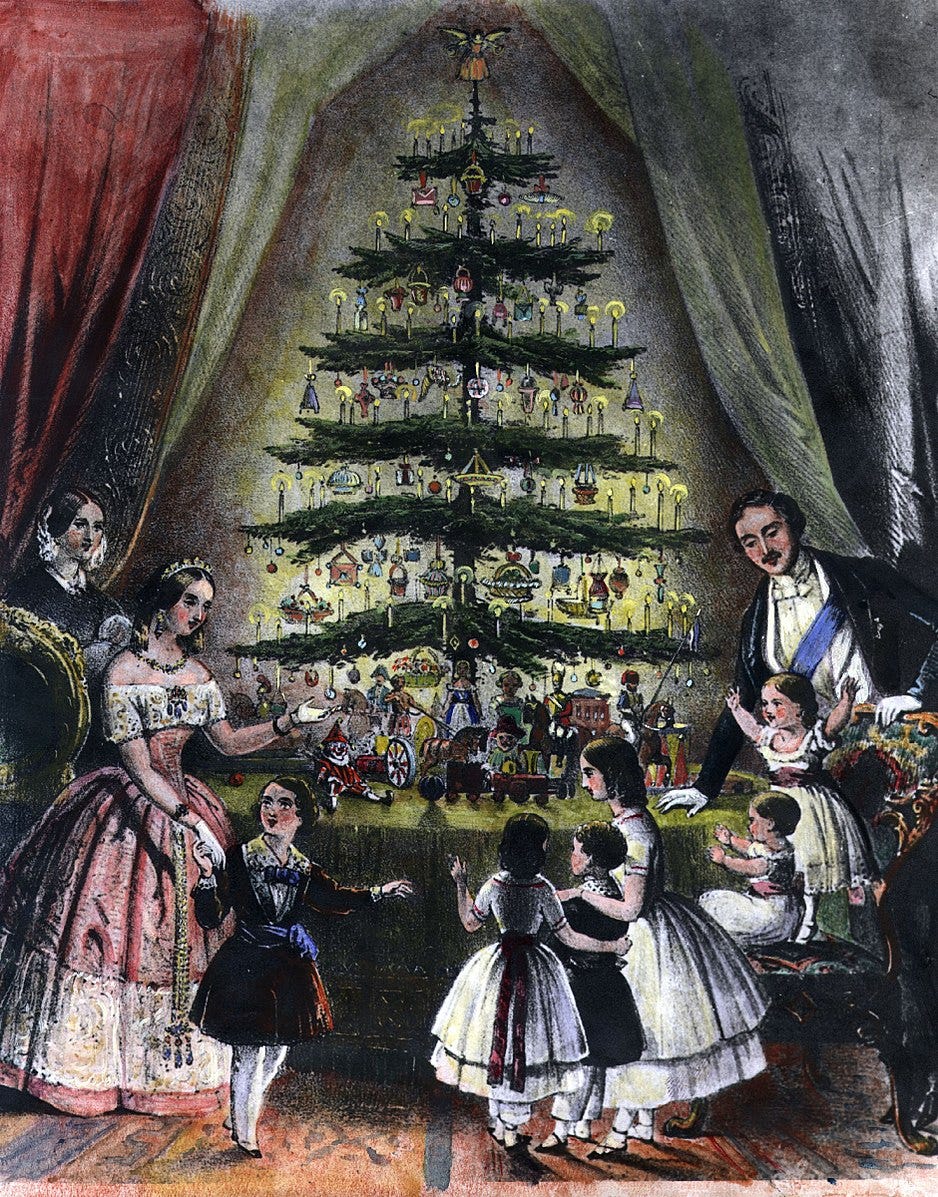
Prior to the Victorian era, Christmas in many European countries was a rowdy affair more closely resembling Mardi Gras than the Christmas of today. Excessive drinking, feasting, and community celebrations were the norm. But along with the urbanization of the 19th century came the shifting moral matrix from the wider community to the domestic sphere. Queen Victoria and Prince Albert were the ultimate symbols of Victorian morality, and this growing inwardness of Victorian family life influenced how Christmas was celebrated. Heightened consumerism also played a role; toys for children were cheaper and more accessible, making it far easier for families of even modest means to participate in traditions associated with Father Christmas or Santa Claus. Thus, Christmas became centered around children.
While A Christmas Carol is still a mainstay of holiday storytelling, if you’d like to read other examples of Christmas ghosts, you can find Told After Supper for free online, or you can check out a more recent anthology, The Valancourt Book of Victorian Christmas Ghost Stories edited by Tara Moore.
A very merry Christmas and happiest of holidays to you all!